Digitalized by University of California Libraries | src Internet Archives
images that haunt us




Filming for me is an illusion planned in detail, the reflection of a reality which the longer I live seems to me more and more illusory.
Ingmar Bergman, The Magic Lantern – IV (trans. Joan Tate) | via

Bonnie Schiffman :: Robert Crumb, 1983. | src
“I’m such a negative person, and always have been. Was I born that way? I don’t know. I am constantly disgusted by reality, horrified and afraid. I cling desperately to the few things that give me some solace, that make me feel good. I hate most of humanity. Though I might be very fond of particular individuals, humanity in general fills me with contempt and despair. I hate most of what passes for civilization. I hate the modern world. For one thing there are just too goddamn many people. I hate the hordes, the crowds in their vast cities, with all their hateful vehicles, their noise, their constant meaningless comings and goings. I hate cars. I hate modern architecture. Every building built after 1955 should be torn down! I despise modern popular music. Words cannot express how much it gets on my nerves—the false, pretentious, smug assertiveness of it. I hate business, having to deal with money. Money is one of the most hateful inventions of the human race. I hate the commodity culture, in which everything is bought and sold. No stone is left unturned. I hate the mass media, and how passively people suck it up. … I hate having to eat, shit, maintain the body—I hate my body. … Nature is horrible. It’s not cute and lovable. It’s kill or be killed. … How I hate the courting ritual! I was always repelled by my own sex drive, which in my youth, never left me alone. … I hate the way the human psyche works, the way we are traumatized and stupidly imprinted in early childhood and have to spend the rest of our lives trying to overcome these infantile mental fixations. And we never fully succeed in this endeavor. I hate organized religions. I hate governments. It’s all a lot of power games played out by ambition-driven people, and foisted on the weak, the poor, and on children. Most humans are bullies. Adults pick on children. Older children pick on younger children. Men bully women. The rich bully the poor. People love to dominate. I hate the way humans worship power—one of the most disgusting of all human traits. I hate the human tendency toward revenge and vindictiveness. I hate the way humans are constantly trying to trick and deceive one another, to swindle, cheat, and take unfair advantage of the innocent, the naïve and the ignorant. I hate all the vacuous, false, banal conversation that goes on among people. Sometimes I feel suffocated. I want to flee from it. For me, to be human is, for the most part, to hate what I am. When I suddenly realize that I am one of them, I want to scream in horror.” Robert Crumb, “The Litany of Hate” in “The R. Crumb Handbook,” Robert Crumb and Peter Poplaski, 2005.
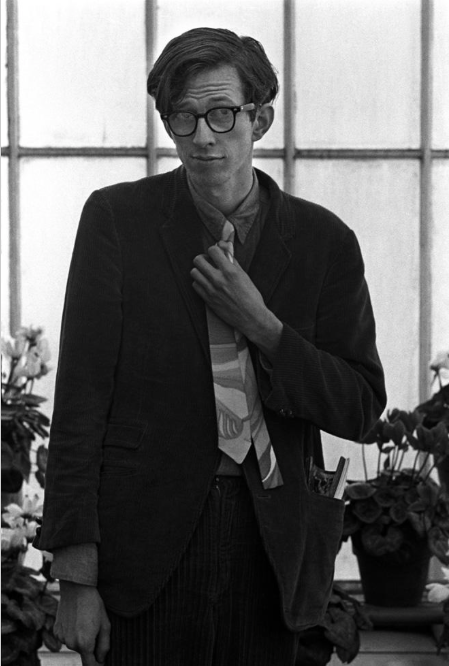
Baron Wolman :: Robert Crumb, Gate Park, San Francisco, 1969 | src
kvetchlandia
| more [+] by this photographer
“When I come up against the real world, I just vacillate.“ Robert Crumb, interview in “The Guardian” with Simon Hattenston, 2005.

Angelika Ejtel :: Self-portrait, 11 June, 2015 / src: Flickr via yama-bato
In a shabby window of an earthly street
by H. Poświatowska
‘night like a wall
behind them
the universe with indifferent
stars for eyes
and only these two -alone
in a shabby window
of an earthly street’
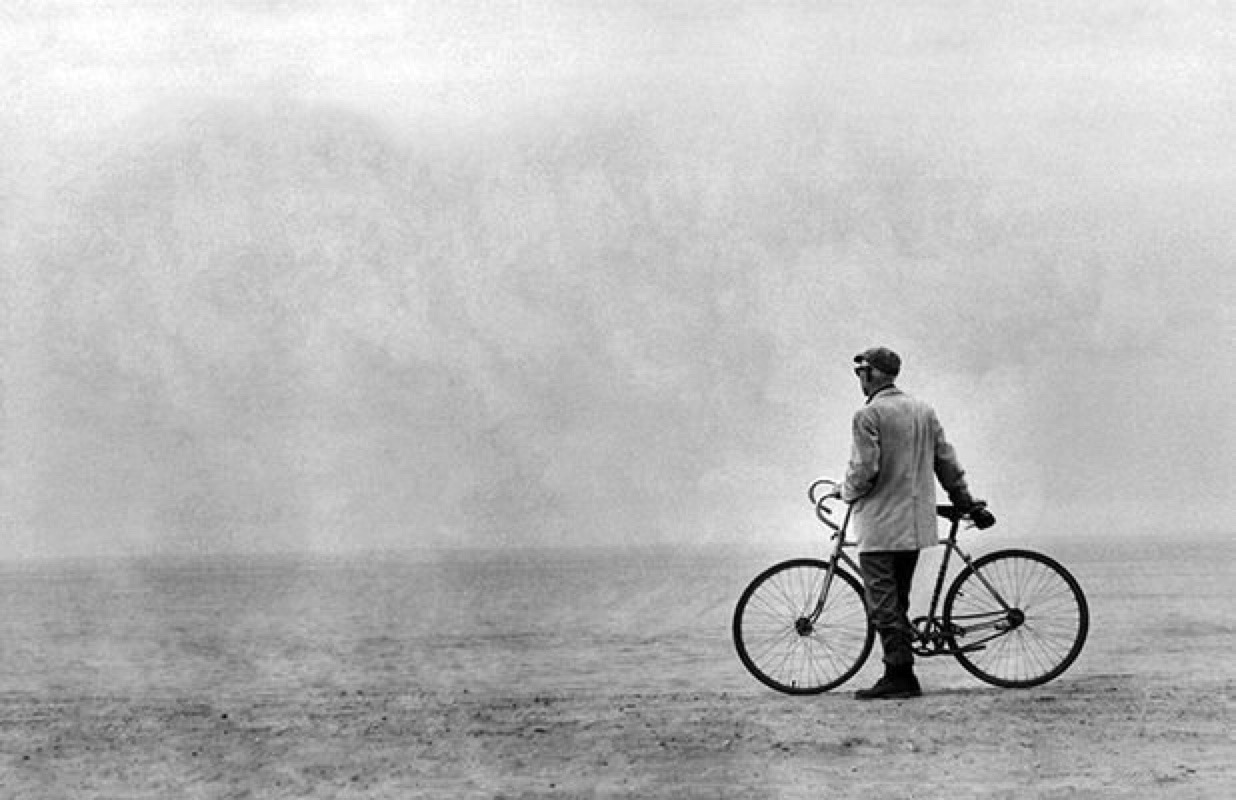
Peter Gowland :: Henry Miller on a Bike, unknown date / Gowland’s website
“I have no money, no resources, no hopes. I am the happiest man alive.”
Henry Miller. (src theimpossiblecool)

Emmy Hennings with Dada-doll, 1917.
Photo from Hans Richter, Dada and Anti-Art, (Thames and Hudson, 1965)
Emmy Hennings (1885-1948) was a performer and poet, and wife of the Dadaist Hugo Ball. Despite her critical role in the founding of the Cabaret Voltaire which launched the Dada movement, and her centrality in its performances (particularly as its only female member), it is difficult to locate information on her that does not correspond directly to her relationship with Ball.
Thomas F. Rugh describes her as “a primary contributor to the sensual display of bombast at the cabaret”, personifying the spirit of the Dada movement with which she was so intimately involved as “impulsive, enigmatic, creative, and at odds with her materialistic culture”.
The Zürcher Post wrote of her on 7 May, 1916: “The star of the cabaret however, is Mrs. Emmy Hennings. The star of who knows how many nights and poems. Just as she stood before the billowing yellow curtain of a Berlin cabaret, her arms rounded up over her hips, rich like a blooming bush, so today she is lending her body with an ever-brave front to the same songs, that body of hers which has since been ravaged but little by pain”.
via
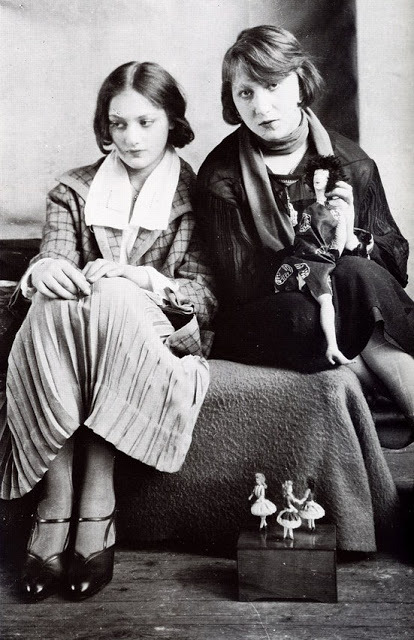
“Bronia, the younger sister, demurely averts her eyes while elder sister Tylia stares almost insolently at the camera, holding a boudoir doll in her hand. […] The sisters were Polish Jews raised in the Netherlands who came to Paris in 1922 when Tylia was 18 and Bronia 16. They both found work modelling for various artists in Montparnasse. Bronia was particularly popular with Nils Dardel, Foujita, and Moïse Kisling (she would often act as hostess for Kisling at luncheons he hosted). She also modelled clothes for designers Paul Poiret and Nicole Grolt.” Quoted from source: tales of a mad cap heiress


 un regard oblique