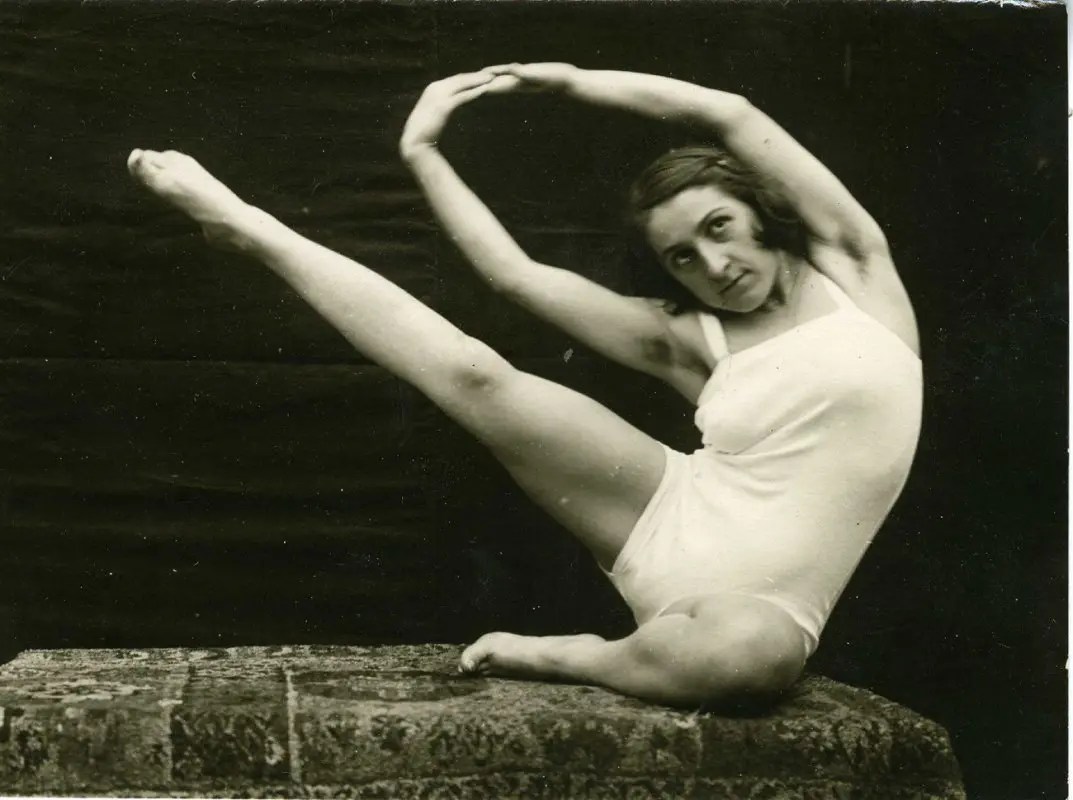
The Breathing Dance, 1928

Ágnes Kalmár Kövesházi in The Breathing Dance [Lélegzőtáncban] (costume: Elsa Kalmár Kövesházi), Cikk-Cakk evenings, 1928, MTA BTK Institute of Art History | src Artmagazin

Breathing exercises played an important role in the Hungarian dance school. Air and breathing exercises also played a big role in Agnes Kövesházi’s life. Since she had lung disease, the regular practice healed the dancer’s body and soul. It is likely that this disease was also the inspiration for her choreography Breathing Dance [Lélegzőtáncban].

Around 1928, Elsa Kalmár Kövesházi made a plaster sculpture entitled “Breathing Dance” (image below). The sculpture was inspired by Ágnes Kövesházi, the sculptor’s daughter. In the 1920s, Agnes was the leading dancer of Alice Madzar’s artists movement and co-creator Ödön Palasofszky’s Quintessential Theatre. Her own dance composition, which ran under the same name, was the inspiration for her mother’s work. The photograph of Ágnes Kövesházi, in a position corresponding to the sculpture work of “Breathing Dance”, was also left for posterity. Her dress is the same fan-like as the sculpture. The costume was also made by Elsa Kalmár Kövesházi.

According to the idea of ​​Elza Kalmár Kövesházi, a costume should start from the character of the movement, amplifying its characteristics: her richly pleated costume, which visually emphasizes the movement of the body, conveys every breath of the dancer. She immortalized her daughter’s solo piece together with other choreographies of the Hungarian Artists Group (Csitsibua, Bilincsek) in sculpture, creating exceptionally beautiful art deco sculptures.
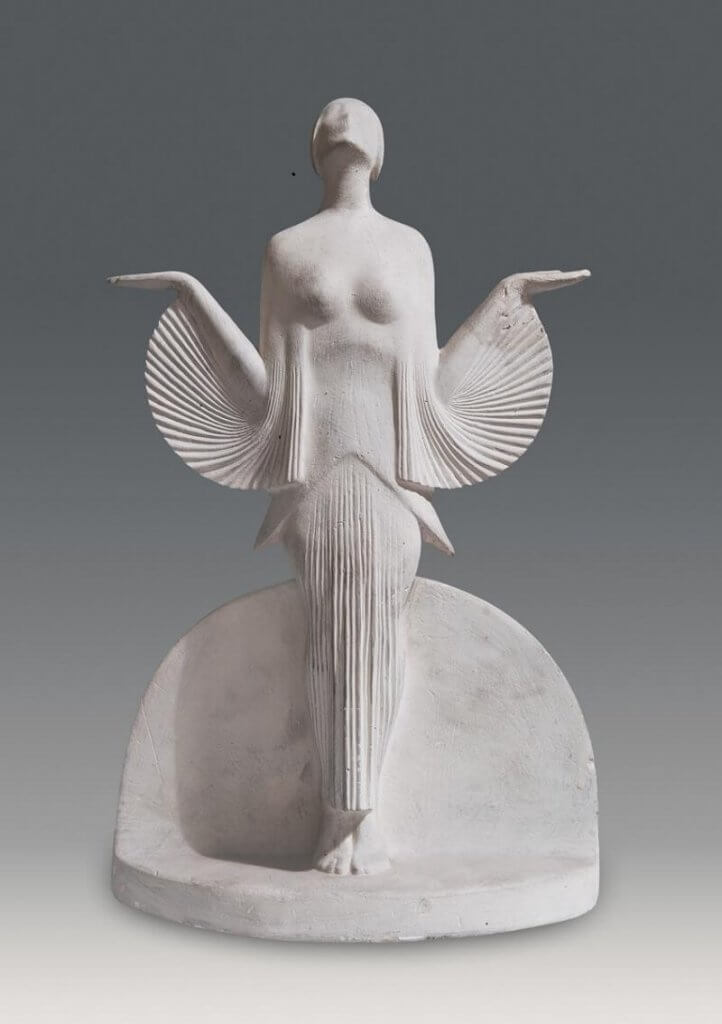
Elsa Kalmár Kövesházi :: Breathing Dance, 1928 (Ágnes Kalmár Kövesházi, gypsum, 28.3 cm, Hungarian National Gallery) | src Óbudai Antiksz
Elsa Kalmár Kövesházi :: Lélegzőtánc | Breathing Dance, 1928 (Ágnes Kalmár Kövesházi, plaster, 28.3 cm, Hungarian National Gallery) | src Óbudai Antiksz

Magda Róna, 1930

Fighting the Snake (pictured: Magda Róna (*), choreographer of the play), 1930, Institute of Art History of the Hungarian Academy of Sciences (Madzsar School) [original caption: Harc a kígyóval (a képen Róna Magda, a darab koreográfusa), 1930, MTA BTK Művészettörténeti Intézet (Madzsar-iskola)]
(*) Róna Magda táncos, koreográfus, színházi rendező (1902–1989) | Magda Róna -aka Mária Magda- dancer, choreographer, theater director (1902–1989) | src A Nőkért Egyesület Honlapja

Lili Madzsar, 1920s

Madzsar Lili tornamutatvány közben, az 1920-as évek elején. Magántulajdon. Digitális példánya az MTA BTK Művészettörténeti Intézetben | Lili Madzsar, daughter of Alice Madzsar, during a gymnastic exercise on the podium in the early 1920s. Private collection. Digital copy at the Institute of Art History of the Hungarian Academy of Sciences. | src papageno.hu

In 1926, Madzsar wrote the book New Ways of Women’s Body Culture, which proved extremely popular. The new 1929 edition was expanded with movement art chapters. Madzsar also plays an important role in Hungarian dance history: she created several public movement art performances with the school’s students and other participants, mostly from a working-class background. The image above was published in: Dr. Madzsarné Jászi Alice: A női testkultúra új útjai, 1926

Alíz Madzsar dancers, 1920s

Táncosnők, Madzsar Alíz (Madzsar Józsefné Jászi Alice) hagyatékából, 1920-as évek | Dancers from the legacy of Alice Madzsar (Alice Jászi), 1920s | src Kassák Múzeum Budapest
Táncosnők, Madzsar Alíz (Madzsar Józsefné Jászi Alice) hagyatékából, 1920-as évek | Dancers from the legacy of Alice Madzsar (Alice Jászi), 1920s | src Kassák Múzeum Budapest | further information on Madzsar’s work here