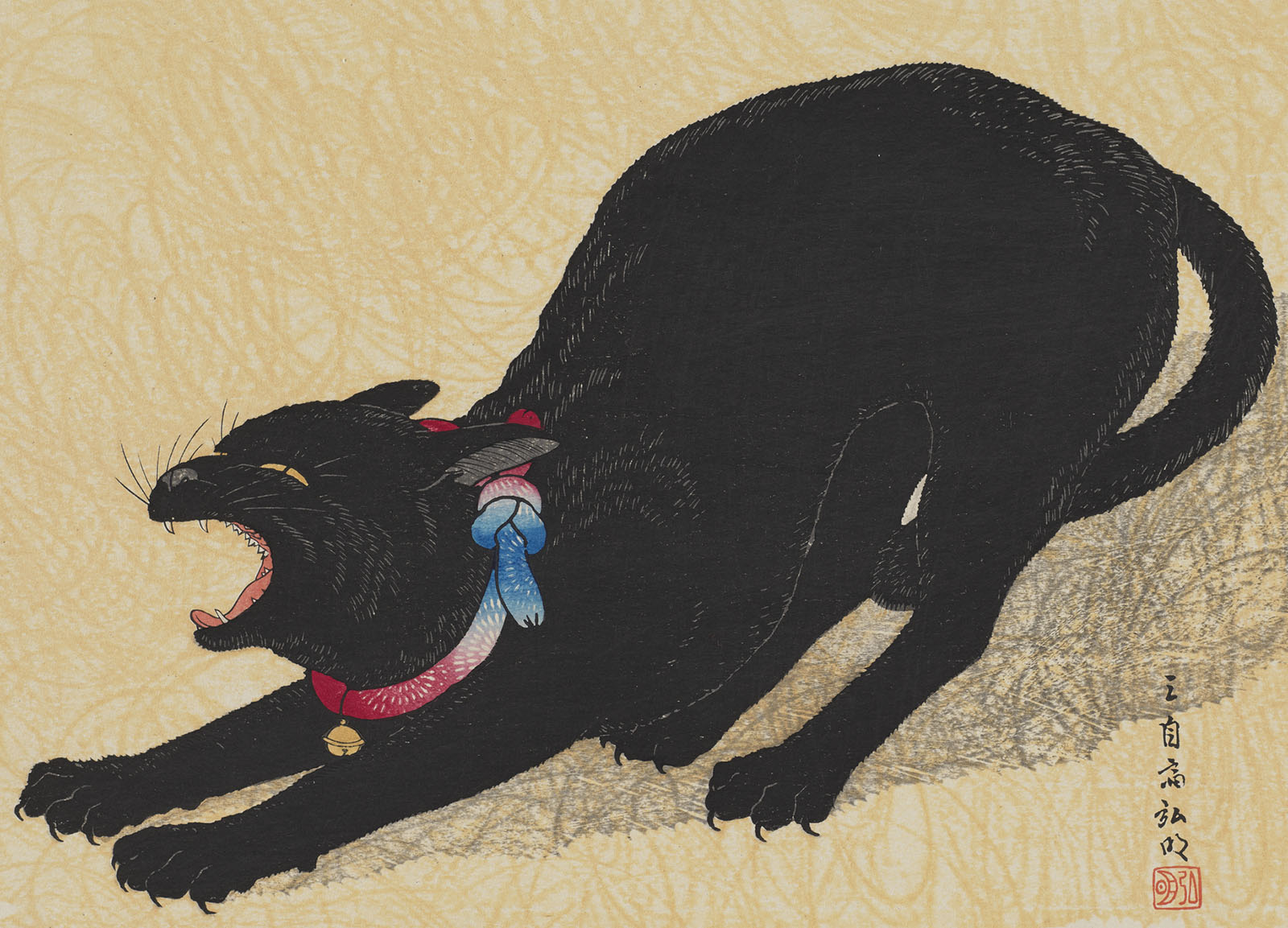
Takahashi Hiroaki (1871–1945) ~ Cat with a Bell, 1929. Color woodblock print on paper. Publisher: Kaneko Fusui (1897-1978)
Takahashi Hiroaki was the first print designer to collaborate with the publisher Watanabe Shôzaburô to revive the themes and techniques of 19th-century ukiyo-e prints. Between 1907 and 1923, when the Great Kantô Earthquake destroyed both prints and blocks, they produced over 500 designs. After the quake, Hiroaki began anew, sometimes creating modified versions of his earlier designs. This work, however, is from his output for a different publisher, Kaneko Fusui, who apparently allowed him to do more experimental designs. The swirling patterns in the background, done in soft yellow-orange, show the movement of the baren pad during the printing process. Takahashi worked with Kaneko for only four years, between 1929 and 1932, so prints from this publisher are relatively rare. (quoted from Portland Art Museum)
Takahashi Hiroaki (1871–1945) ~ Cat with a Bell, 1929. Color woodblock print on paper. | src Portland Art museum
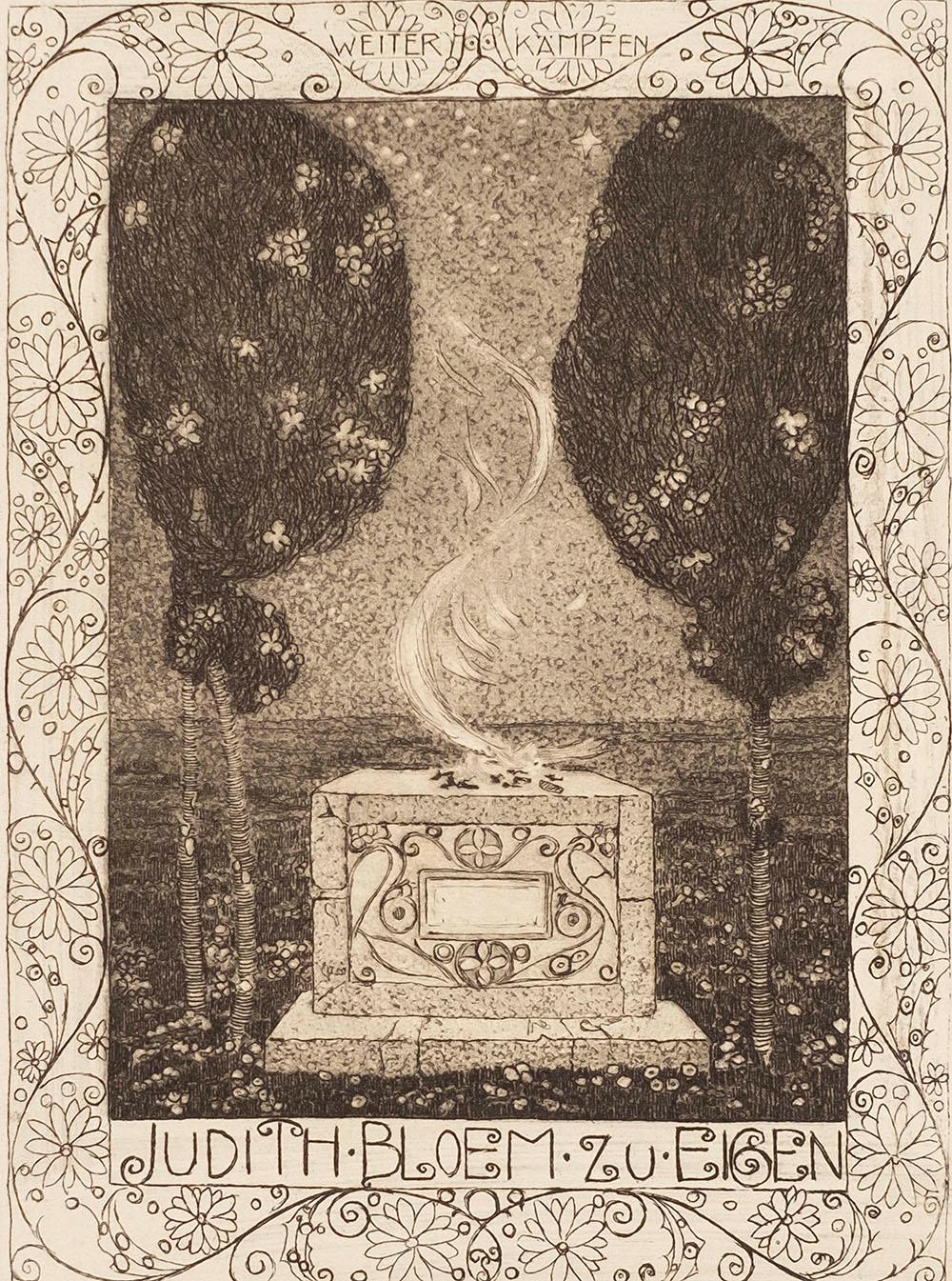
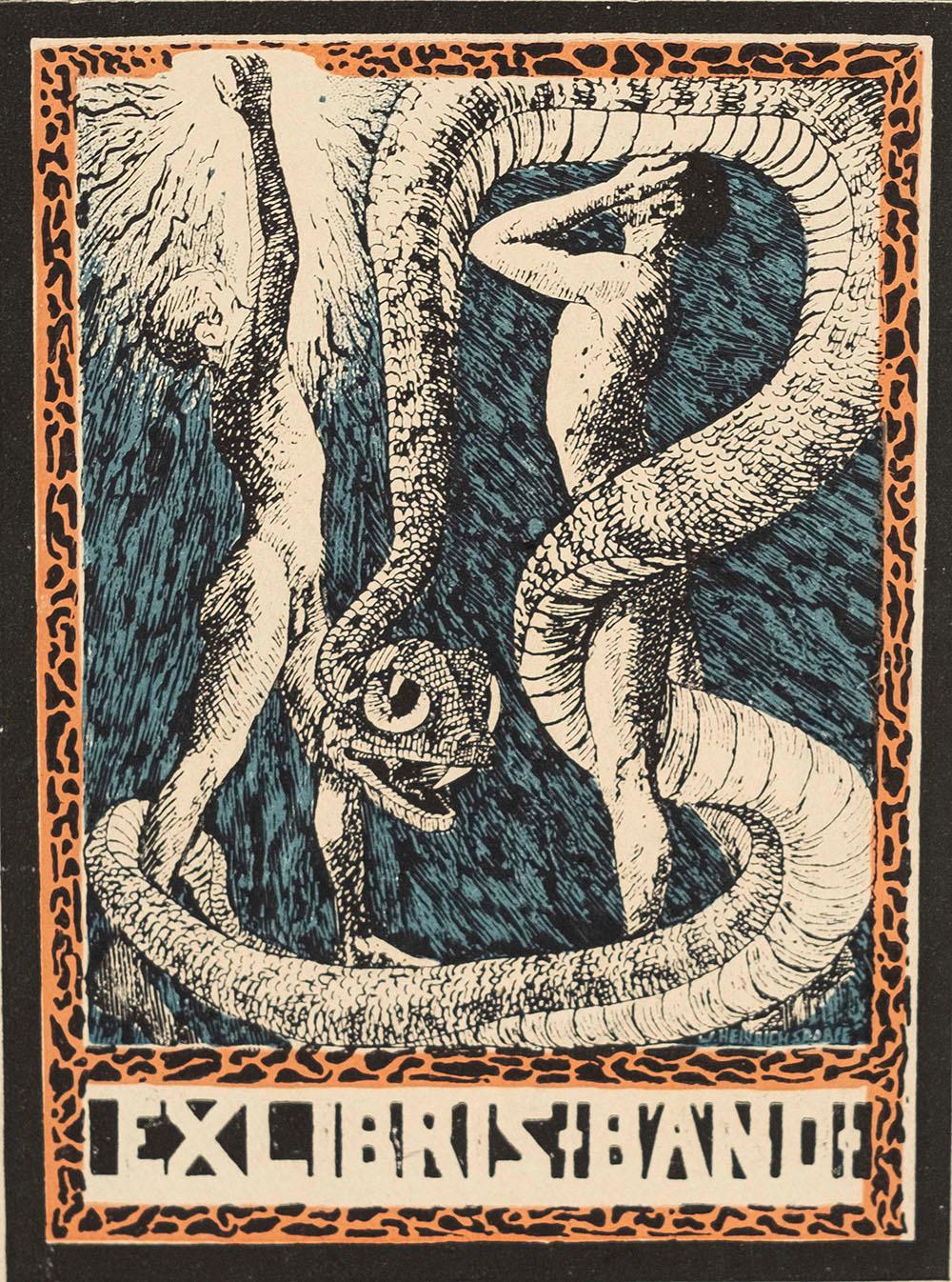
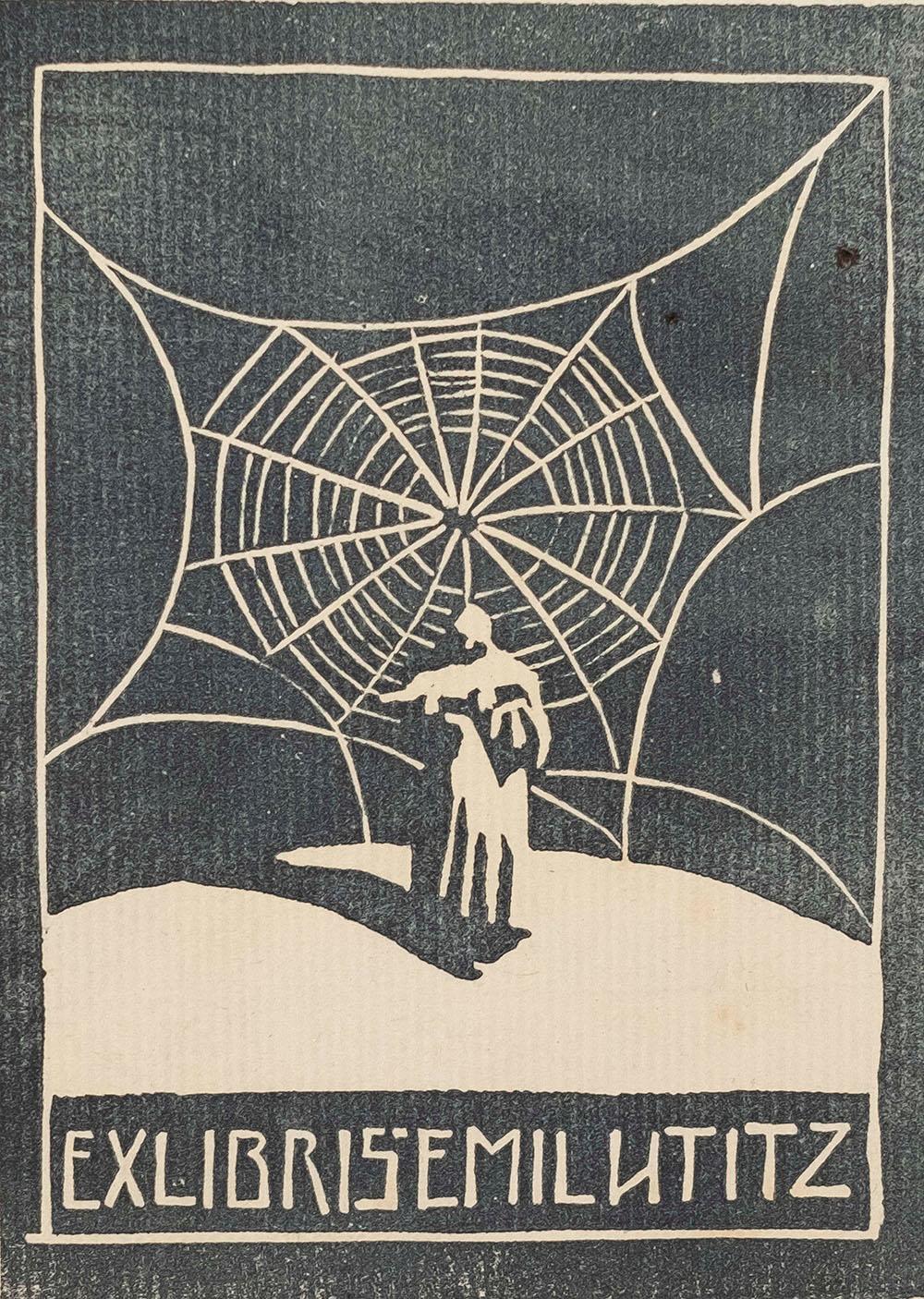
Exlibris / weiter kampfen / Judith Bloem zu Eigen | src Schneider-Henn (link to pdf)W. Heinrichsdorf ~ Exlibris, Motivsammlung: Die Schlange | src Schneider-Henn (link to pdf)Exlibris / emilhtitz | src Schneider-Henn (link to pdf)Ex-libris / Karl Sievert | src Schneider-Henn (link to pdf)
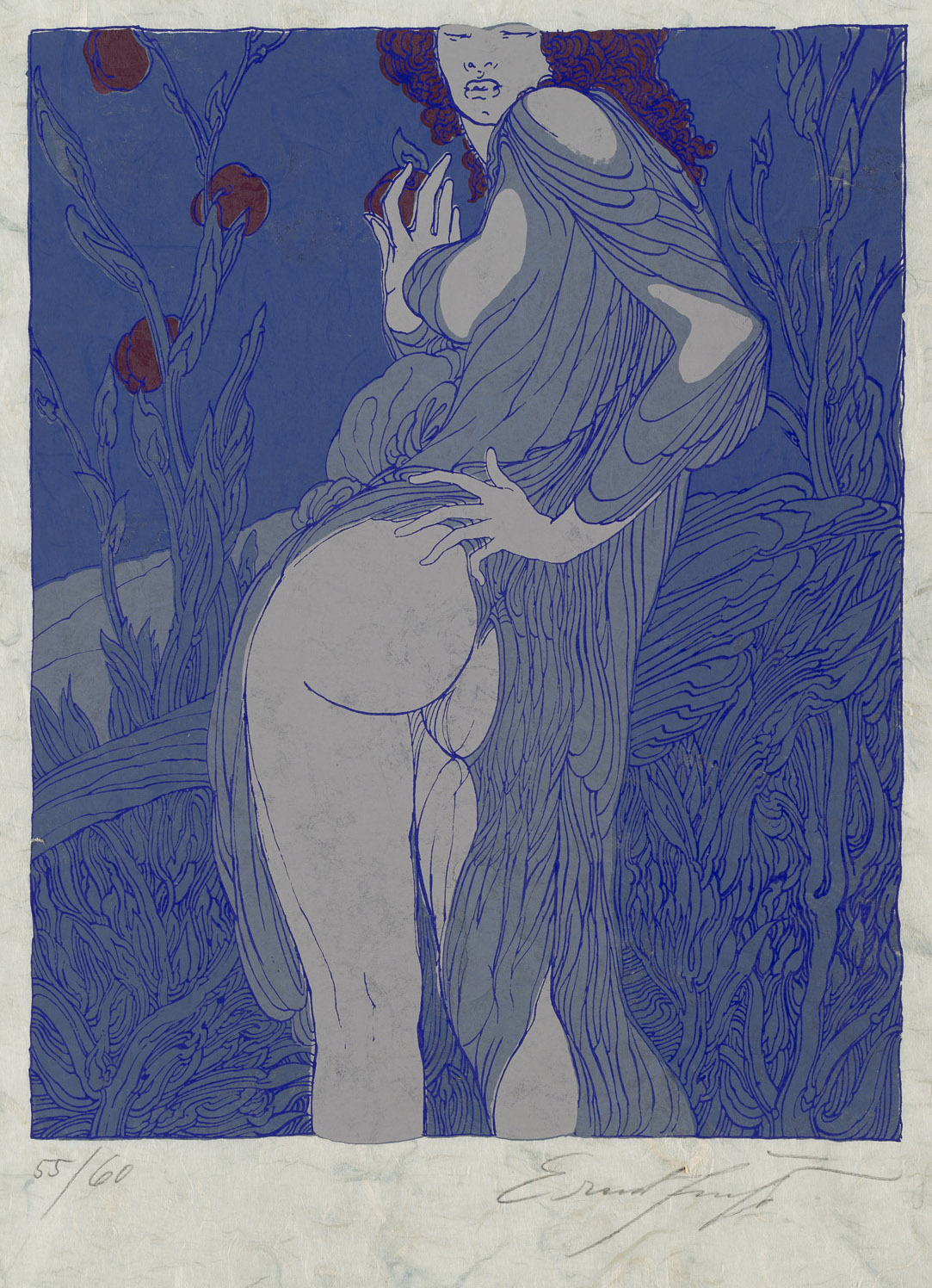
Ernst Fuchs ~ Stehender weiblicher Akt in Rückenansicht mit Frucht; ca. 1969. Farbserigraphie auf Japon Nacré (Colour silkscreen). | src Jeschke Jádi (JVV) Auktion 147 lot 902
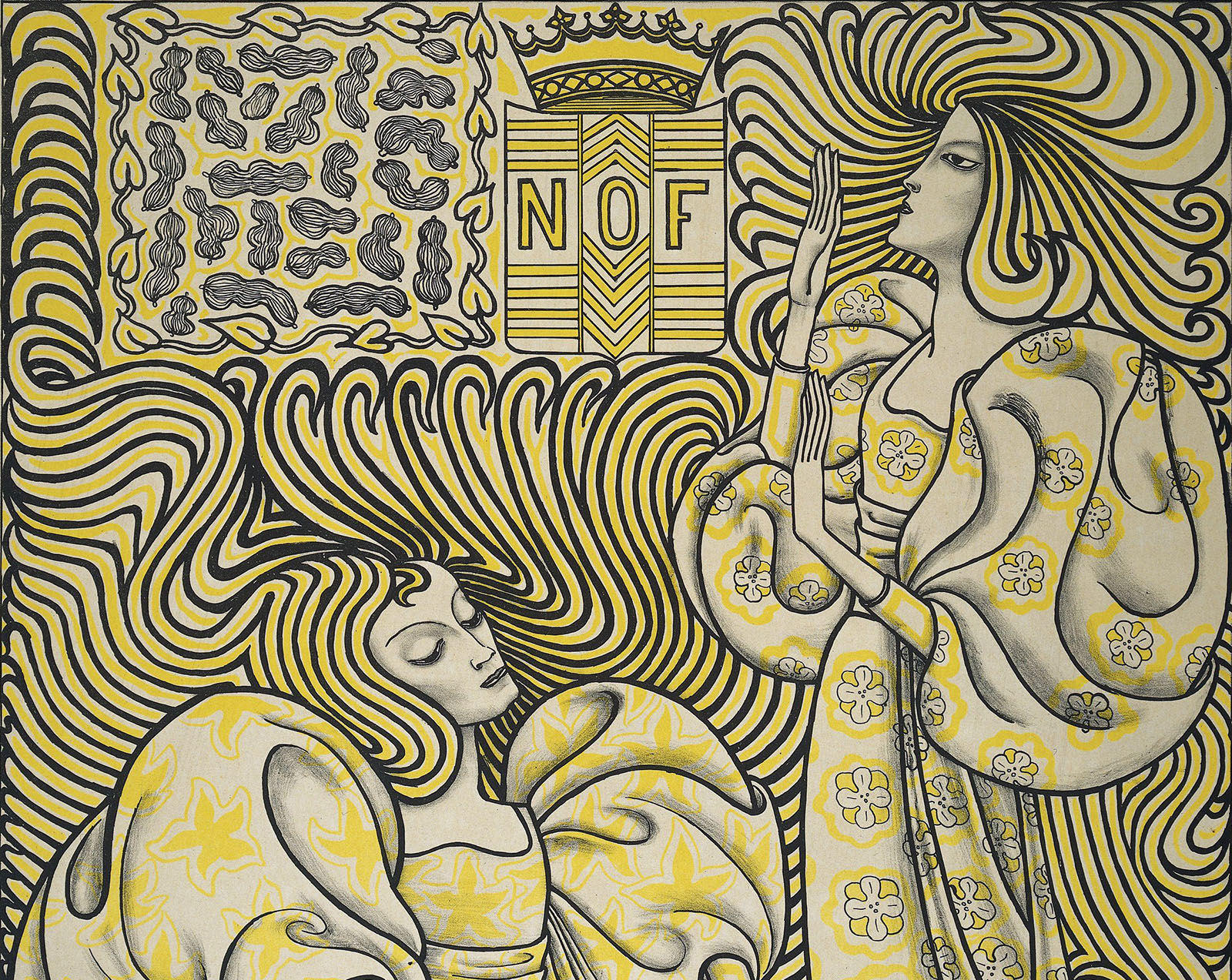
Jan Toorop ~ Poster for Delft Salad Oil, 1894 (RP-P-1912-2395) | src Rijksmuseum
Affiche Delftsche Slaolie (1894) This poster was commissioned by the Nederlandsche Oliefabriek, an oil manufacturer in Delft. Two women with wavy hair and billowing draperies occupy most of the composition. One of them is dressing a salad.
The inscription on top Delftsche Slaolie makes it clear that the advert concerns salad oil, as do the bottles of salad oil on either side of the text. Below it is the crowned coat of arms of the factory (N O F), with a decorative area with peanuts on the left. The majority of the poster is taken up by the two graceful female figures with long hair and billowing draperies. One sits and is dressing a lettuce salad in a large container; the other has her gaze and hands raised. The women with their emphatic contours draw attention away from the actual advertisement, namely for the salad oil. The wavy, rhythmic interplay of lines with which the women’s hair fills the picture surface made such an impression that it became an icon and lent Dutch Art Nouveau its nickname, slaoliestijl, the ‘salad oil style’. | text adapted from Rijksmuseum [x]
Jan Toorop ~ Image Design for a Poster. Wagenaar’s Cantata ‘The Shipwreck’, 1899. Zincograph in blue-black on yellow wove paper | src AICJan Toorop (1858-1928) ~ Two female figures with clock in hand, 1913 (?). Pencil and chalk on paper. | src RijksmuseumJan Toorop ~ Twee gestileerde vrouwelijke figuren met klok in de hand (1894)
Jan Toorop (1858–1928) was born on the island of Java in the Dutch East Indies, Toorop settled in the Netherlands at the age of eleven. After studying art at the Rijksakademie in Amsterdam, he’d spend his time between The Hague, Brussels, England (where his wife was from), and, after 1890, the Dutch seaside town of Katwijk aan Zee. It was during this time that he developed his distinctive style: highly stylized figures, embedded in complex curvilinear designs, with his dynamic line showing influence from his Javanese roots. While perhaps most famous for turning these techniques to his exquisite poster designs, Toorop also produced a substantial body of work far removed from the anodyne demands of the advertising industry, beautiful but haunting works dealing with darker subjects such as loss of faith and death (that you can find in this other post). | text adapted from Public Domain review
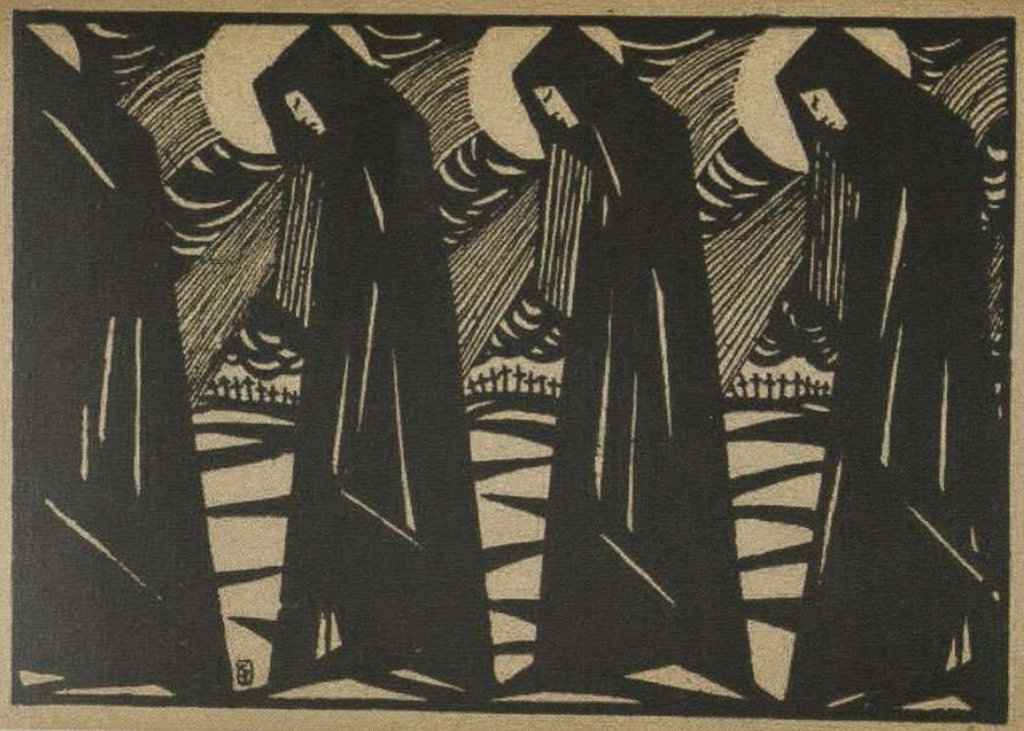
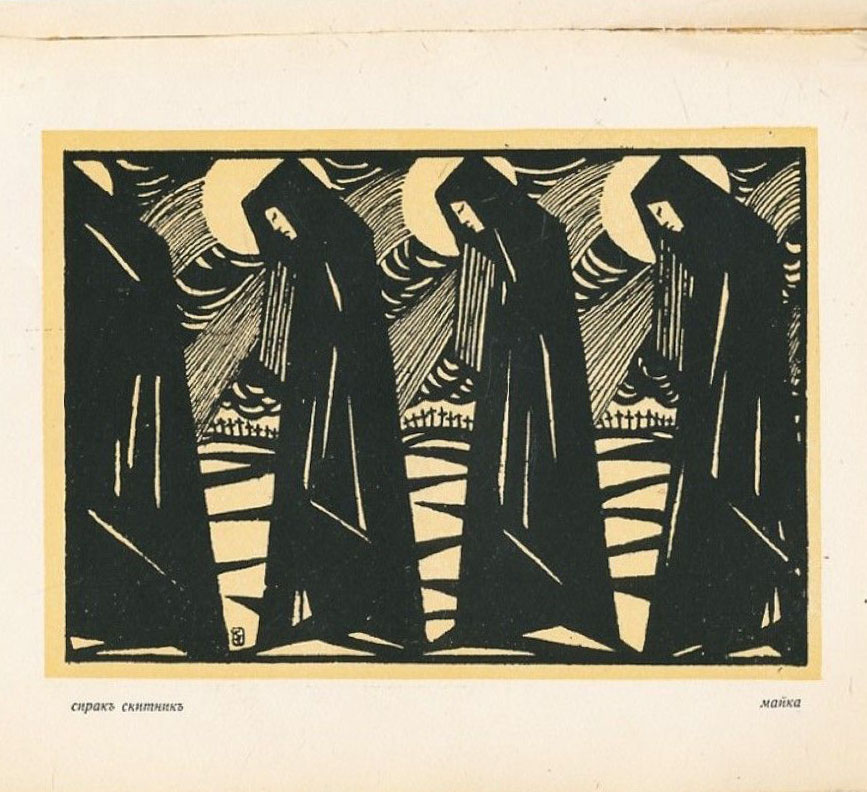
Bulgarian Ballads by Teodor Traianov, 1921; illustrator / engraver : Sirak Skitnik | detail from book coverBŭlgarski baladi / Bulgarian Ballads by Teodor Trayanov, 1921, illustrator Sirak Skitnik. Book front cover | src modernism.scas.bgMaika by Sirak Skitnik. Third illustration from the cycle Bulgarian Ballads by Teodor Trayanov, 1921Maika / Mourning mothers. From: Bulgarian Ballads by Teodor Trayanov, 1921, illustrator Sirak Skitnik. | book scan from Alba
If you wish to learn more or read more about Sirak Skitnik and Bulgarian Modernism or Native Art, you may want to dig further here:
Modernism and the National Idea in Bulgaria @ sledva.nbu.bg (in English)
The whole batch of illustrations from the book are available to be viewed (but in very poor resolution) at the NYPL
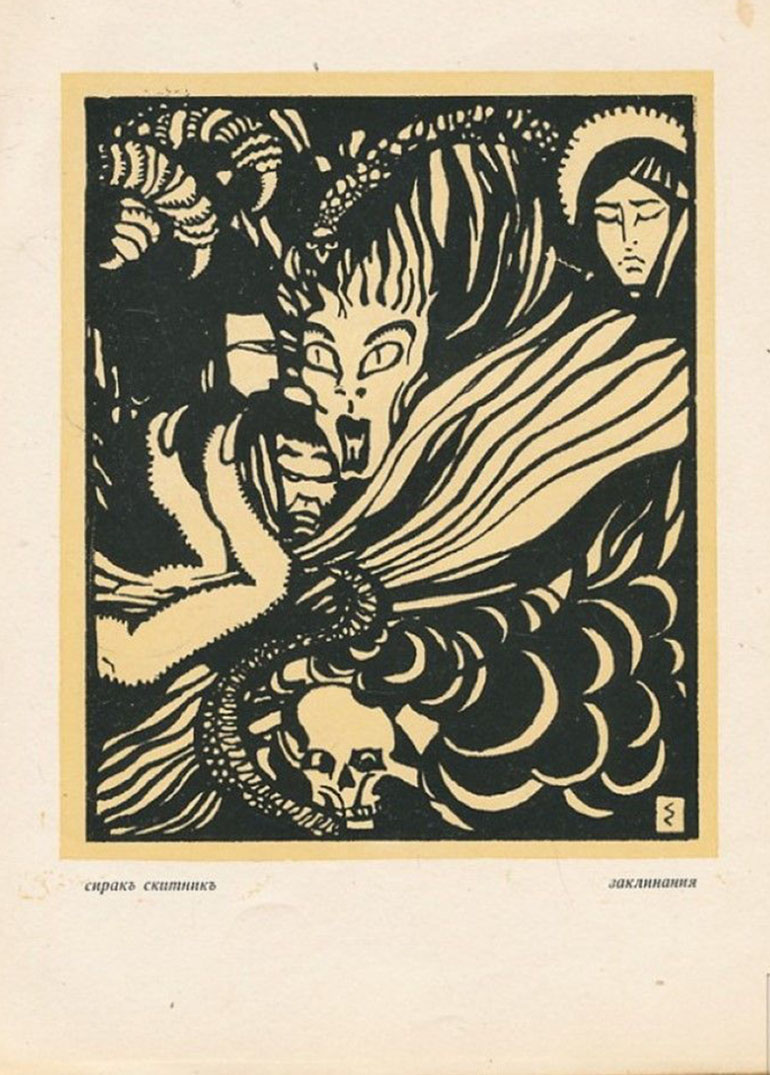
Сирак Скитник / Sirak Skitnik ~ Maika / Mourning mothers, 1920-1921 According to Irina Genova, there are three versions of this same compositionSirak Skitnik ~ (Opustoshenie / Devastation, 1920-1921 From : Bŭlgarski baladi / Bulgarian Ballads by Teodor Trayanov, 1921, illustrator / engraver : Sirak SkitnikSirak Skitnik ~ Zaklinania / Incantation, 1920-1921 Bulgarian Ballads by Teodor Trayanov, 1921, illustrator Sirak Skitnik (Zaklinania / Incantation). Book scan from Alba
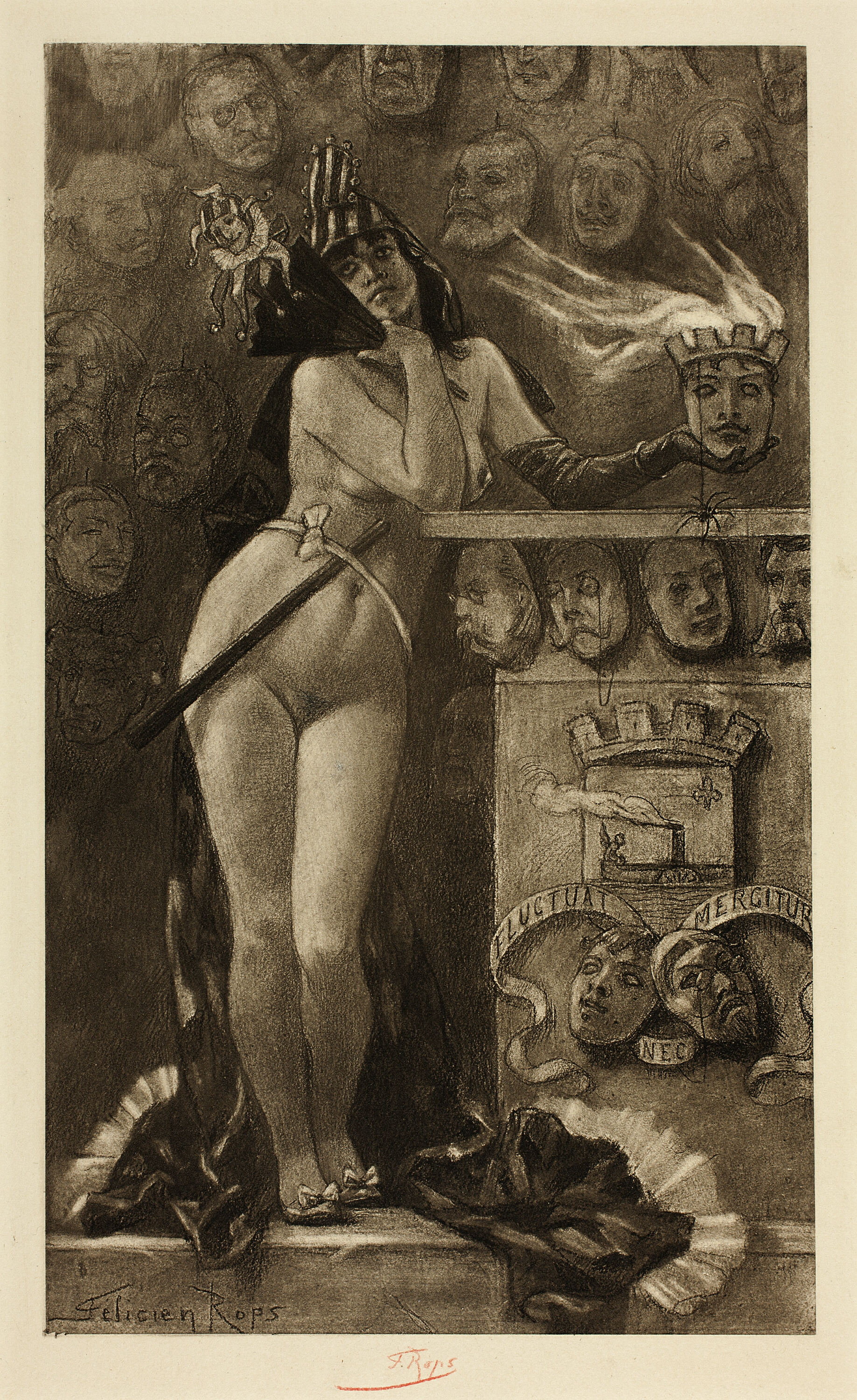
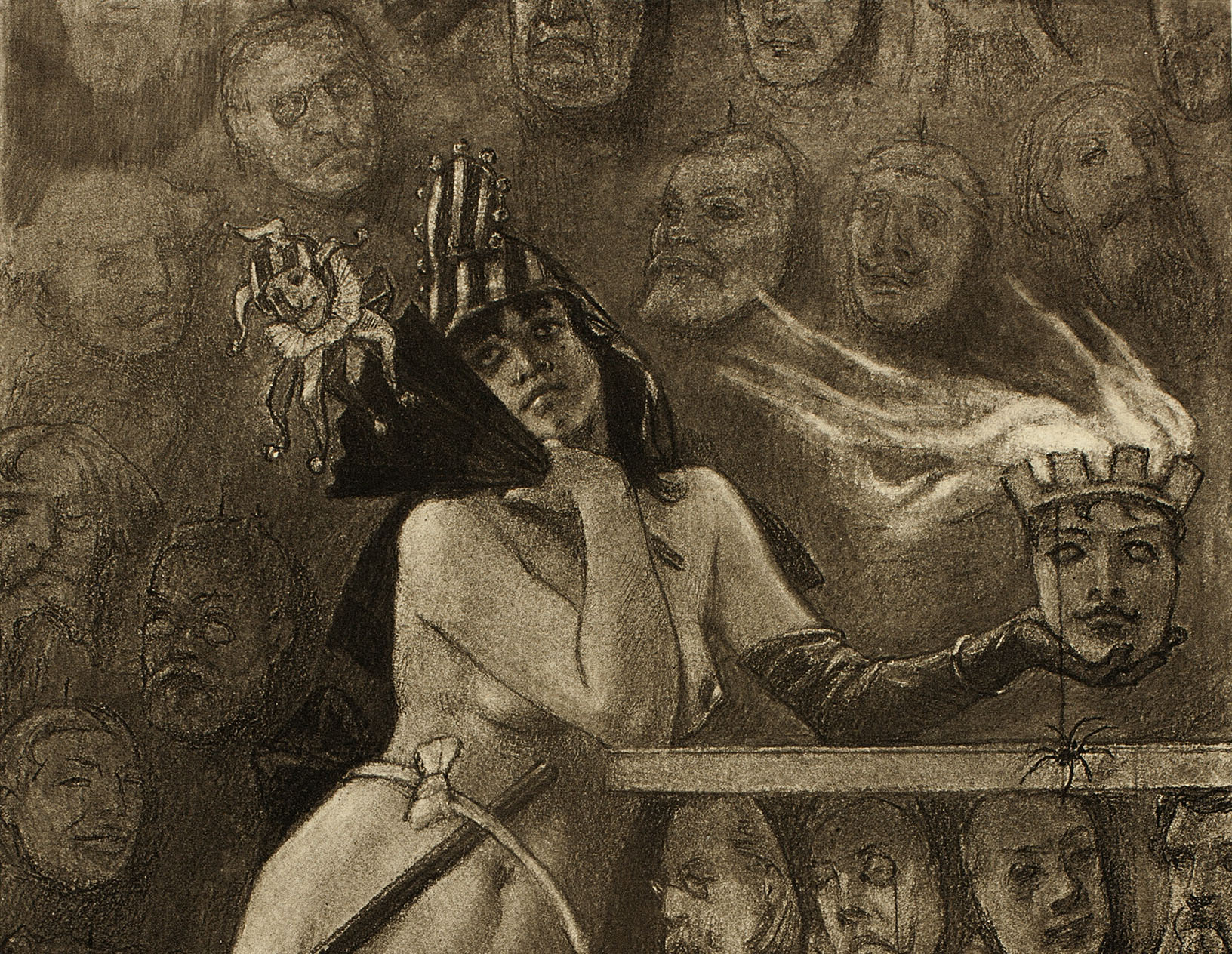
Félicien Rops (Belgian, 1833-1898) ~ Modern Masks, 1889. Photogravure in dark brown retouched with soft varnish (vernis mou), roulette and blue handcoloring on thick cream wove paper. | src AICFélicien Rops (Belgian, 1833-1898) ~ Modern Masks, 1889. DETAIL | src AIC
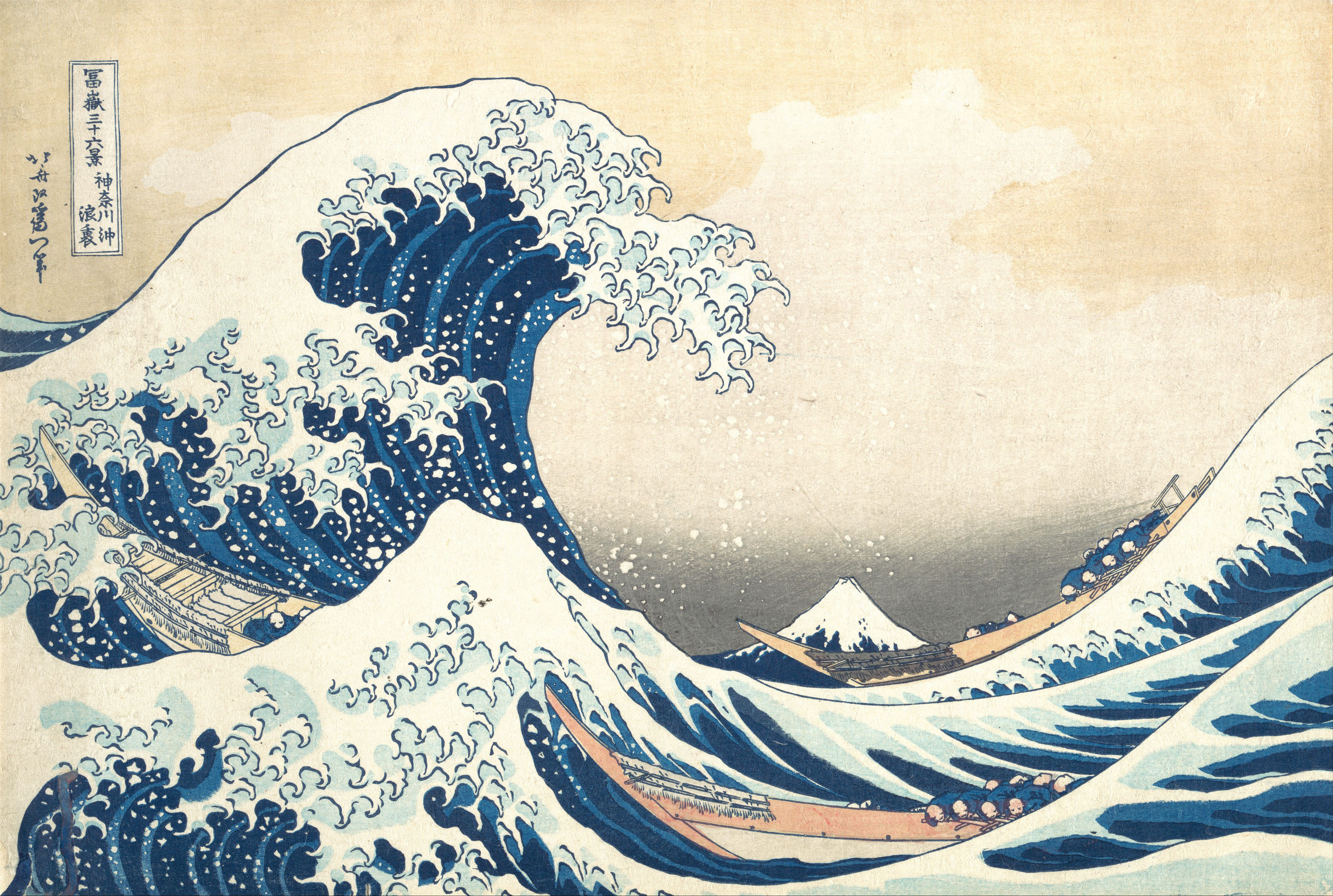
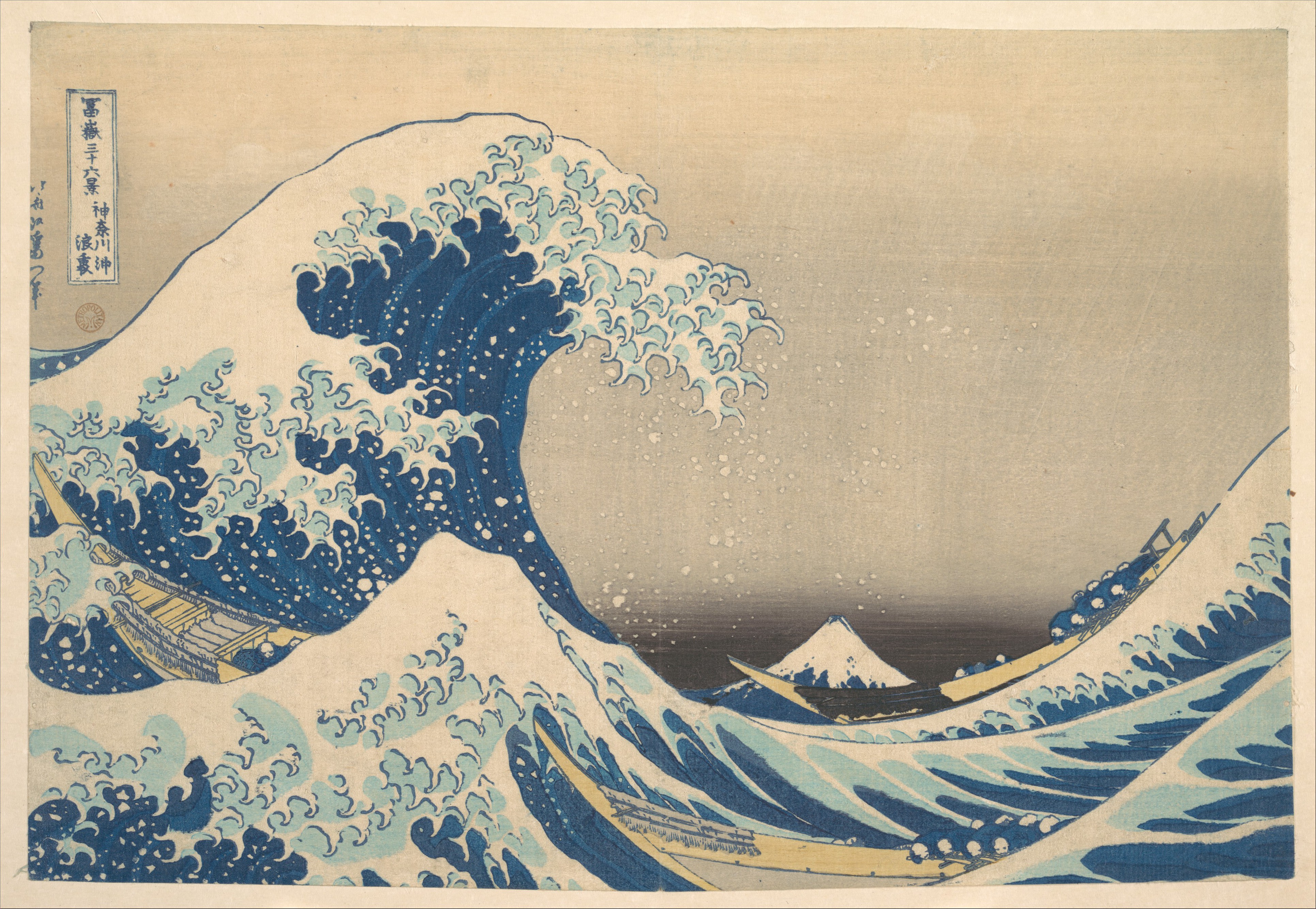
Katsushika Hokusai (1760 – 1849) ~ Unter der Welle im Meer vor Kanagawa, aka The Great Wave, 1830-32. | src Monopol Magazin
Die Bayerische Staatsbibliothek hat eines der bekanntesten grafischen Kunstwerke der Welt erworben die Große Welle von Katsushika Hokusai (1760-1849). Read more at Monopol Magazin
Katsushika Hokusai (1760 – 1849) ~ Under the Wave off Kanagawa (Kanagawa oki nami ura), also known as The Great Wave, from the series Thirty-six Views of Mount Fuji (Fugaku sanjūrokkei), ca. 1830-32. Woodblock print; ink and color on paper. | src The MetKatsushika Hokusai (1760 – 1849) ~ Fuji at Sea, ca. 1834; from 100 Views of Mount Fuji. Woodblock print. | src Ronin Gallery
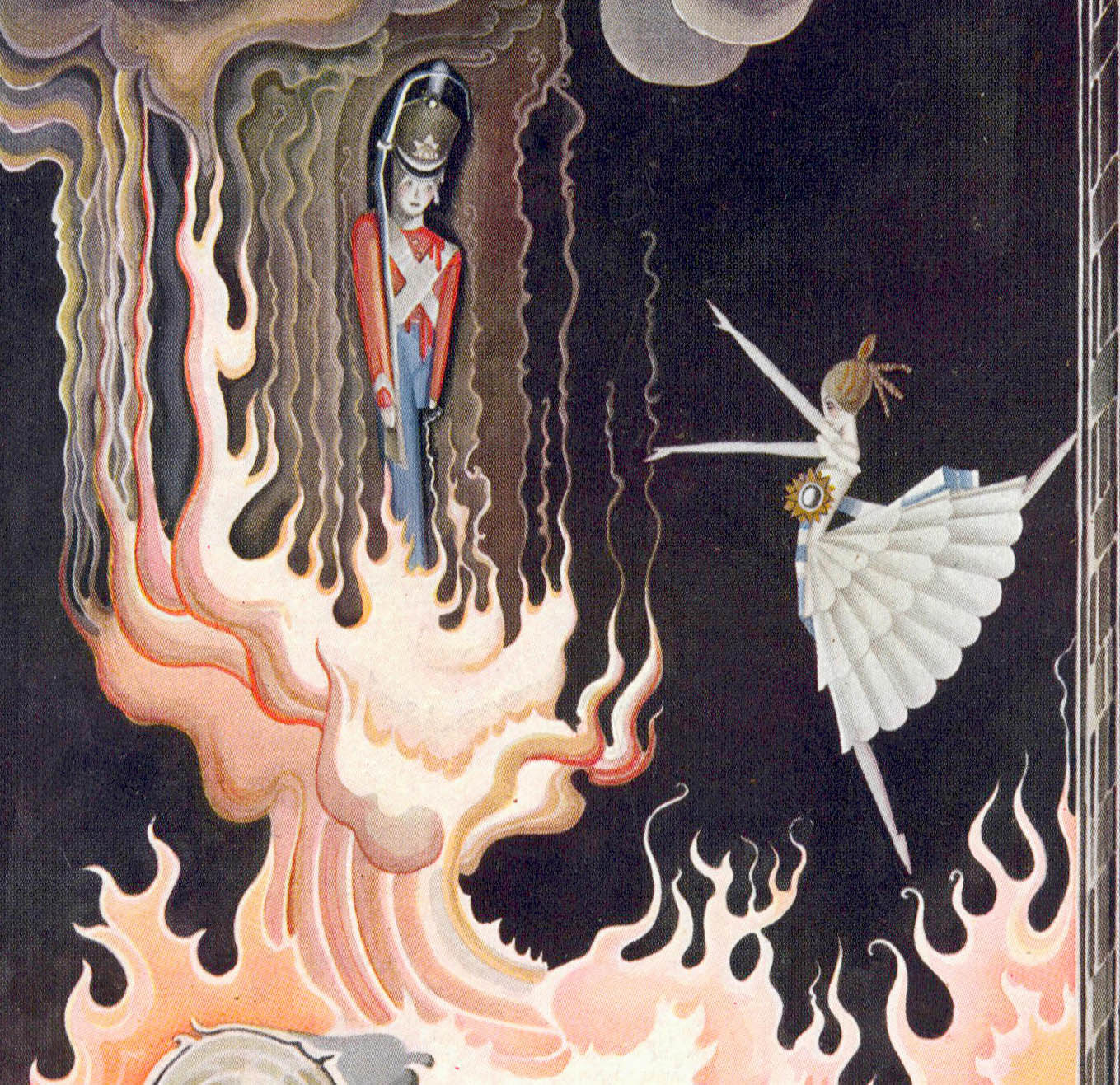
Hans Christian Andersen’s Fairy Tales, signed by the illustrator, 12 tipped-in colour plates and illustrations by Kay Nielsen, red half morocco gilt by Birdsall, 1924 | src Bonhams
The draught of air caught the dancer, and she flew like a sylph just into the stove to the tin soldier.[The Tin Soldier and the Dancer ~The Brave Tin Soldier ~The Hardy Tin Soldier(1838)]
“She stood all day on the roof waiting, and most likely she is wailing still.” ~ The Flying Trunk (The Met, 1981)Andersen’s Fairy Tales, with illustrations by Kay Nielsen ~ The Tin Soldier and the Dancer ~The Brave Tin Soldier (detail) | src Bonhams
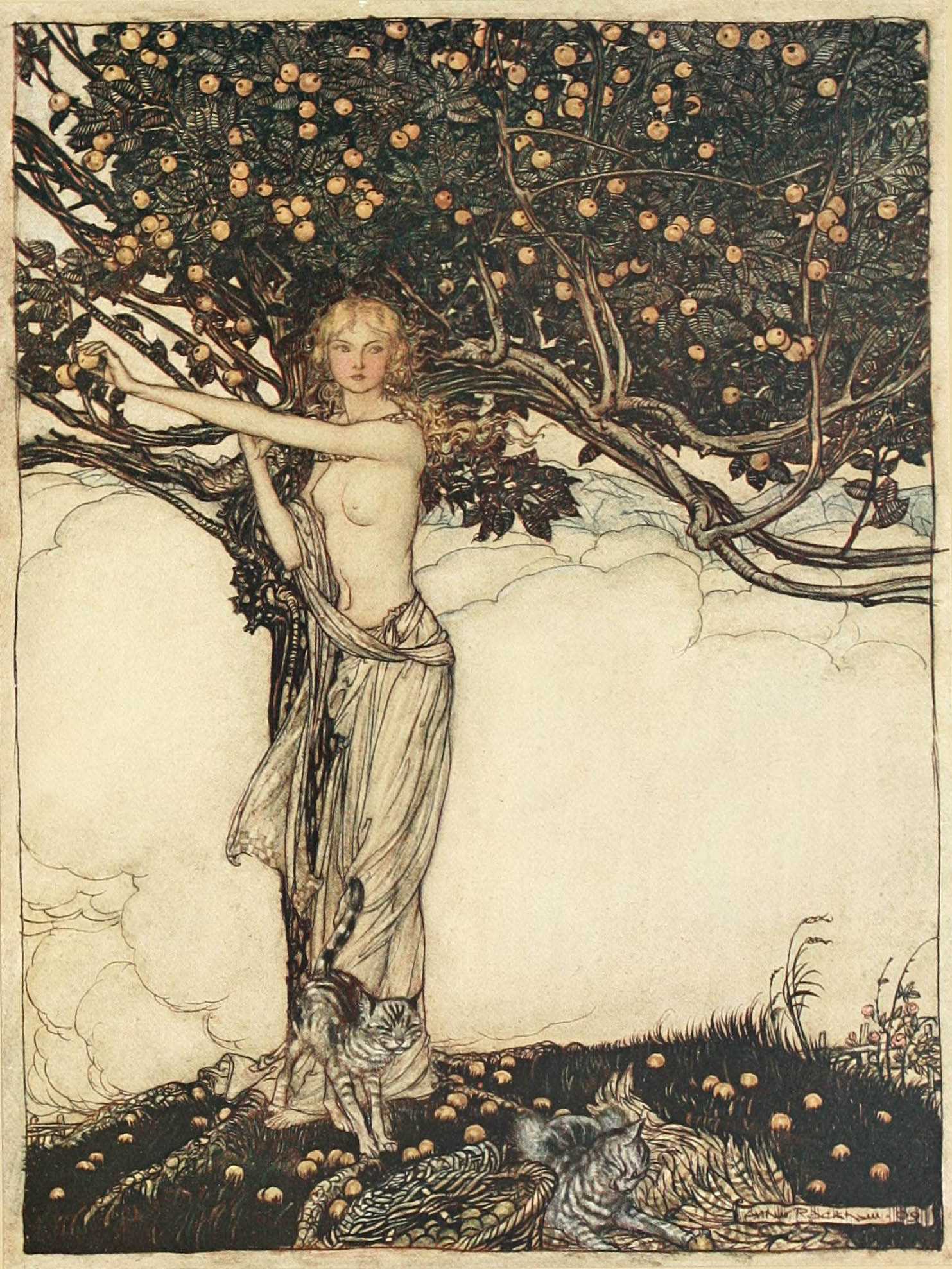
Freia, the fair one · From : The Rhinegold & the Valkyrie, 1910Freia · From : The Rhinegold & the Valkyrie, 1910Brünnhilde · From : The Rhinegold & the Valkyrie, 1910Brünnhilde slowly and silently leads her horse down the path to the caveBrünnhilde stands for a long time dazed and alarmed · From : The Rhinegold & the Valkyrie, 1910Sieglinde prepares Hunding’s draught for the night” Father ! Father ! Tell me what ails thee ? With dismay thou art filling thy child ! “
” The Rhine’s fair children, Bewailing their lost gold, weep “From : The Rhinegold & The ValkyrieThe Rhine-Maidens teasing Alberich · From : The Rhinegold & The Valkyrie” Mock away ! Mock ! The Niblung makes for your toy ! ““Seize the despoiler ! Rescue the gold ! Help us ! Help us ! Woe! Woe!”The frolic of the Rhine-Maidens · From : The Rhinegold & The Valkyrie
All illustrations are from : The Rhinegold & The Valkyrie by Richard Wagner (1813-1883). Illustrations by Arthur Rackham (1867-1939). Published in 1910. New York Public Library at internet archive













 un regard oblique