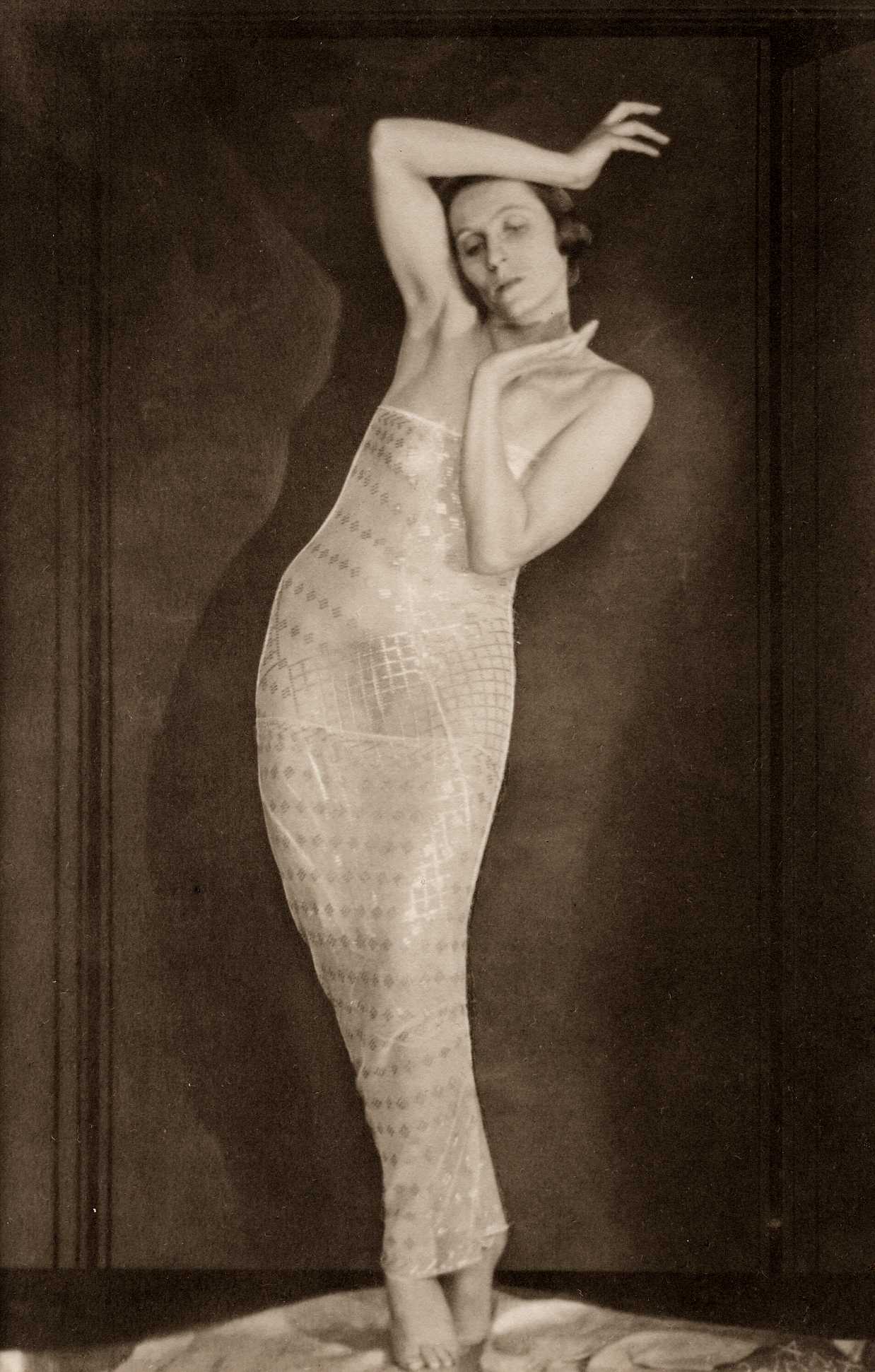
Tordis by Antios · 1926
images that haunt us
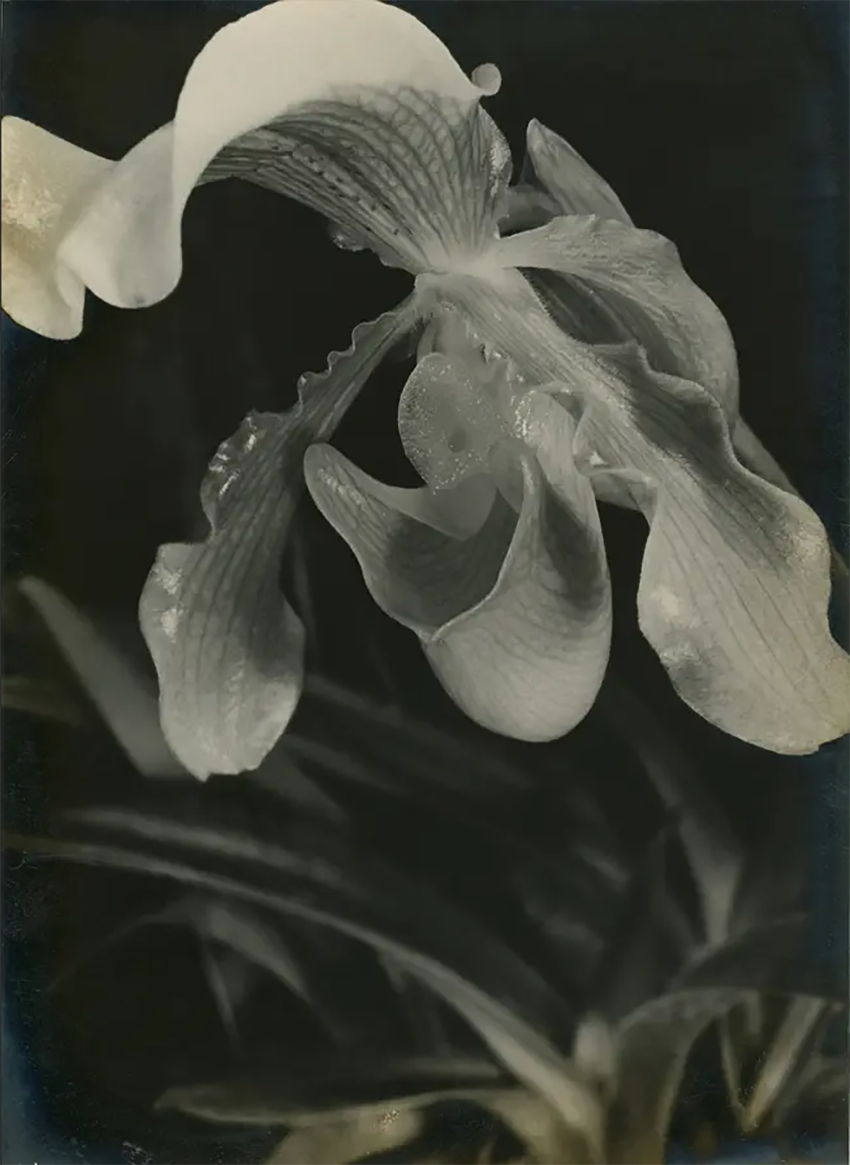
![Aenne Biermann :: Orchid, ca. 1930. Gelatin silver print. [Detail] From : Aenne Biermann : Up Close and Personal at Tel Aviv Museum of Art](https://unregardoblique.com/wp-content/uploads/2023/01/aenne-biermann_orchid-ca.-1930-detail-tel-aviv-museum.jpg)


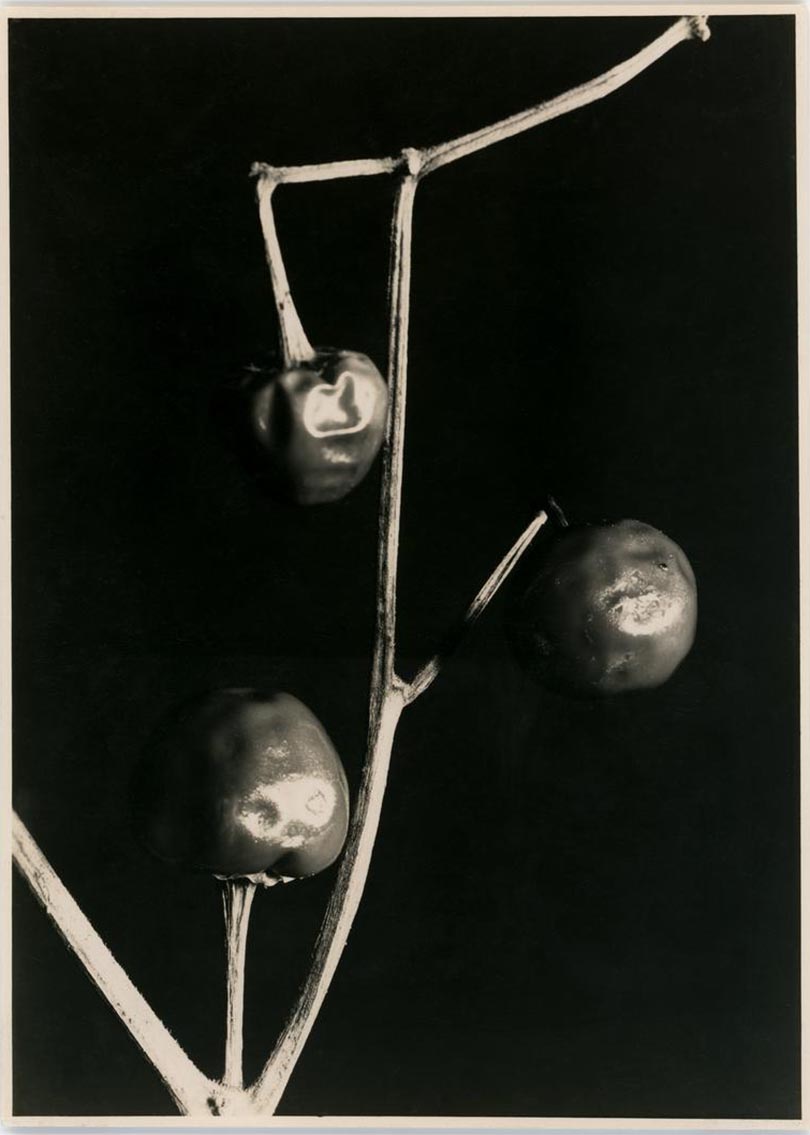
![Aenne Biermann (1898-1933) :: Kaktus, [Cactus], around 1929, © Museum Ludwig, Köln](https://live.staticflickr.com/65535/52626356372_254b3ddb72_o.jpg)
Aenne Biermann zeigte, wie viel Poesie in unscheinbaren Dingen stecken kann
Die deutsche Fotografin Aenne Biermann begann als Autodidaktin mit der Geburt ihrer Kinder zu fotografieren. Auch wenn sie das Alltägliche abbildete, banal sind ihre Arbeiten keineswegs.
Aenne Biermann (1898-1933) wurde als Tochter einer wohlhabenden jüdisch-deutschen Familie geboren. Mit der Geburt ihrer Kinder begann sie ohne künstlerische Ausbildung als Autodidaktin zu fotografieren. Sie fotografierte zunächst in ihrer häuslichen Umgebung – oft ihre Kinder. Aber auch Landschaften, Architekturdetails und Stillleben gehörten seit den Anfängen zum fotografischen Oeuvre der Künstlerin.
Die Fotografin arbeitete sich in ihrer nur 13-jährigen dauernden Schaffenszeit an ihrer unmittelbaren Umgebung ab (welche in Gera war) und vergrösserte ihren Radius bis Paris. Mit Ausweitung ihres Radius’ erweiterte sich auch ihre Arbeitsweise – Akt- und Stadtaufnahmen von Paris ergänzten ihr späteres Werk.
Betrachtet man ihre Bilder, ist es so, als ob man eine zweite Chance bekäme, das Banal-Alltägliche neu zu sehen. Die Arbeiten zeigen Früchte, Pflanzen, das Innenleben einer Schublade, Eier, Steine, Krimskrams, Gleise, das Innere eines Klaviers, Kindergesichter oder Körper.
Die Fotografin muss in einer Art Unermüdlichkeit und Konzentriertheit das sie Umgebende auf Schönheit und Stimmung abgetastet haben. Baumnüsse in einer Papiertüte oder Äpfel auf einem Teller, alles ist einem vertraut. Und doch sind ihre Werke durch das Spiel mit Perspektiven, Ausschnitt, Kontrast und Licht einzigartig und voll Poesie. Ihre Arbeiten haben etwas Beruhigendes an sich und könnten den gestressten, von reizüberfluteten Jetztlern ein neues Sehen beibringen.
Ob der klaren Schönheit und Pointierung gerät man beinah in eine Art kontemplative Verzückung und beginnt, die Dinge, die Landschaften, die Personen neu, anders oder wahrhaftig zu sehen. Diese sensible, unaufgeregte, aber auch sehr konkrete Eigenschaft ihrer Bilder führte dazu, dass sie zu einer der wichtigsten Vertreterinnen der Avantgardefotografie der 1920er und 1930er Jahre wurde.
Der Verlag Scheidegger & Spiess hat jüngst unter dem Titel «Aenne Biermman: Up close and personal» in Kooperation mit dem Tel Aviv Museum of Art eine Publikation veröffentlicht, die mit 100 Abbildungen und mehreren Essays Biermanns Schaffen umfassend beschreiben. Die Publikation begleitet die Anfangs August 2021 eröffnete Ausstellung in Tel Aviv.
Aenne Biermann showed how much poetry can be found in inconspicuous things
The German photographer Aenne Biermann started as an autodidact with the birth of her children. Even if she depicts the everyday, her works are by no means banal.
Aenne Biermann (1898-1933) was born into a wealthy Jewish-German family. With the birth of her children, she began to photograph as an autodidact without any artistic training. She initially photographed in her home environment – often her children. But landscapes, architectural details and still-lifes have also been part of the artist’s photographic oeuvre from the very beginning.
During her creative period of only 13 years, the photographer worked on her immediate environment (which was in Gera) and extended her radius to Paris. As her radius expanded, so did her way of working – nude and city photographs of Paris complemented her later work.
Looking at her paintings is like getting a second chance to see the mundane everyday in a new way. The works show fruits, plants, the inner workings of a drawer, eggs, stones, odds and ends, rails, the inside of a piano, children’s faces or bodies.
The photographer must have scanned her surroundings for beauty and mood with a kind of tirelessness and concentration. Tree nuts in a paper bag or apples on a plate, everything is familiar. And yet her works are unique and full of poetry through the play with perspective, detail, contrast and light. There’s something calming about her work, and it could teach the stressed, overstimulated now-people a new way of seeing.
Because of the clear beauty and emphasis, one almost falls into a kind of contemplative rapture and begins to see the things, the landscapes, the people in a new, different or truthful way. This sensitive, calm, but also very concrete quality of her pictures made her one of the most important representatives of avant-garde photography of the 1920s and 1930s.
The publishing house Scheidegger & Spiess recently published a publication entitled “Aenne Biermman: Up close and personal” in cooperation with the Tel Aviv Museum of Art, which comprehensively describes Biermann’s work with 100 illustrations and several essays. The publication accompanies the exhibition that opened in Tel Aviv at the beginning of August 2021.
Quoted from Bellevue (NZZ)

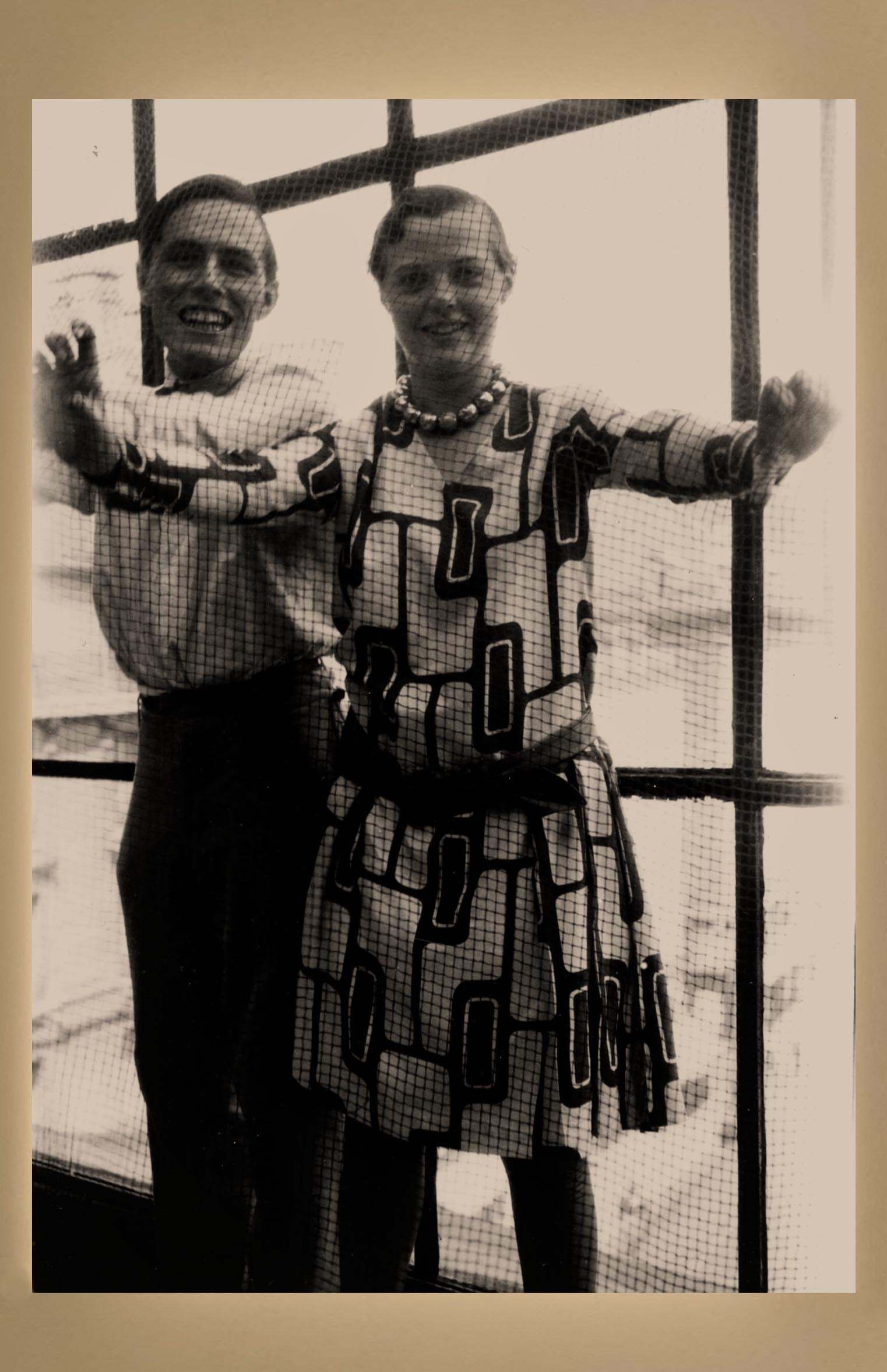
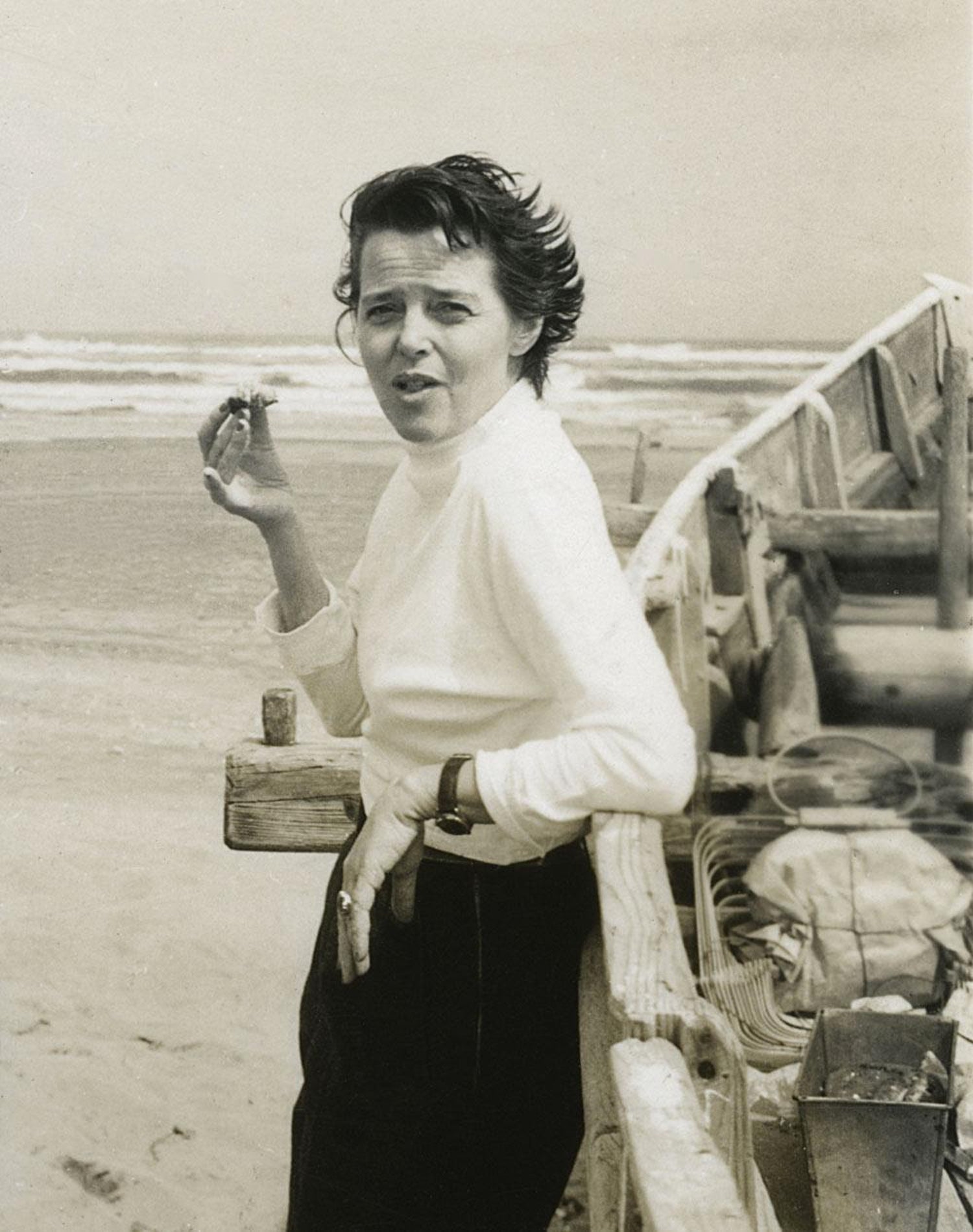


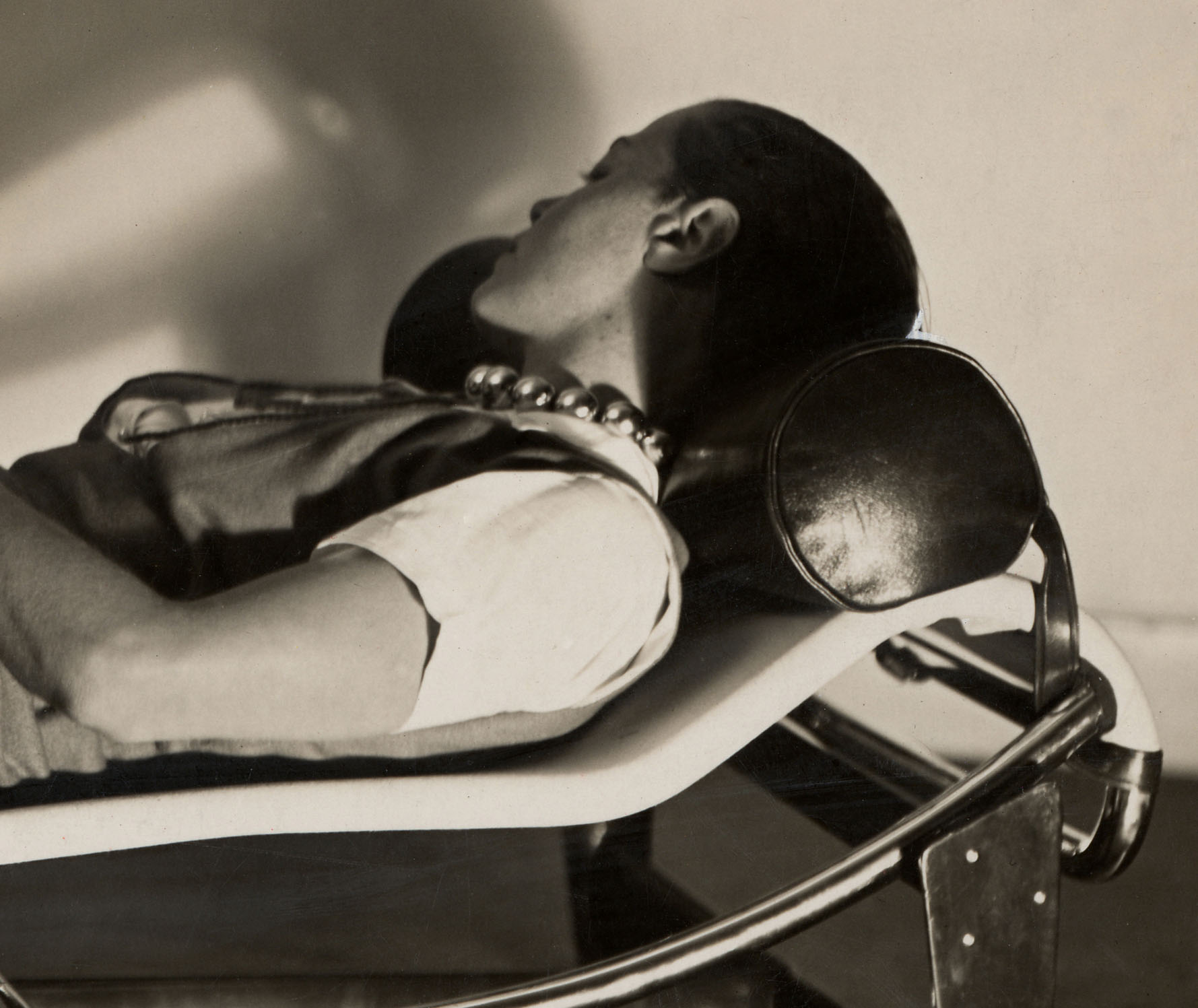


Charlotte Perriand’s ball-bearings necklace was exhibited in 2009 at the exhibition “Bijoux Art Deco et Avant Garde” at the Musee Des Arts Decoratifs in Paris and, in 2011, in the show “Charlotte Perriand 1903-99: From Photography to Interior Design” at the Petit Palais. The necklace became, for a short period, synonymous with Perriand and with her championing of the machine aesthetic in the late 1920s and has subsequently attained the status of a mythical object and symbol of the machine age. This essay considers the necklace as an object and symbol in the context of modernist aesthetics. It also discusses its role in the formation of Perriand’s identity in the late 1920s, when she was working with Le Corbusier, and aspects of gender and politics in the context of the wider modern movement. [more on Semantic Scholar]

“I had a street urchin’s haircut and wore a necklace I made out of cheap chromed copper balls. I called it my ball-bearings necklace, a symbol of my adherence to the twentieth-century machine age. I was proud that my jewelry didn’t rival that of the Queen of England.”
Perriand had asked an artisan with a workshop in the Faubourg Saint-Antoine to make the piece out of lightweight chrome steel balls strung together on a cord. The piece was inspired by Fernand Léger’s still life “Le Mouvement à billes” (1926).
The necklace became a symbol of Perriand’s passion for the mechanical age […] (see also: Charlotte Perriand’s “Ball Bearings” Necklace on Irenebrination)

“Art is in everything,” insisted Charlotte Perriand. […] When you see Charlotte’s chaise longue, chair, and tables in front of that immense Léger, you cannot imagine the design without the art—it is a global vision.
On an adjacent wall, Collier roulement à billes chromées (1927)—a silver choker made from automotive ball bearings that Perriand not only designed but wore—is placed next to a Léger painting, Nature morte (Le mouvement à billes) (Still life [Movement of ball bearings], 1926). [quoted from William Middleton review of the exhibition Charlotte Perriand: Inventing a New World, on Gagosian]
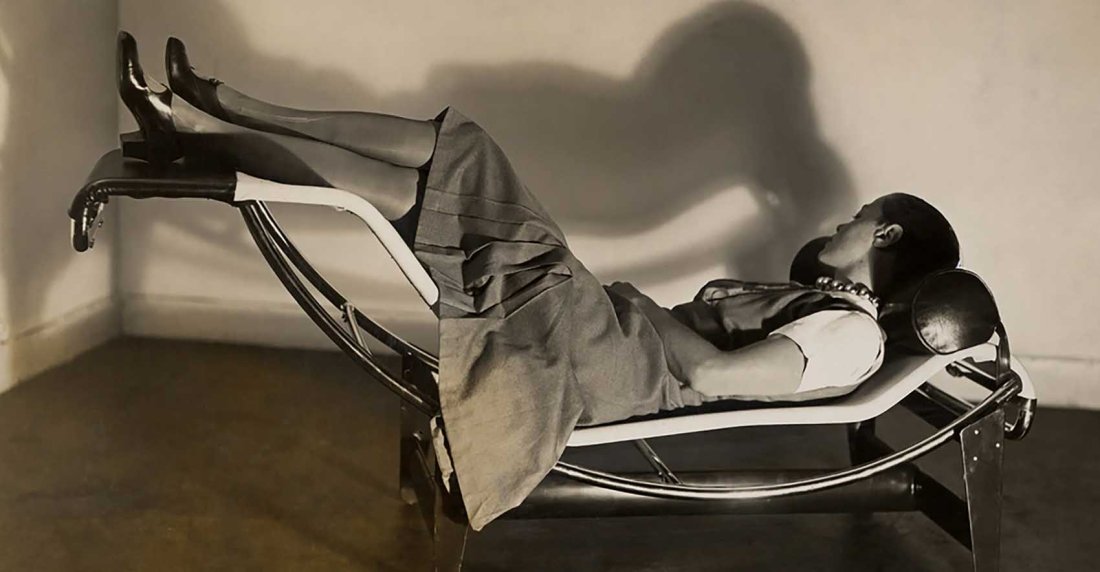
She recalls how in 1927 at the age of just 24 she marched into the studio of Le Corbusier in Paris and showed the master architect her designs in order to present herself as an architect. He looked at everything and then said, “Mademoiselle, we don’t embroider cushions here.” [src indion]

The young woman bathed confidently in the sparkling energy of the “années vingt”, learned the Charleston, admired Josephine Baker, wore her hair cropped short and had a necklace made of chrome-plated balls, which she called her “ball bearings” – a provocation of industrial aesthetics. Modernism was gathering momentum. In her apartment, a car headlamp hung above her extending table made of materials used in automotive production. The direction was clear: we need to get away from the classical parlour. [src indion]

Charlotte Perriand did not have to wait until her meeting with Le Corbusier to give vent to her creativity; it was long before then that she started to design pieces completely off her own bat. To be sure, the turning point came for her in 1927, when she read the Swiss architect’s two essays, Vers une architecture and L’art décoratif aujourd’hui, and had a revelation: “Those books made me see past the wall that was blocking my view of the future. So I took a decision: I was going to work with Le Corbusier.” But their first meeting was a disaster. She presented herself at no. 35 Rue de Sèvres, the studio that the Swiss architect and his cousin Pierre Jeanneret had set up in a long corridor that had formerly been the cloister of a Jesuit monastery (a building that was later demolished and replaced by a glass and concrete construction). She took out her drawings and when Le Corbusier asked her what she wanted, blurted out the only sentence she had prepared: “To work with you.” He looked her up and down through his round spectacles, glanced through the drawings and dismissed her with the words: “We don’t embroider cushions here.” Disheartened, Perriand turned on her heel, but not before telling Le Corbusier about her Bar sous le toit on show at the Salon. [quoted from Klat magazine]

These were not easy times for women: the world of architecture was peopled with extremely misogynous men. Charlotte felt herself to be a failure: she had not been able to get herself accepted. So it was a delightful surprise for her to find out, a few days later, that Le Corbusier had seen her furniture and was ready to let her join his studio to design the interiors of his new buildings. The mutual understanding between them in design would be so great that Charlotte Perriand’s name would be overshadowed and even erased by Le Corbusier’s, even though their collaboration would last for about ten years. [quoted from Klat magazine]

Those were years of great complicity. The pair shared a passion for emptiness: “Vacuum is all potent because all containing,” as Taoism teaches us. But they would also be years filled with enthusiasms and jealousies, seeing that, after her divorce from Percy Kilner Scholefield, Charlotte discovered Moscow and Berlin, founded an association of artists and had a love affair with Le Corbusier’s cousin and partner Jeanneret, forming a fruitful and complicated relationship with him. Together they would embark on research into art brut, studying with Fernand Léger the shapes of pebbles on the beaches of Dieppe, the fractals of fossils and the trunks of trees. And together they would work until 1940. [quoted from Klat magazine]

In the summer of 1940 Charlotte Perriand left for Tokyo. Appointed, thanks to her friend, colleague and former intern Junzo Sakakura, an adviser on industrial design to the Japanese government; Perriand was supposed to stay in Japan for just a year and a half to prepare a major exhibition. She was to remain there for six years, as the war upset her plans, separating her from Jeanneret and leading her to finding a new love, Jacques Martin, who would become her second husband and the father of her daughter Pernette. From that time on, the life of this infinitely resourceful girl from the mountains, a skilled skier and off-piste enthusiast, but also a lover of the sea and fanatic swimmer, would be an unending series of encounters and discoveries in a continual process of renewal in order to try out new forms and unprecedented solutions. [quoted from Klat magazine]
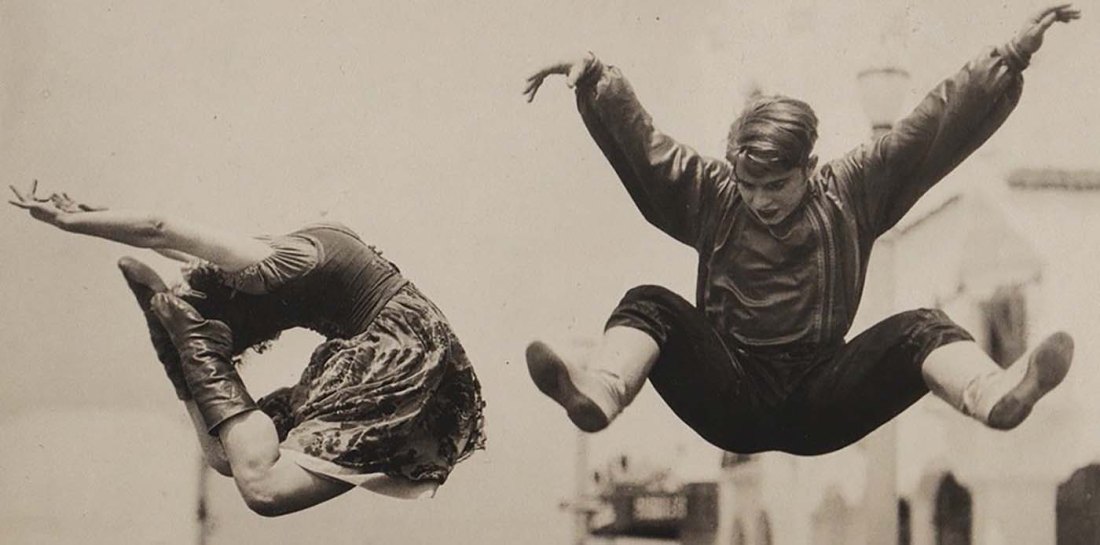
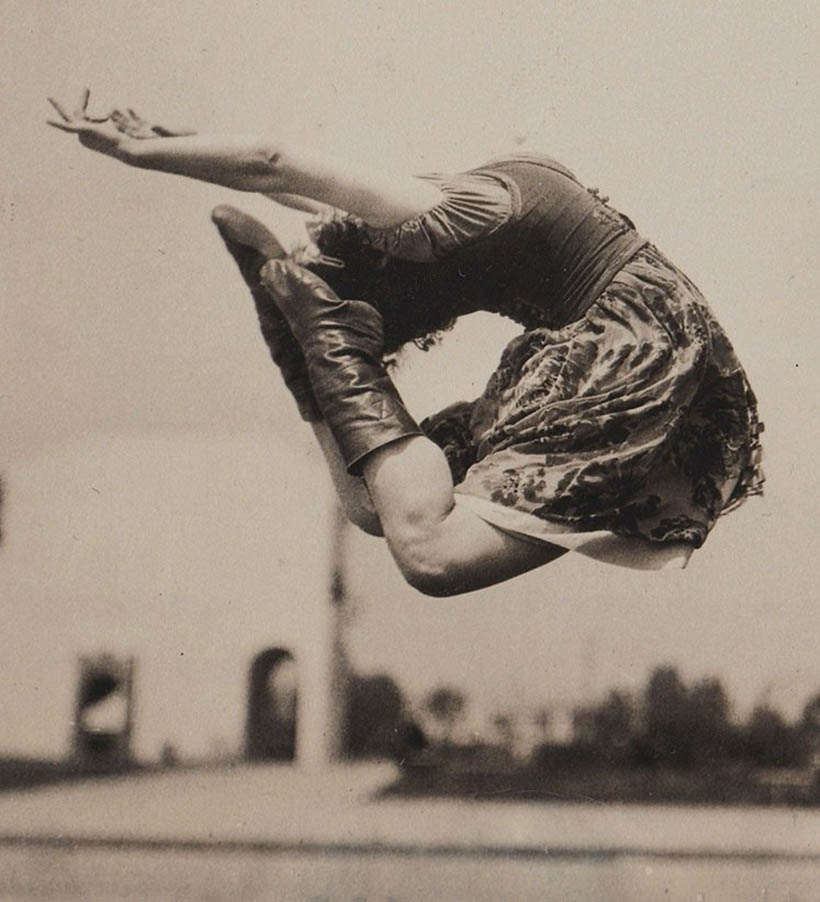
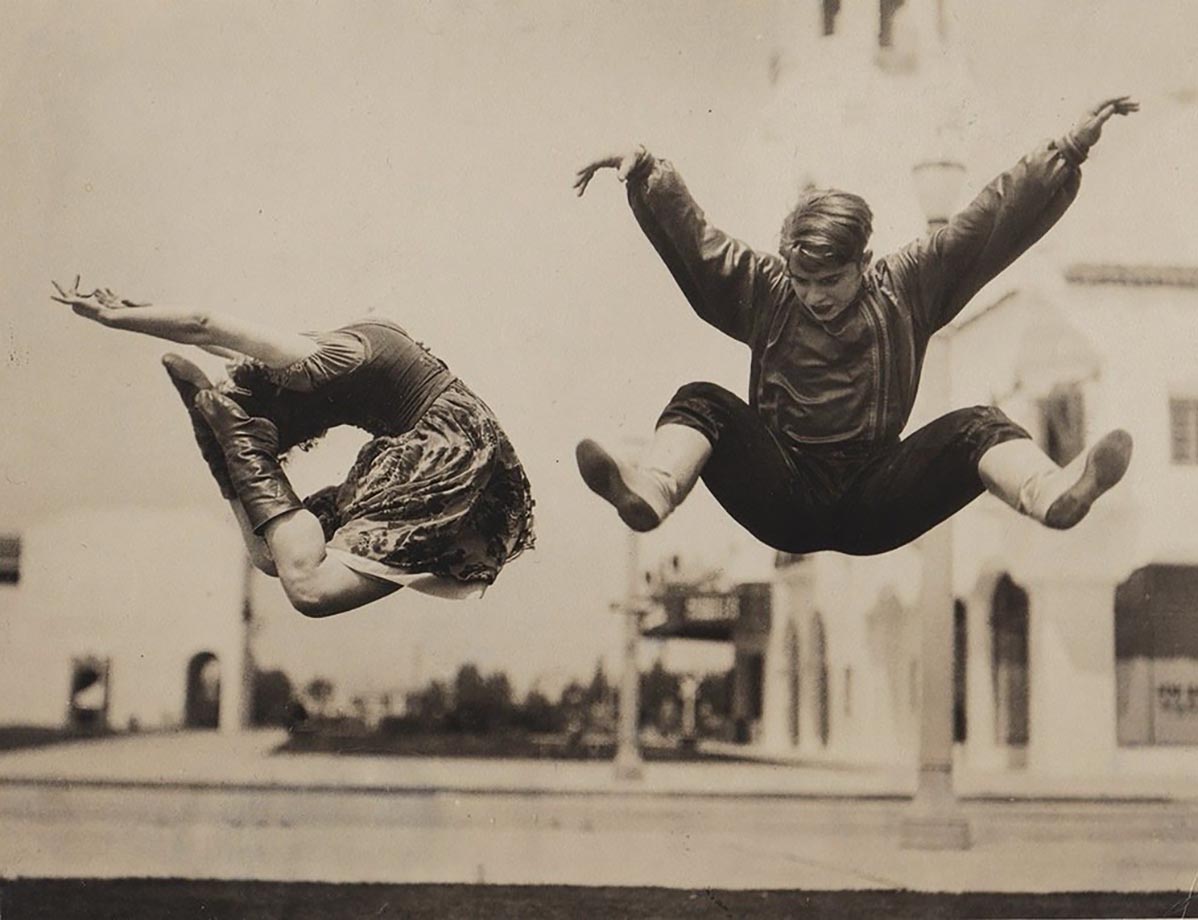
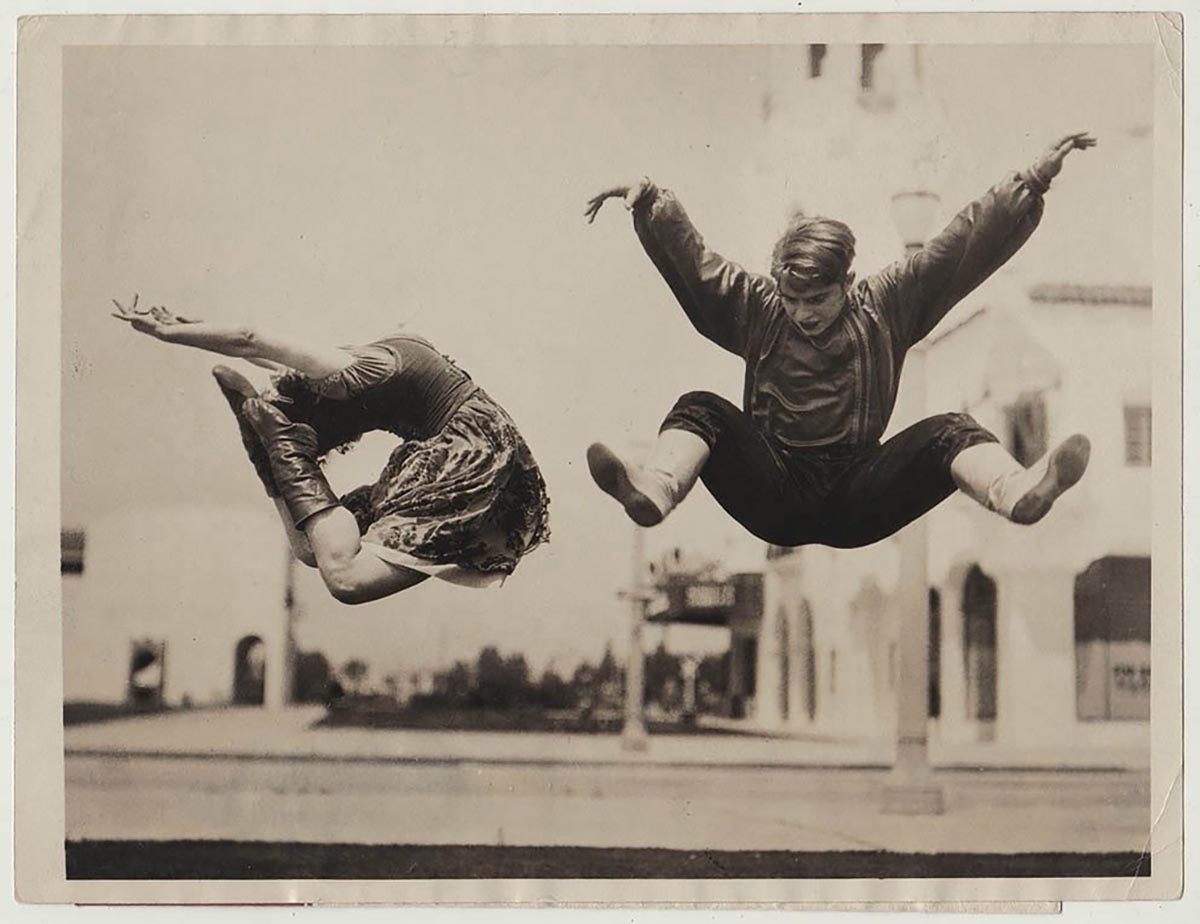
Press Agency / Newspaper Stamp on the reverse reads: S/644A309 By Underwood and Underwood. / Louise and Frieda Berkoff. Here’s action: How many can do this? / For once in his life “Old Man Gravity”, the well known friend of Isaac Newton, came out second best when Louis and Frieda Berkoff prectised these spectacular flying “steps” of a new Russian dance on the lawn of the Carthay Circle, a Los Angeles suburb.
Photo shows: brother and sister “Up in the air”. An exclusive Underwood photograph. Watch your credit line
 un regard oblique