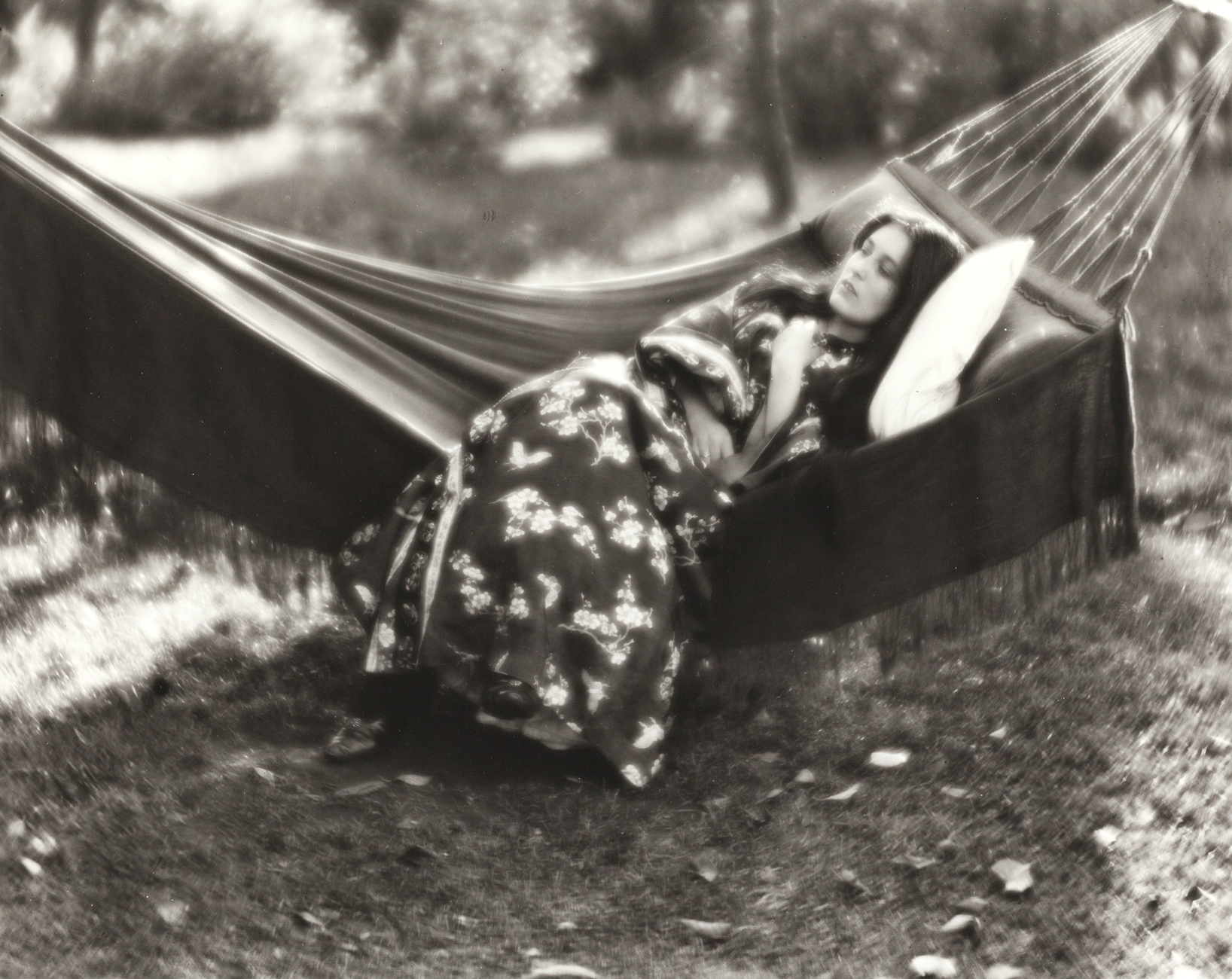
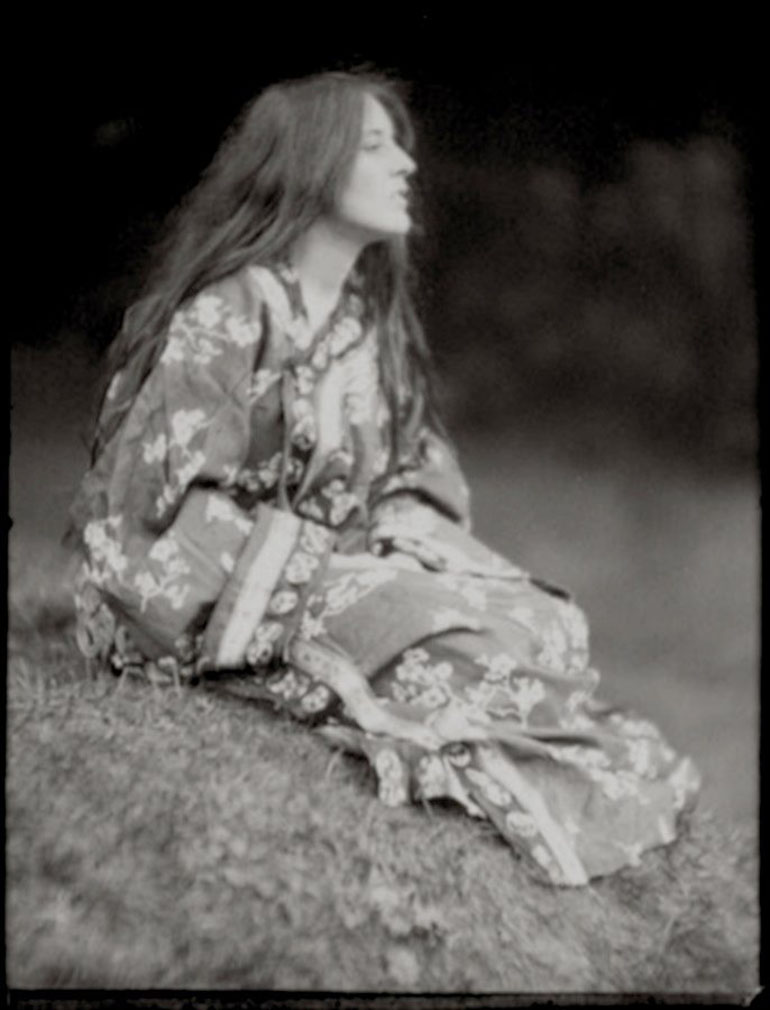
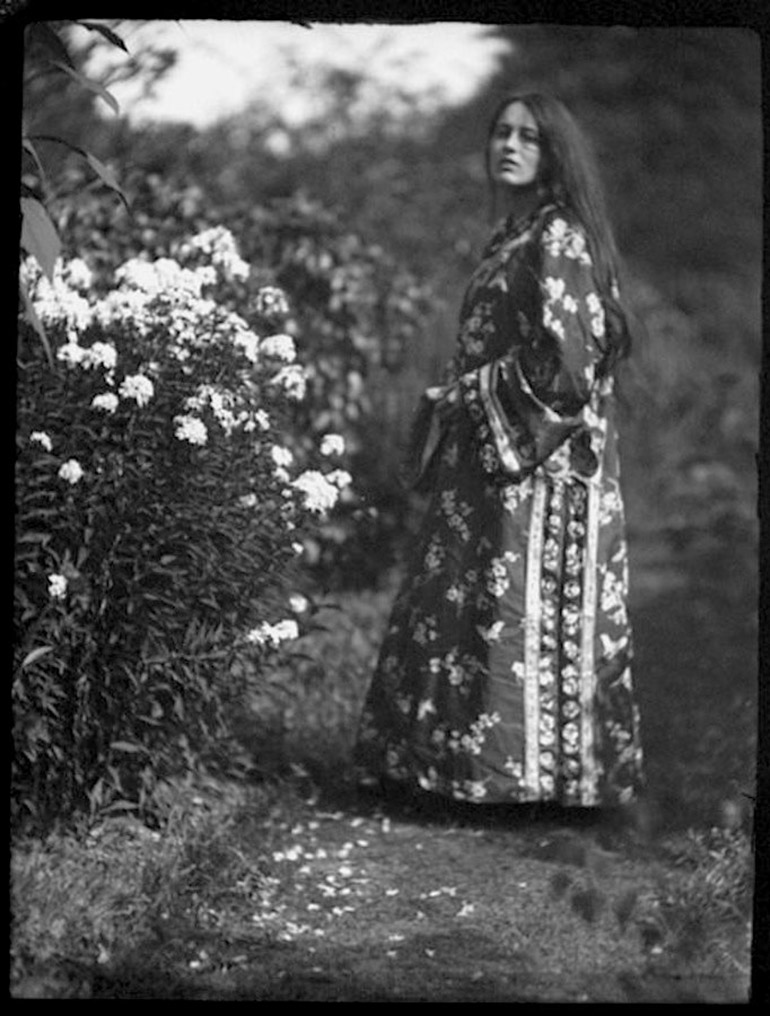
Alvin L. Coburn (1882–1966) :: ‘Toodles (Elsie Thomas)’, ca. 1908. Gelatin silver print, printed in the 1980s | Ostlicht Auktion 2023
Coburn was given his first camera at the age of eight and was introduced to photography by his cousin Fred Holland Day. As early as 1902 he became a member of the New York Photo-Secession initiated by Alfred Stieglitz, and two years later his first pictures appeared in Stieglitz’s magazine “Camera Work”. A vintage print of this beautiful motif is hold at The Museum of Fine Arts, Houston (MFAH), there titled and dated. Coburn also made autochromes of the same model, showing the red colour of her kimono.
Alvin Langdon Coburn (1882–1966) :: ‘Toodles (Elsie Thomas)’, ca. 1908 | Ostlicht Auktion 2023Alvin Langdon Coburn :: Elsie Thomas in an Eastern costume sitting on a hammock, ca.1908. AutochromeAlvin Langdon Coburn :: Elsie Thomas in a red an Eastern costume with sunflower, ca.1908. Autochrome LumièreAlvin Langdon Coburn :: Elsie Thomas (‘Toodles’) in an Eastern costume, ca.1908Alvin Langdon Coburn :: Elsie Thomas wearing an Eastern costume, ca.1908
we do not own these photographs (unless indicated otherwise), we just share images that somehow haunt us.
Please, if you share them do not remove credits or/and sources.
View all posts by un regard oblique
Published
5 thoughts on “Toodles by Alvin L. Coburn”
These pictures, strange to say, have a cuteness to them. I like em.😊 I wouldn’t wear a kimono like that, but I like it!
Hello, this is NOT a kimono, it is a late Qing Dynasty Chinese woman’s dress, the Japanese kimono of the same era does not look like this at all.I know this because I am from China and have knowledge of the traditional costumes of both countries.
Hello there. Thank you for sharing your knowledge and for letting us know. BTW, do you happen to know if this Qing Dynasty dress has a short name? Thanks again. Cheers!
Hello, thank you for your reply. This dress is called 氅衣, 氅衣 is the Qing Dynasty Manchu women’s clothing, its style for the round neck, large lapel right overlapping, flat broad sleeves, body length to cover the feet, sleeve length and elbow, cuffs multi-layered between for can be turned down, train left and right open to the armpit, straight type robe, generally do for outerwear use, is the Qing Dynasty women’s casual wear, the most elaborate edging, the most unique production method, the most exquisite workmanship, the most rich pattern, the most decorative effect of casual wear.
It should be noted that the Qing Dynasty was a dynasty ruled by the Manchu, a minority ethnic group, and China was a society with a dominant Han Chinese population. And before the Qing Dynasty, Manchu dress and Han dress were completely different systems in terms of craftsmanship, patterns, clothing styles, functional attributes and cultural aspects, for example, Manchu dress had a typical nomadic style and was more convenient for horse riding. After the establishment of the Qing Dynasty, the Han and Manchu peoples gradually became one in terms of cultural practices, and the costumes were also borrowed from each other and fused to form what is now known as the Qing Dynasty costumes.
In addition, although the Japanese kimono originally developed its own dress culture based on Chinese Han Chinese dress, the two are completely different, both in terms of production techniques and patterns, and even in terms of style and ornamentation. When the Joseon dynasty was first established, Korean costumes were largely copied from the Chinese Ming Dynasty, but they still developed their own characteristics and eventually became very different from the Chinese Ming Dynasty costumes (especially women’s costumes). The Vietnamese national costume, on the other hand, looks very much like the Chinese cheongsam, but in reality they are very different. The countries of East and South East Asia may not look very different to the Western world, but in reality they are very different in terms of culture and national costume, just as France can never be equated with Norway even though they are both European countries.
The Chinese Han costume is also very different from the costumes of the other 55 ethnic minorities in China, and the costumes of the various ethnic minorities are also different from each other, even if they are from the same ethnic group but from different regions or tribes. For example, the Tibetan costume in Lhasa, Tibet is very different from the Tibetan costume in Ganzi, Sichuan, and the Miao costume in Hunan is completely different from that of the Miao in Guangxi.
The history and culture of Chinese ethnic dress is too long and complex to explain, but I can say with complete certainty that this dress is not a Japanese kimono, but a “氅衣”, a Chinese women’s dress from the late Qing Dynasty (probably during the Guangxu period).
If only I could post pictures, I could stitch together pictures of Han Chinese costumes before the Qing Dynasty, Qing Dynasty costumes and Japanese kimonos, and you could visually see the difference between the three.
Anyway, thanks for your reply and for the fact that I really, really enjoy your blog♡
Hello. Don’t thank me I thank YOU for pointing my mistake and I am also very grateful for this detailed information (which I will read in detail -there’s so much info to process here-). You are absolutely right: “The countries of East and South East Asia may not look very different to the Western world, but in reality they are very different in terms of culture and national costume”. Our cultural “centrism” added to a high quote of ignorance make us blind… there’s so much we have to learn and also not take for a fact what one find in an auction caption or even in a museum caption. Last but not least, I want to thank you again for taking the time to write and share this info. My apologies for the ignorance. Hope to see you around! Danke!



 un regard oblique
These pictures, strange to say, have a cuteness to them. I like em.😊 I wouldn’t wear a kimono like that, but I like it!
LikeLiked by 1 person
Hello, this is NOT a kimono, it is a late Qing Dynasty Chinese woman’s dress, the Japanese kimono of the same era does not look like this at all.I know this because I am from China and have knowledge of the traditional costumes of both countries.
LikeLiked by 1 person
Hello there. Thank you for sharing your knowledge and for letting us know. BTW, do you happen to know if this Qing Dynasty dress has a short name? Thanks again. Cheers!
LikeLike
Hello, thank you for your reply. This dress is called 氅衣, 氅衣 is the Qing Dynasty Manchu women’s clothing, its style for the round neck, large lapel right overlapping, flat broad sleeves, body length to cover the feet, sleeve length and elbow, cuffs multi-layered between for can be turned down, train left and right open to the armpit, straight type robe, generally do for outerwear use, is the Qing Dynasty women’s casual wear, the most elaborate edging, the most unique production method, the most exquisite workmanship, the most rich pattern, the most decorative effect of casual wear.
It should be noted that the Qing Dynasty was a dynasty ruled by the Manchu, a minority ethnic group, and China was a society with a dominant Han Chinese population. And before the Qing Dynasty, Manchu dress and Han dress were completely different systems in terms of craftsmanship, patterns, clothing styles, functional attributes and cultural aspects, for example, Manchu dress had a typical nomadic style and was more convenient for horse riding. After the establishment of the Qing Dynasty, the Han and Manchu peoples gradually became one in terms of cultural practices, and the costumes were also borrowed from each other and fused to form what is now known as the Qing Dynasty costumes.
In addition, although the Japanese kimono originally developed its own dress culture based on Chinese Han Chinese dress, the two are completely different, both in terms of production techniques and patterns, and even in terms of style and ornamentation. When the Joseon dynasty was first established, Korean costumes were largely copied from the Chinese Ming Dynasty, but they still developed their own characteristics and eventually became very different from the Chinese Ming Dynasty costumes (especially women’s costumes). The Vietnamese national costume, on the other hand, looks very much like the Chinese cheongsam, but in reality they are very different. The countries of East and South East Asia may not look very different to the Western world, but in reality they are very different in terms of culture and national costume, just as France can never be equated with Norway even though they are both European countries.
The Chinese Han costume is also very different from the costumes of the other 55 ethnic minorities in China, and the costumes of the various ethnic minorities are also different from each other, even if they are from the same ethnic group but from different regions or tribes. For example, the Tibetan costume in Lhasa, Tibet is very different from the Tibetan costume in Ganzi, Sichuan, and the Miao costume in Hunan is completely different from that of the Miao in Guangxi.
The history and culture of Chinese ethnic dress is too long and complex to explain, but I can say with complete certainty that this dress is not a Japanese kimono, but a “氅衣”, a Chinese women’s dress from the late Qing Dynasty (probably during the Guangxu period).
If only I could post pictures, I could stitch together pictures of Han Chinese costumes before the Qing Dynasty, Qing Dynasty costumes and Japanese kimonos, and you could visually see the difference between the three.
Anyway, thanks for your reply and for the fact that I really, really enjoy your blog♡
LikeLiked by 1 person
Hello. Don’t thank me I thank YOU for pointing my mistake and I am also very grateful for this detailed information (which I will read in detail -there’s so much info to process here-). You are absolutely right: “The countries of East and South East Asia may not look very different to the Western world, but in reality they are very different in terms of culture and national costume”. Our cultural “centrism” added to a high quote of ignorance make us blind… there’s so much we have to learn and also not take for a fact what one find in an auction caption or even in a museum caption. Last but not least, I want to thank you again for taking the time to write and share this info. My apologies for the ignorance. Hope to see you around! Danke!
LikeLike