
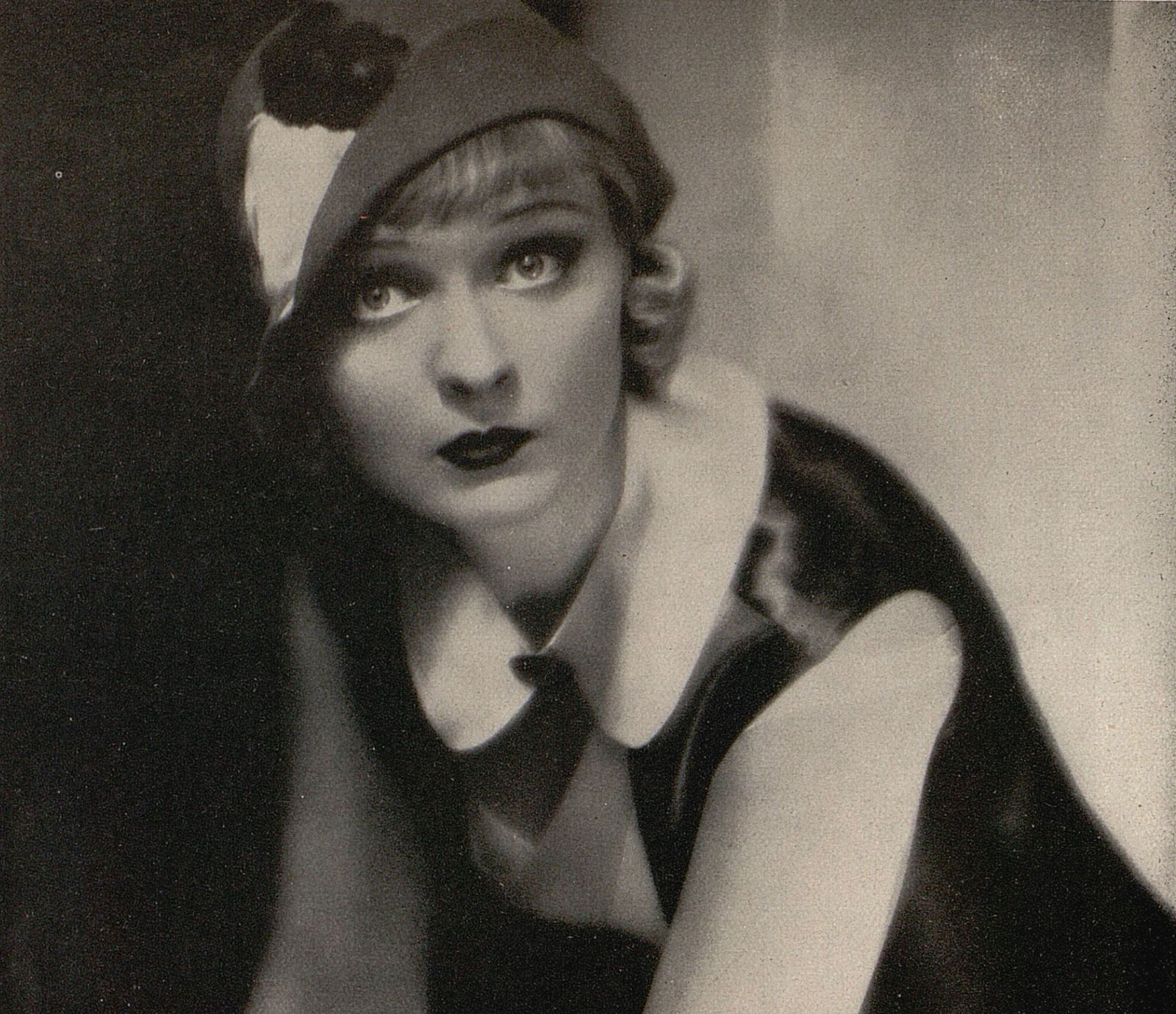

images that haunt us
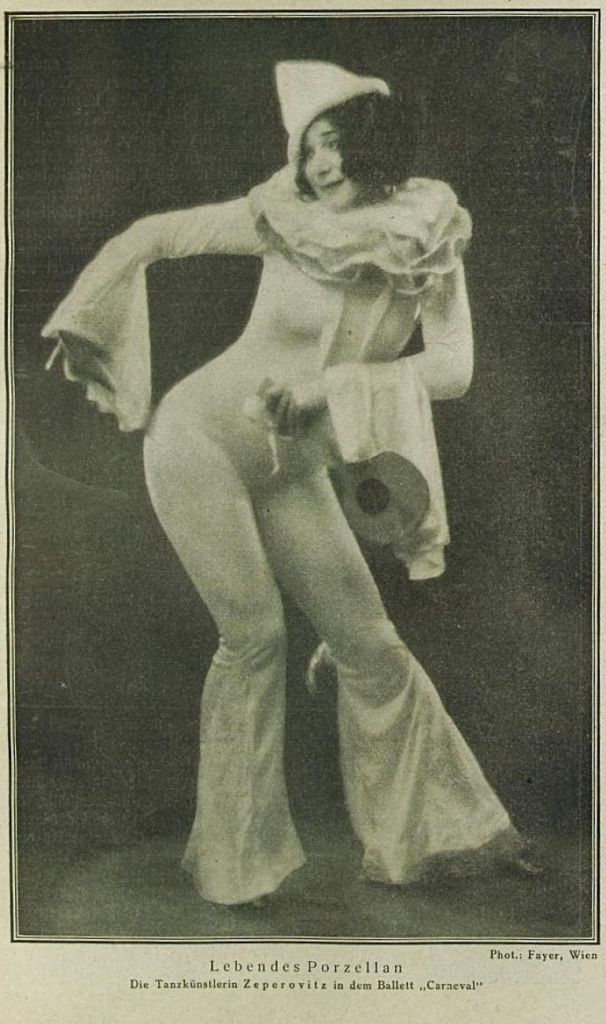
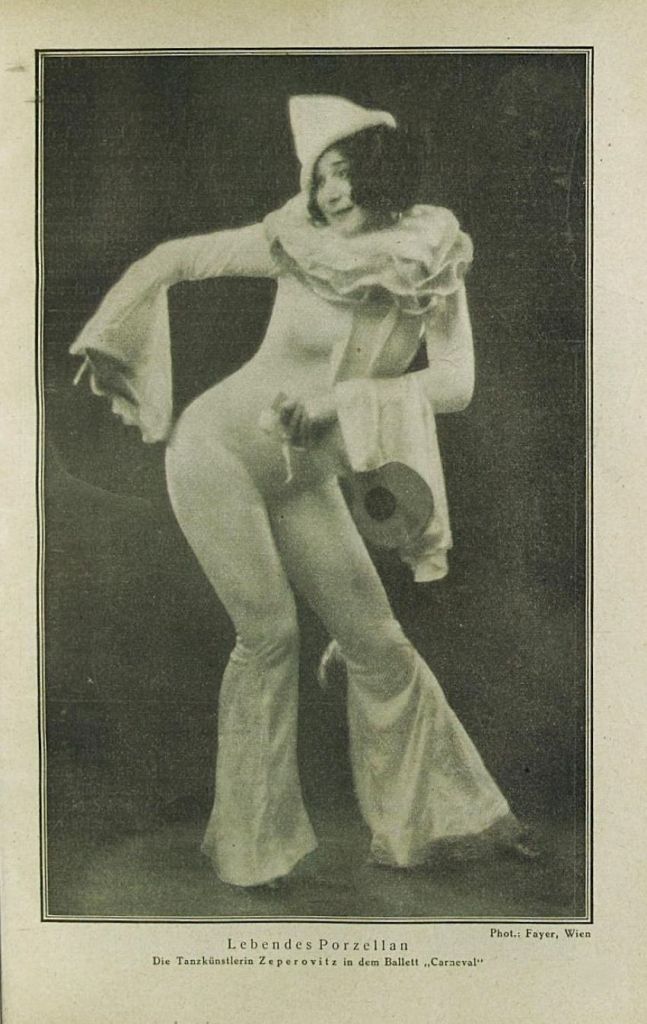
Lebendes Porzellan. Die Tanzkünstlerin Zeperovitz in dem Ballett Carneval. Foto: Fayer (Wien). Revue des Monats B.1 H.4, Februar 1927


Approximately by the time this photo was taken Joseph Stalin was launching his campaign to compel all Soviet artists to observe the rules of ‘socialist realism’. The hunting took a step further and the Meyerhold weren’t the exception. In this new scenario of persecution there was no room for avant-gardists; it did not matter at all that he was one of the first prominent Russian artists to welcome the Bolshevik Revolution.
Reich and Meyerhold married in 1922 after Meyerhold return to Moscow and the foundation of his own theater in 1920, which was known from 1923 to 1938 as the Meyerhold Theatre. In the 1930s the Stimmung became more and more toxic and after Shostakovich had been singled out as being guilty of ‘formalism’, in January 1936, Meyerhold evidently surmised that he would soon be a target, and in March 1936 delivered a talk entitled “Meyer against Meyerholdism”.
A year later, in April 1937, his wife, Zinaida Reich, wrote Stalin a long letter alleging that her husband was the victim of a conspiracy by Trotskyists and former members of the disbanded Russian Association of Proletarian Writers.
In June 1939, Meyerhold was arrested in Leningrad (the 20th). Three weeks later two assailants stabbed Reich to death at the couple’s apartment in Moscow (July 14-15th). The murder is generally regarded as having been organized by the NKVD (People’s Commissariat for Internal Affairs). According to Arkadiy Vaksberg: “Beria needed this sadistic farce” because the actress was extraordinarily popular, independent, outspoken and known for saying: “if Stalin can make no sense of art, let him ask Meyerhold, and he will explain” (Toxic Politics; 2011)
Following his arrest, Meyerhold was taken to NKVD headquarters in Moscow and tortured repeatedly. But it was not until the 1st February 1940 after his “confession” of being a British or Japanese spy that he was sentenced to death by firing squad and executed the next day.
The images of this post are from an earlier, brighter era for the Meyerhold and in the USSR.

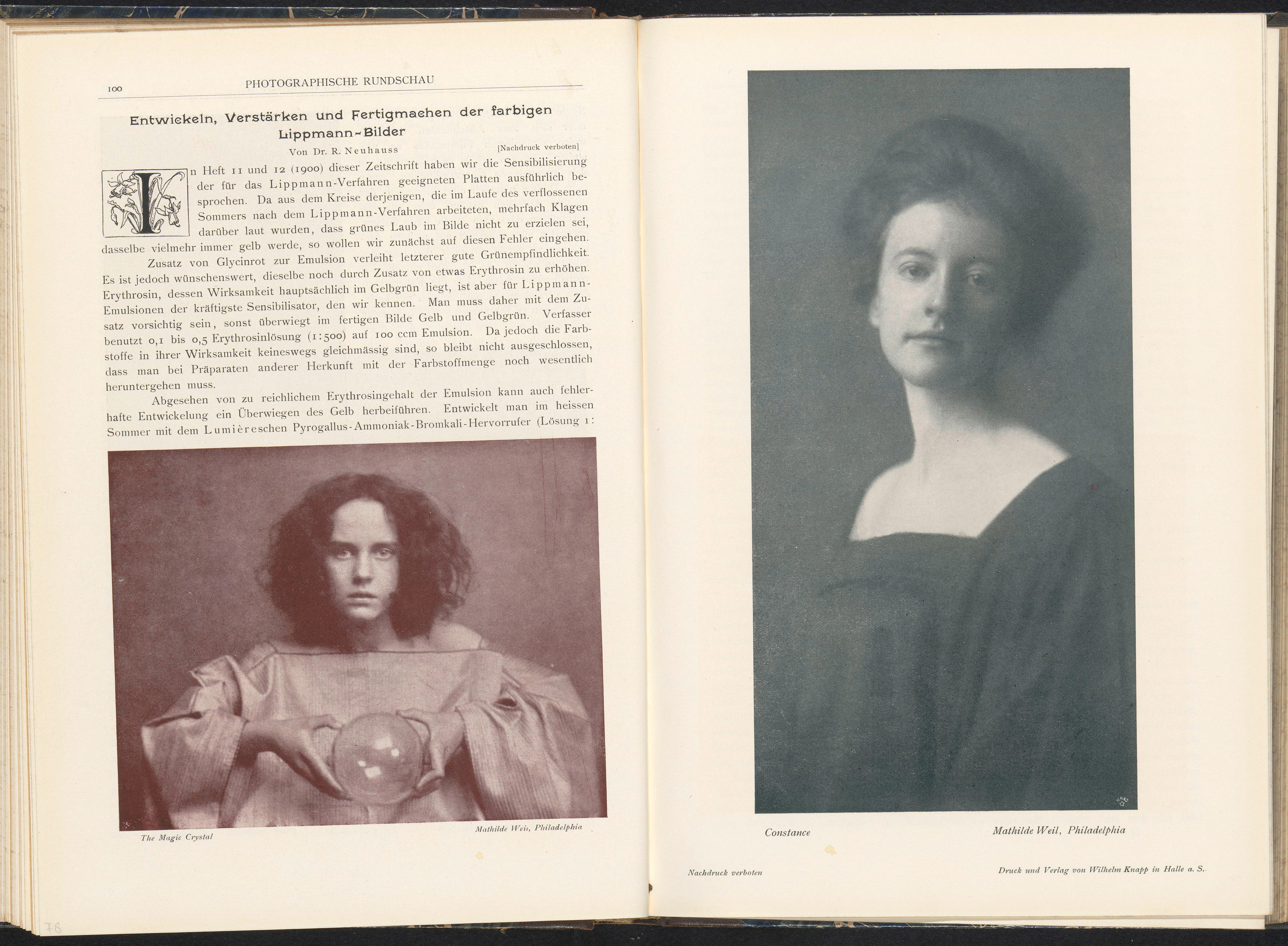
![Mathilde Weil :: The Magic Crystal [Portret van een onbekende vrouw met een glazen bol / Portrait of an unknown woman with a crystal ball], ca. 1896 - in or before 1901. This work belongs to Photographische Rundschau: Zeitschrift für Freunde der Photographie, 1901. | Rijksmuseum](https://unregardoblique.com/wp-content/uploads/2022/08/portret-van-een-onbekende-vrouw-met-een-glazen-bol-mathilde-weil-c.-1896-in-or-before-1901-rijksmuseumcrp.jpg)
![Mathilde Weil :: Constance [Portret van een onbekende vrouw / Portrait of an unknown woman], ca. 1896 - in or before 1901. This work belongs to Photographische Rundschau: Zeitschrift für Freunde der Photographie, 1901. | src Rijksmuseum](https://live.staticflickr.com/65535/52260781178_9c84c1cbd2_o.jpg)
![«Die neueste Skandalaffäre im Alpenhotel oder weshalb Frl. Schneider und Herr Müller so spät von der Gletschertour heimkehrten.» | The latest scandalous affair in the Alpenhotel or why Miss Schneider and Mr Müller returned home from their glacier tour so late. Zeitschrift für Humor und Kunst. Meggendorfer-Blätter nº 1230, 23 Juli 1914. [Illegible photographer’s name on lower right] | src Universitätsbibliothek Heidelberg](https://unregardoblique.com/wp-content/uploads/2022/09/die-neueste-skandalaffare-im-alpenhotel-oder-weshalb-fraulein-schneider-und-herr-muller-so-spat-von-der-gletschertour-heimkehrten-not-jugend.jpg?w=1100)

«Die neueste Skandalaffäre im Alpenhotel oder weshalb Frl. Schneider und Herr Müller so spät von der Gletschertour heimkehrten.» | The latest scandalous affair in the Alps hotel or why Miss Schneider and Mr. Müller returned from their glacier tour so late.
![«Die neueste Skandalaffäre im Alpenhotel oder weshalb Frl. Schneider und Herr Müller so spät von der Gletschertour heimkehrten.» | The latest scandalous affair in the Alpenhotel or why Miss Schneider and Mr Müller returned home from their glacier tour so late. Zeitschrift für Humor und Kunst. Meggendorfer-Blätter nº 1230, 23 juli 1914. [Illegible photographer’s name on lower right] | src Universitätsbibliothek Heidelberg](https://unregardoblique.com/wp-content/uploads/2022/09/die-neueste-skandalaffare-im-alpenhotel-oder-weshalb-fraulein-schneider-und-herr-muller-so-spat-von-der-gletschertour-heimkehrten-not-jugend.jpg)

The Bauhaus weaving workshop, composed primarily of women, was among the school’s most successful and experimental workshops. Influenced by the color and formal theories of Vasily Kandinsky, Paul Klee, and Johannes Itten, the students experimented with traditional and industrial dyeing and weaving techniques. Lotte Beese took no formal classes in photography, but she made a number of photographs during her years in Dessau and is known especially for her Bauhaus portraiture. Uniting her interest in portraying fellow students with her intimate participation in the weaving workshop, where she studied textile design under Gunta Stölzl, Beese’s image of a circular cluster of progressive young women weavers was featured on the cover of the Bauhaus journal in 1928, with a headline beckoning, “Young people, come to the Bauhaus!” Beese likely shot this picture from a ladder or with her camera mounted on an elevated tripod, using a Rollholder that she described as a “rickety second camera.”
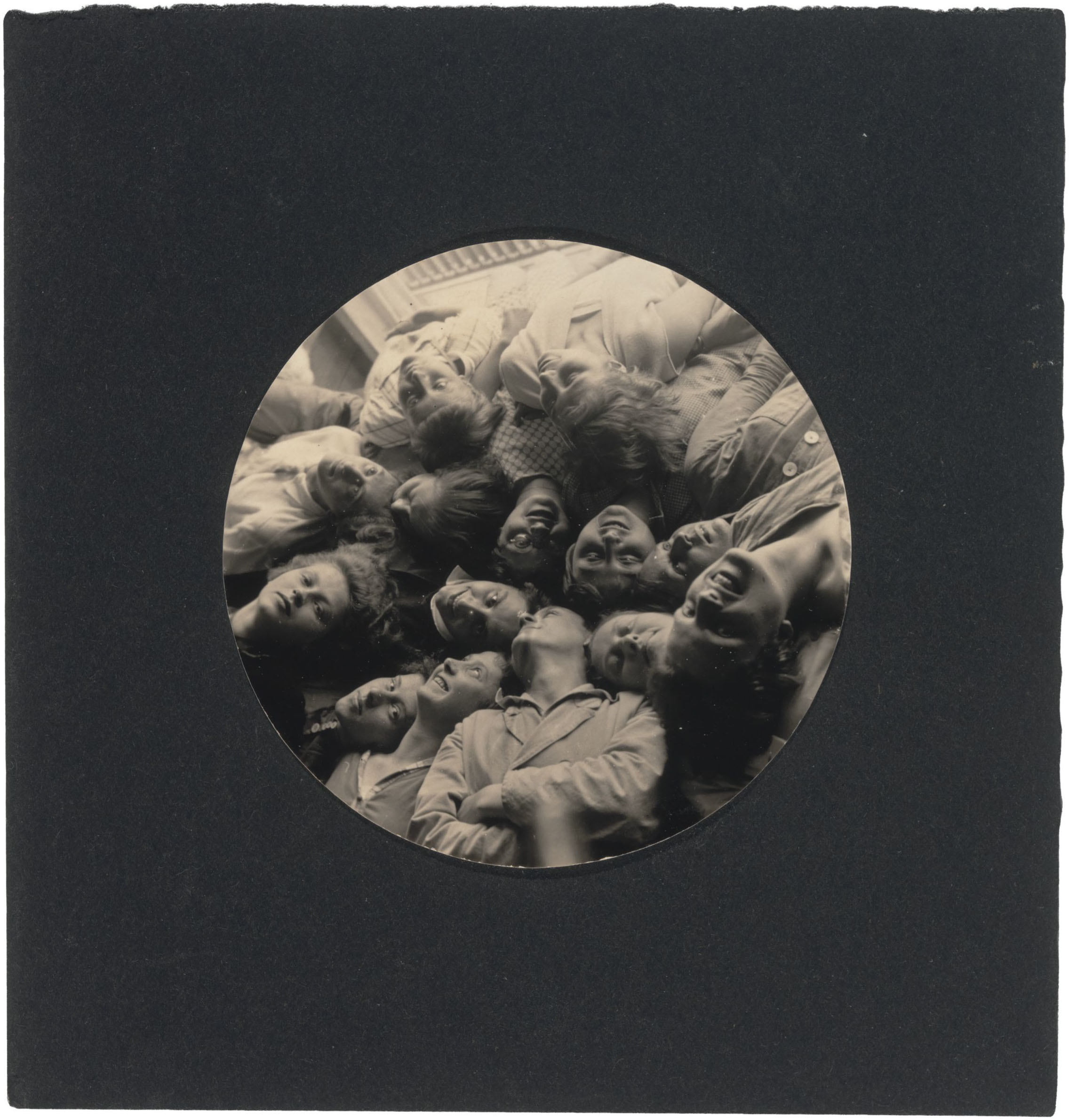
The picture is printed on Velox, a Gaslight Paper known for its warm highlights and light texture. The material was marketed to amateurs because it required no enlarger or darkroom; it could be exposed in the comfort of one’s parlor, just inches from an ordinary gas jet or electric bulb. Bauhaus artists experimented with Velox and other contact papers before a formal photography program was established at the school.
To achieve the picture’s circular format, Beese prepared a masking layer with a round window 8.5 centimeters (3 3/8 inches) in diameter, which she placed over the unexposed photographic paper and the rectangular negative. This stacked construction was then exposed to light and processed, resulting in a circular image in the center of a white sheet of paper. She then carefully trimmed around the image edge and retouched a few white lines and spots. At some point the print was mounted to black paper, whose rough, hand-torn edges and embossed line along one side indicate that it once was part of an album.
—Mitra Abbaspour, Hanako Murata | quoted from MoMA

 un regard oblique