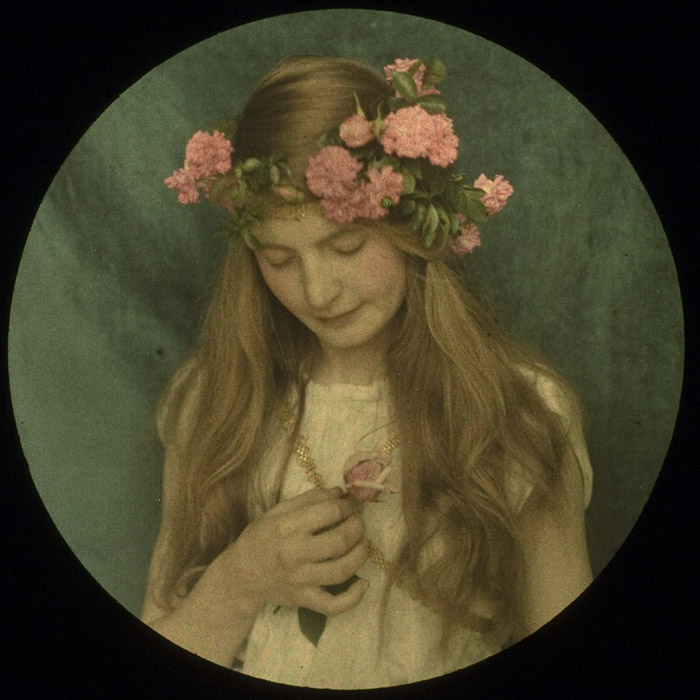
Alfonse van Besten (1865-1926) was a painter, and took full advantage of the possibilities of the new colour process: the Autochrome. One can see that many of his Autochromes were taken with a “painterly eye” e.g. Musing (Mrs.van Besten) or Symphony in white.
During the first World War (1914-1918) he was a refugee in The Netherlands. Together with his friend A. van Son, another Belgian autochromist and refugee, they gave countless lectures at several Dutch photography societies. They were praised for their excellent Autochrome work, e.g. on the 16th of April 1915 the photographic society “Meer Licht” from Nymegen (NL) paid an homage to Van Besten for his outstanding autochrome plates. See Homage to Van Besten at Nymegen.
He was member of The photographic association IRIS-Antwerp and the Association Belge de Photographie. [quoted from source]

 un regard oblique