Ashibe Odori 1910shttps://embedr.flickr.com/assets/client-code.js

Ashibe Odori, 1910′s
Maiko (apprentice geisha) Yachiyo II of Osaka, dressed for the Ashibe Odori, the public dances of the Nanchi Gokagai (Southern five geisha districts), which were first performed in November 1888. The geiko (geisha) of Osaka are known for their “hera-hera odori” or dances that feature acrobatic stunts such as handstands. / src: Blue Ruin

A Geisha biting a Tenugui 1920shttps://embedr.flickr.com/assets/client-code.js

A Geisha biting a Tenugui, 1920′s
“[She] rises to one knee and puts one end of her [tenugui] hand towel in her teeth, pulling on it with her right hand. This is a typical Kabuki gesture for a female character in the throes of a deep emotion.” According to “The Art of Kabuki” edited by Samuel L. Leiter, first published in 1979, page 114. / src: Blue Ruin

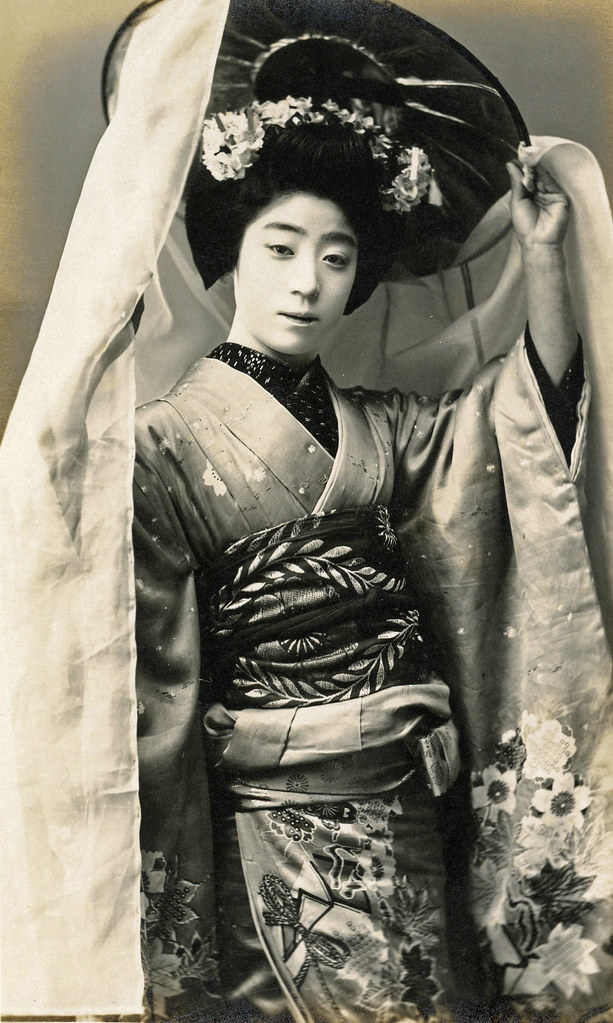
Geiko Yachiyo with a Heian Period Hat 1910shttps://embedr.flickr.com/assets/client-code.js

Geiko Yachiyo with a Heian Period Hat, 1910′s
Yachiyo dressed for the Ashibe odori (Ashibe public dance), holding a travelling hat from the Heian Period.

Yachiyo (1887-1924) was a famous geiko (geisha) from Osaka, known for her elegance and her lovely personality. People were said to weep with joy at the sight of her dancing. She became a maiko (apprentice geisha) at the age of thirteen and left the profession to marry the artist Suga Tatehiko at the age of twenty-nine. / src: Blue Ruin

Maiko Momotaro - Sakkou Hairstyle 1920shttps://embedr.flickr.com/assets/client-code.js

Maiko Momotaro – Sakkou Hairstyle, 1920′s 
“Originally believed to be worn by married women of the merchant class during the late Edo period (1603-1868), starting in the Meiji era (1868-1912) the sakkou was the hairstyle worn by apprentice geisha in the weeks leading up to their debut as full-fledged geisha.“

(Voyages en Photographie) /   src: Blue Ruin

Koyakko showing her Obi 1920shttps://embedr.flickr.com/assets/client-code.js

Koyakko showing her Obi, 1920′s
The very iki (stylish or chic) geisha Koyakko. During her subsequent career as the master dancer Hanayagi Sumi, an orchestral ballet entitled “Heavenly maiden and fisherman” was written for her, which she first performed in 1932. / src: Blue Ruin

Osaka Maiko Yachiyo II - 1915https://embedr.flickr.com/assets/client-code.js

Osaka Maiko Yachiyo II, 1915
Myōseki (inherited names) are often used when naming a new Maiko (Apprentice Geisha) as a mark of respect for a former Geiko (Geisha) and as a means of carrying the cachet of celebrity down through generations.

The geimei (professional name) of a meigi (famous geisha) who has retired from the profession is given to a promising young maiko, but with the suffix ‘the second’ added to it. This can carry on ad infinitum i.e. ‘the third, the fourth, etc.’ with successive generations. This hereditary naming system applies to almost all artisan professions in Japan, including Tayuu (Courtesans) and Kabuki Artists. source: Blue Ruin