Portraits of Jane Morris · II of II

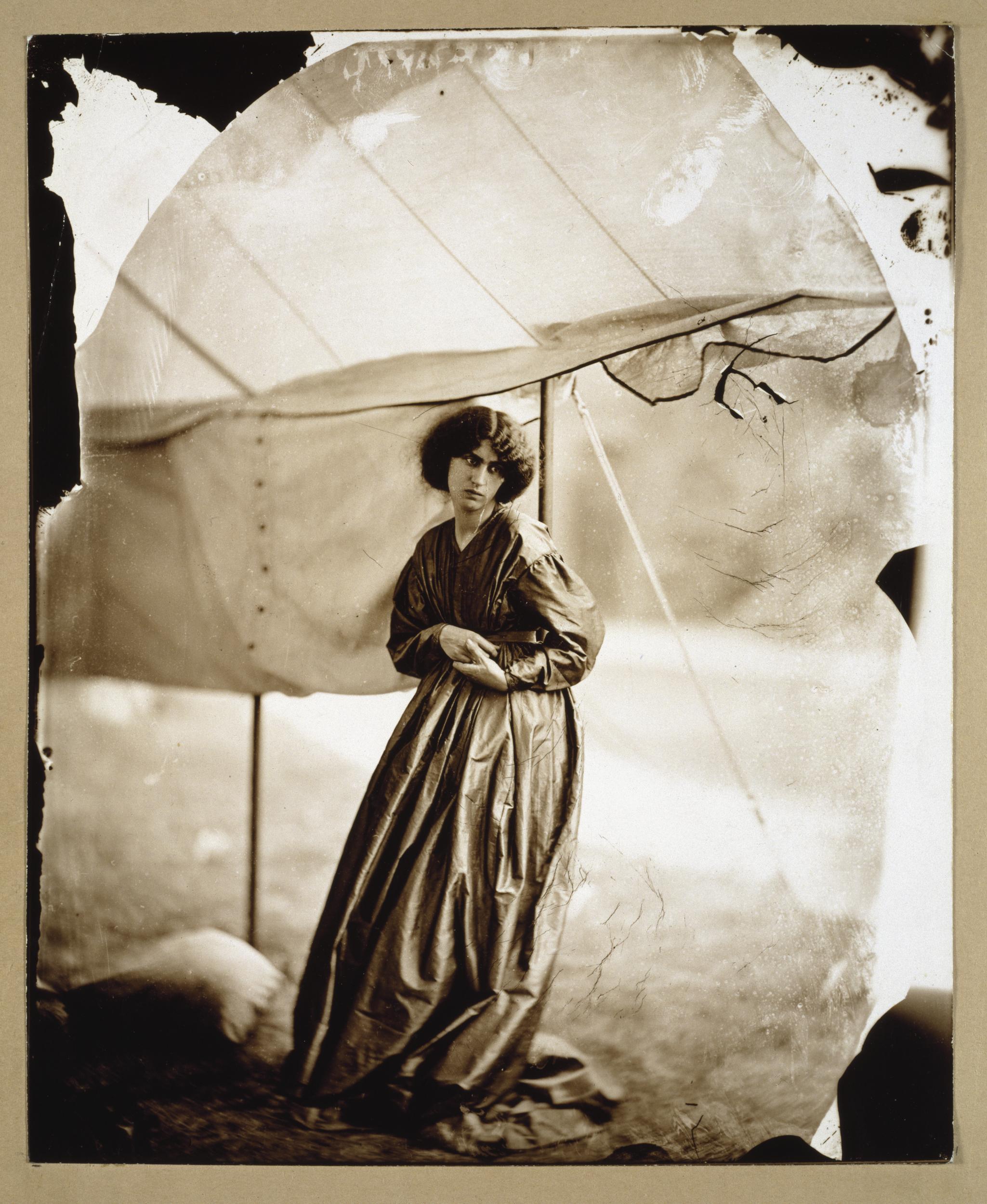
Jane Morris outdoors against the billowing canopy; this copy (two prints done around 1930, differing in exposition)

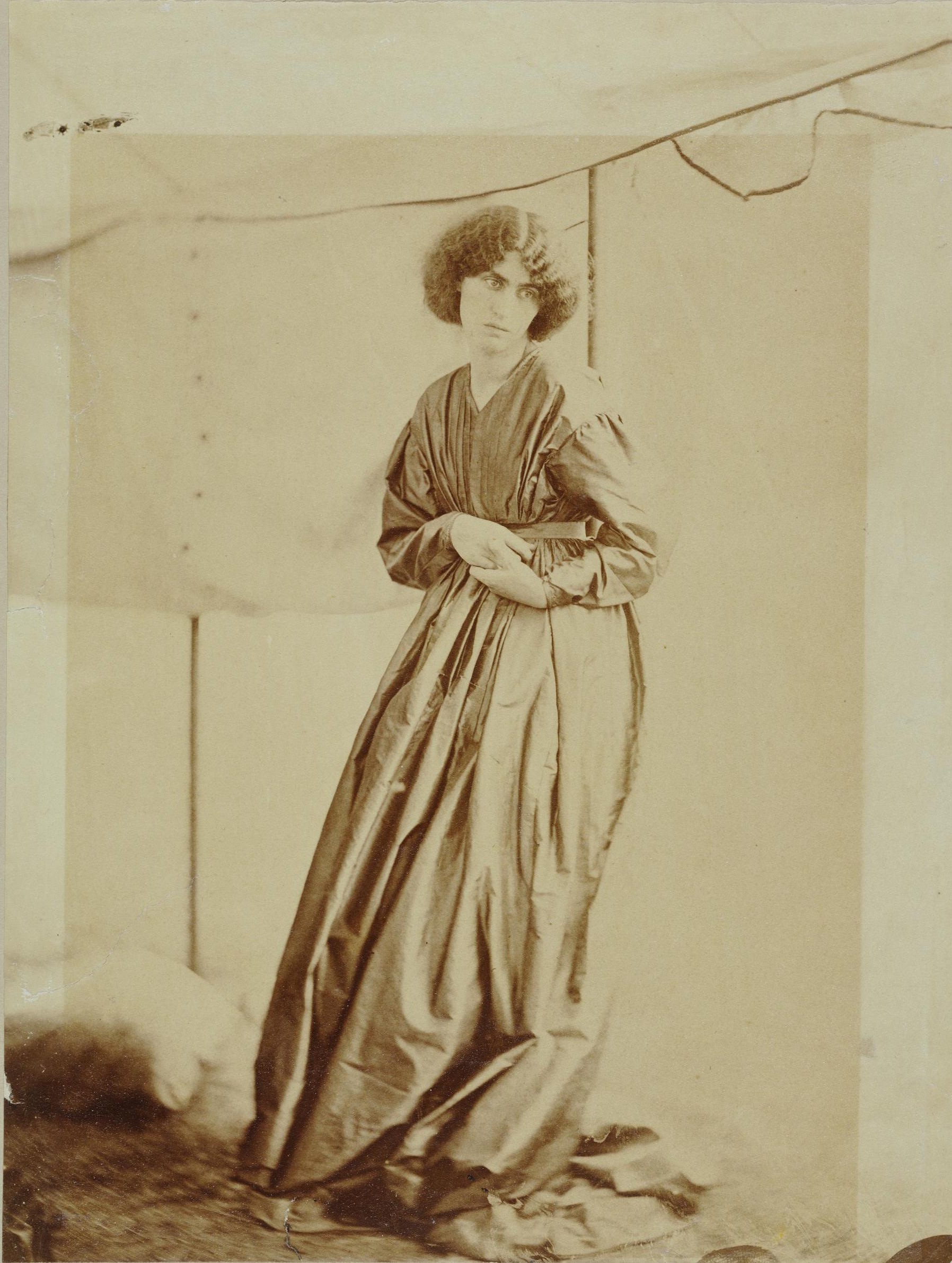
As with a number of photographs in the Jane Morris series, at least three copies of this pose survive, one print in the Birmingham City Museum and Art Gallery, this copy (two prints done around 1930, differing in exposition), and another also in the Victoria and Albert Museum’s Album of Portraits of Mrs. William Morris (Jane Burden). Posed by Rossetti, 1865 .

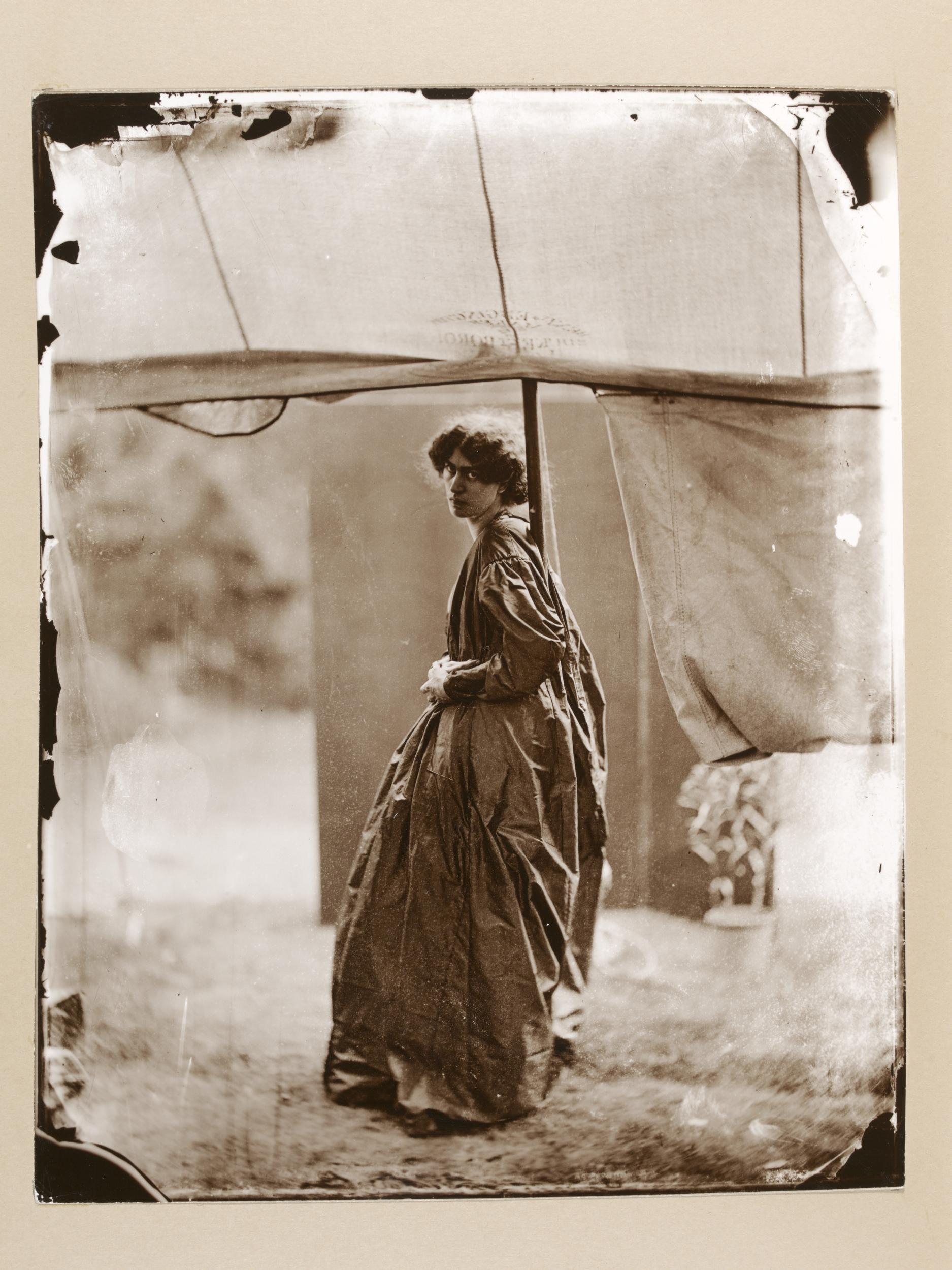
This picture is one of the most remarkable in the series, especially the two prints that are preserved in the Victoria and Albert album. Mrs. Morris is posed outdoors against the backdrop of a billowing canopy, with her hands clasped at her midriff. She is turned facing the camera, though she looks away to the right. The other V&A print [image # 3] is cropped down from the original negative, as is the Birmingham copy. The modern prints shows the composition of the original negative and is far the more dramatic and dynamic image, though the cropped version is also interesting and effective, not least because of certain ghostly internal “framing” effects (these appear on several other of the pictures in the series). The Birmingham print, which is a replica of the cropped version, does not display this framing effect.

This pose is very close in style to another pose also composed outdoors in the marquee [images # 4, 5, and 6].
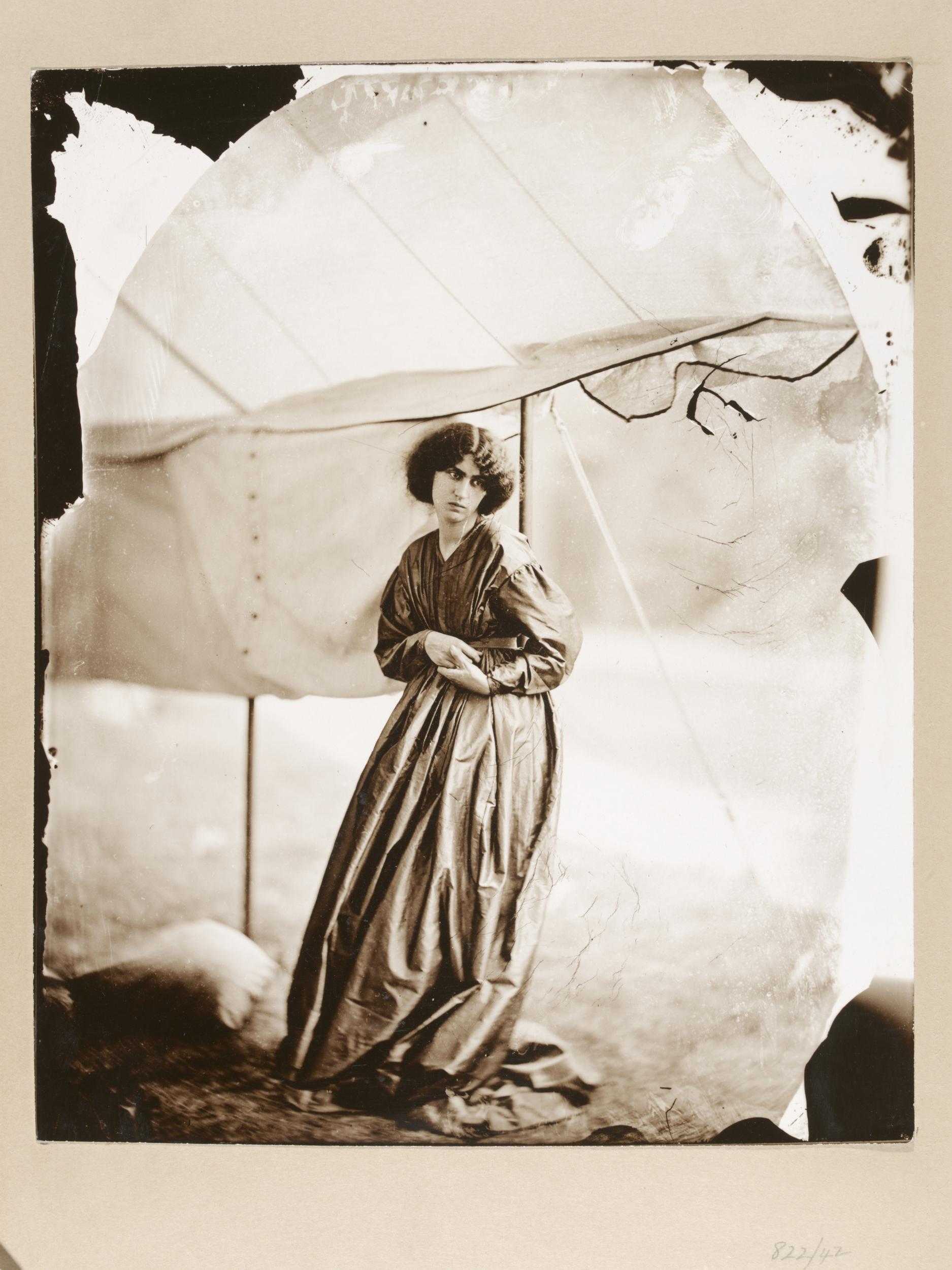
Jane Morris is posed outdoors against the backdrop of a billowing canopy, with her hands clasped. Modern print (1930s)
Jane Morris standing, in marquee. The older V&A print (1865)
Jane Morris outdoors under a marquee, her body turned to the left, her face turned towards the camera. Modern print (1930s)

This pose is closely related to the previous one in which Mrs. Morris is outdoors under a marquee and against a white backgroup, with her hands clasped at her midriff. In this pose her body is turned to the left but her face is turned directly at the camera. As in the related pose, this exists in two printed states, one that shows a billowing canopy, the other that is cropped close. The cropped print is much less dramatic. The uncropped picture is in fact a modern print made when Gordon Bottomly was putting together the album of photographs that house all of the Victoria and Albert prints.

The Victoria and Albert Museum has two other prints of this picture. The Museum records identify the cropped print as an original, the other as a modern copy. Of course all the copies of the uncropped version ultimately derive from an original 1865 negative, and in fact it is these copies that show the negative’s original compositional structure.

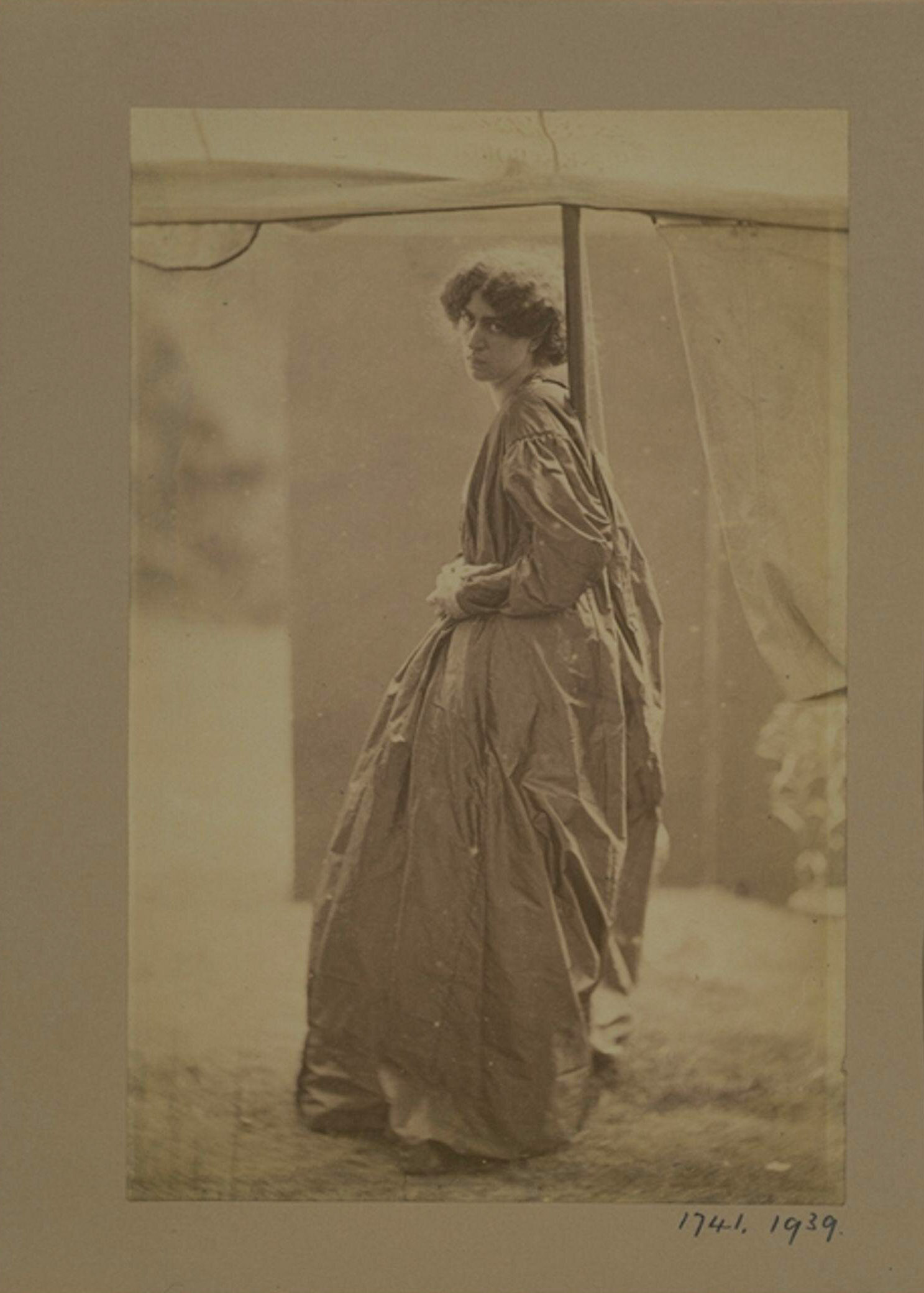
Jane Morris outdoors under a marquee, her body turned to the left, her face turned towards the camera. Cropped version
Jane Morris outdoors against a black backdrop in front of a white cloth

Mrs. Morris standing facing right, outdoors against a black backdrop in front of a white cloth. The image is particularly startling because it contains two ghostly framing areas around Mrs. Morris, as we see in several other prints from this picture series (notably Jane Morris standing, in marquee: two sets of thee images each, discussed previously). These effects were generated subsequent to the shoot. They are due to the deterioration of the wet collodion negatives during handling.

Mrs. Morris, wearing a cape, is standing at a table. The scene is indoors with a window as background. This is the second photograph mounted in the album of Jane Morris Photographs put together in 1933 by Gordon Bottomly.
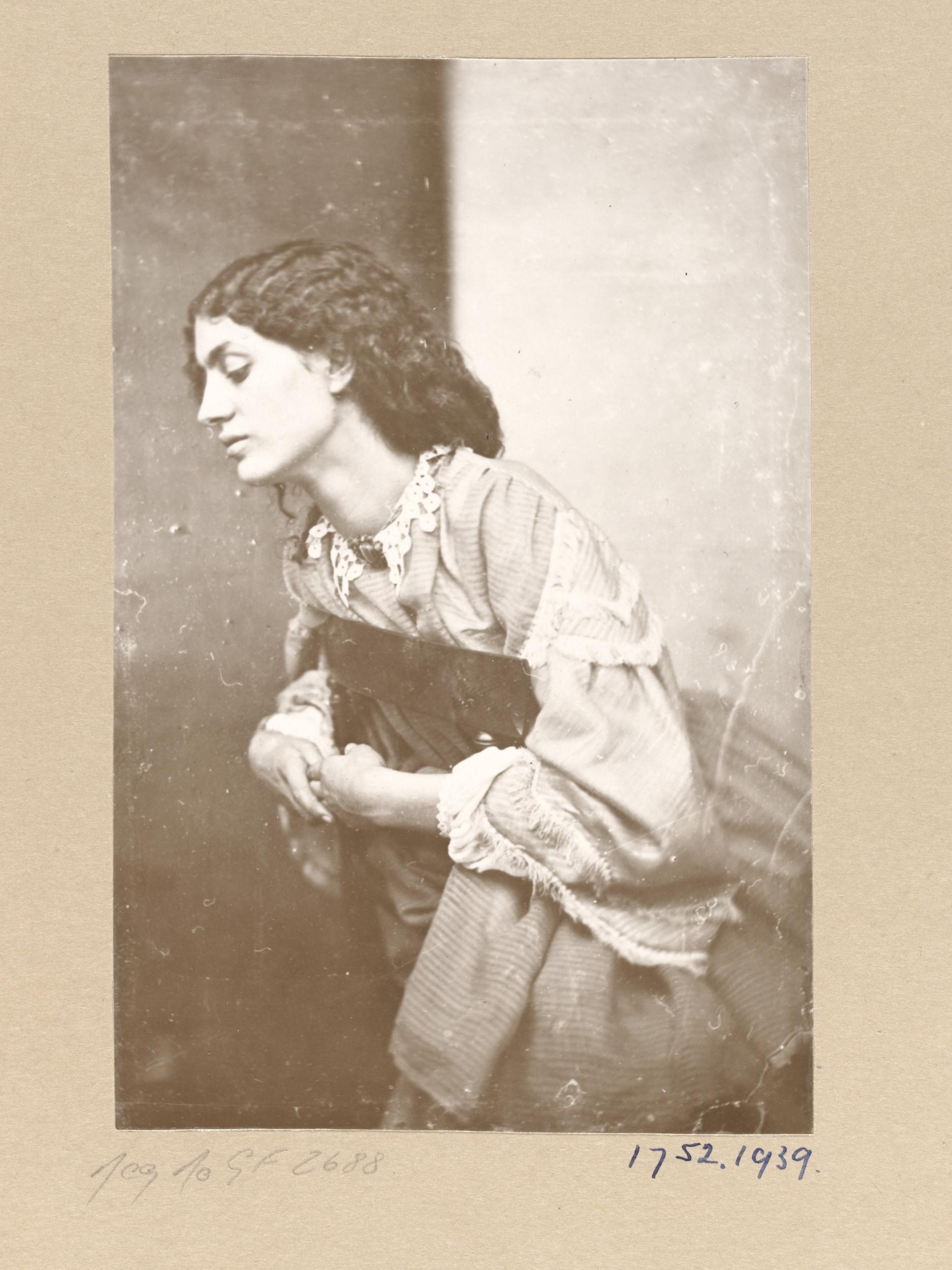
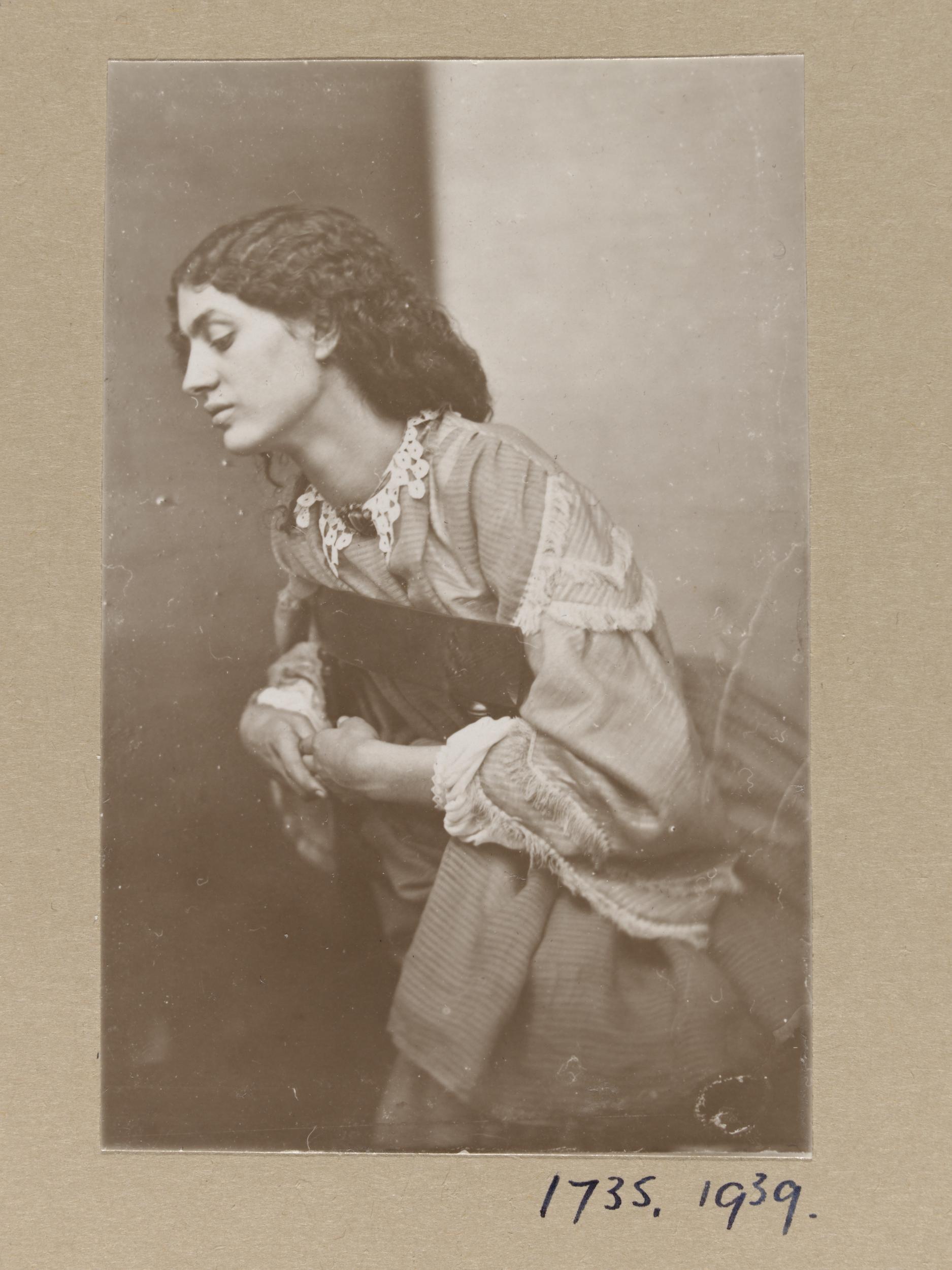
Mrs. Morris is seated, facing left. The scene is indoors. She is leaning forward over the back of a chair, with her arms clasping the chair. Her eyes are virtually closed.
This is the first print in the album of Jane Morris Photographs put together in 1933 by Gordon Bottomly.
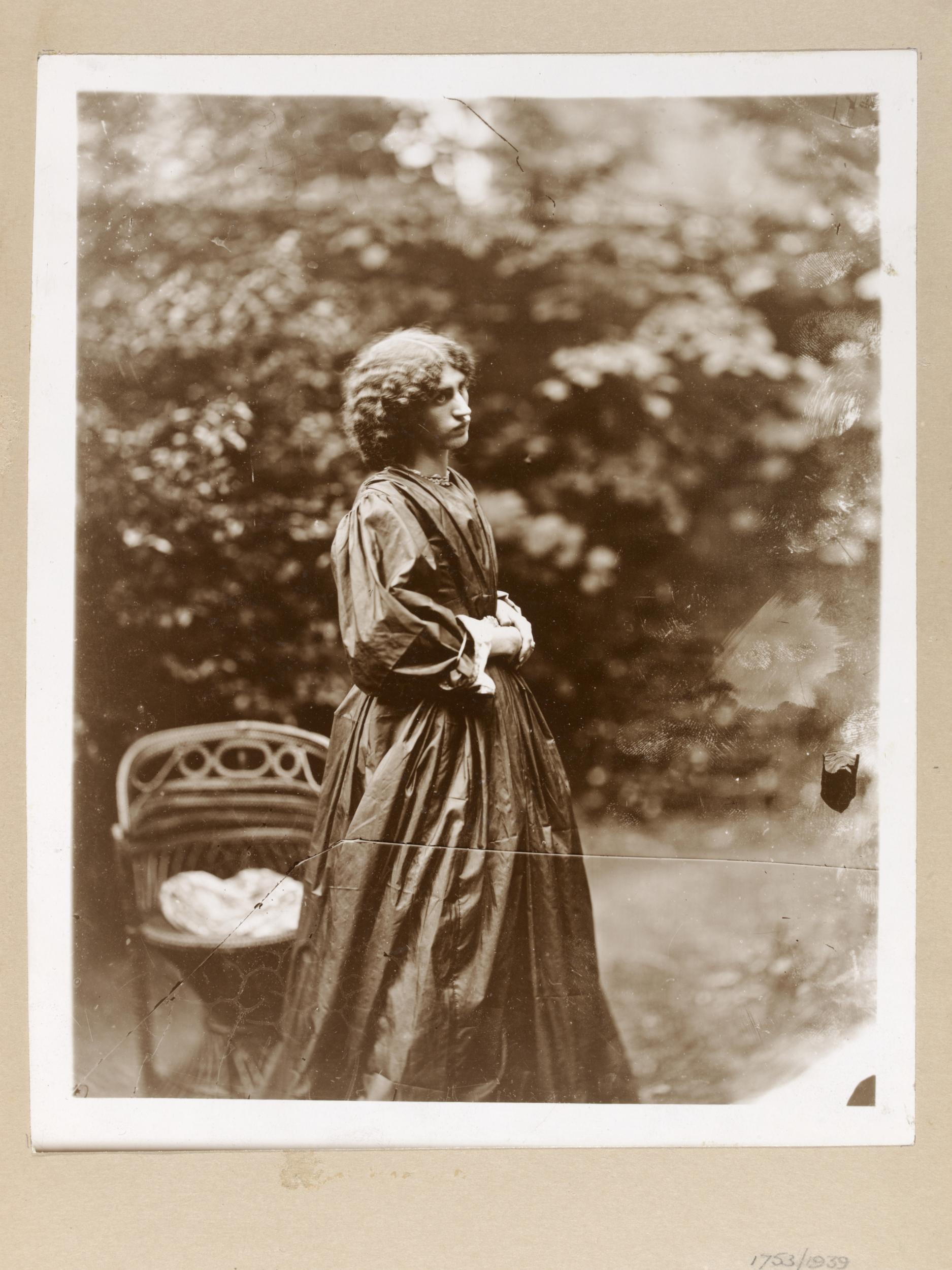
Jane Morris standing outdoors, her back to the camera, her head turned to the right. 1865 print

Mrs. Morris stands outdoors, her back to the camera, her head turned to the right over her shoulder showing her profile. On the wicker chair to her left a shawl is draped. The only background is the garden vegetation, which is out of focus. A copy, cropped and printed darker, is the print made in 1865 [image above].

Jane Morris standing beside wicker chair. This is a modern copy showing the whole of the original compositional structure (1930s print)
Jane Morris outdoors, standing in front of wicker chair

Mrs. Morris outdoors, standing in front of wicker chair and turned at an angle toward the camera. Her hands are at her midriff. The shot is a variation on Jane Morris standing beside wicker chair [the two images previously discussed]. In this picture the shawl lies on the chair seat and is not draped over the chair.

Jane Morris standing with spray of foliage. Print made in 1865

This is a print made in 1865. Mrs. Morris stands outdoors facing right with her head lowered. Her hands, at her midriff, hold a spray of foliage. The only background is the garden vegetation, which is out of focus. A second print [image below], less cropped and printed darker, is identified in museum records as a modern copy made from the 1865 original negative.
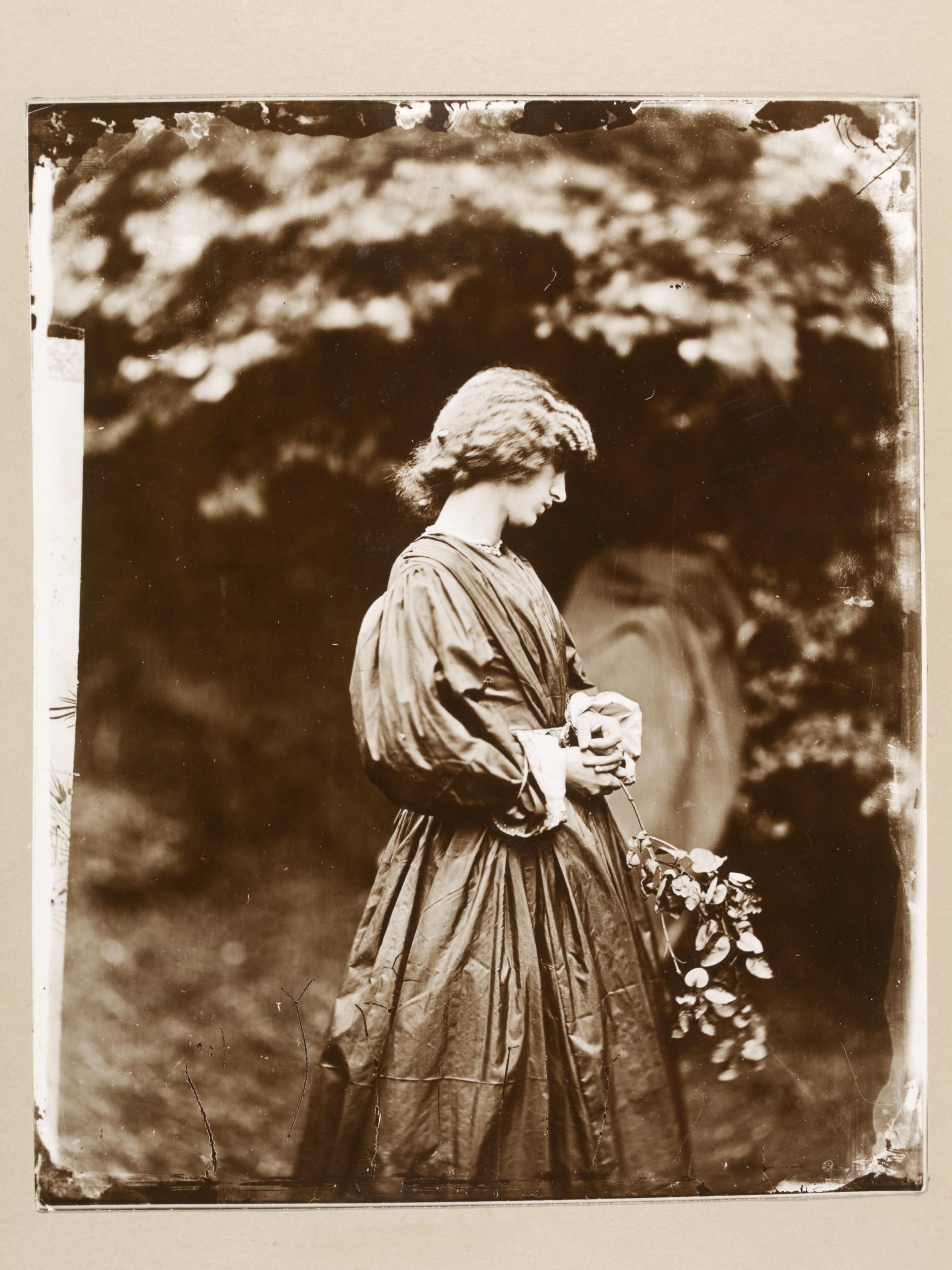
Jane Morris standing with spray of foliage. Modern print (ca. 1930)

All images are from the book : Album of Portraits of Mrs. William Morris (Jane Burden) Posed by Rossetti, 1865. Composed by Gordon Bottomly in 1933

source of images V&A Museum

source of text Rossetti Archive

Ellen Terry at 16 by Cameron

Julia Margaret Cameron :: Sadness, 1863-64 (Shakespearean Actress Dame Ellen Terry, Age 16) | Victoria & Albert Museum
Julia Margaret Cameron :: Sadness, 1863-64 (Shakespearean Actress Dame Ellen Terry, Age 16) Carbon print from copy negative | Victoria & Albert Museum. Royal Photographic Society. National Media Museum
Julia Margaret Cameron :: Sadness, 1863-64 (Shakespearean Actress Dame Ellen Terry, Age 16) | Victoria & Albert Museum
Julia Margaret Cameron :: Sadness, 1863-64 (Shakespearean Actress Dame Ellen Terry, Age 16) Carbon print. | Victoria & Albert Museum

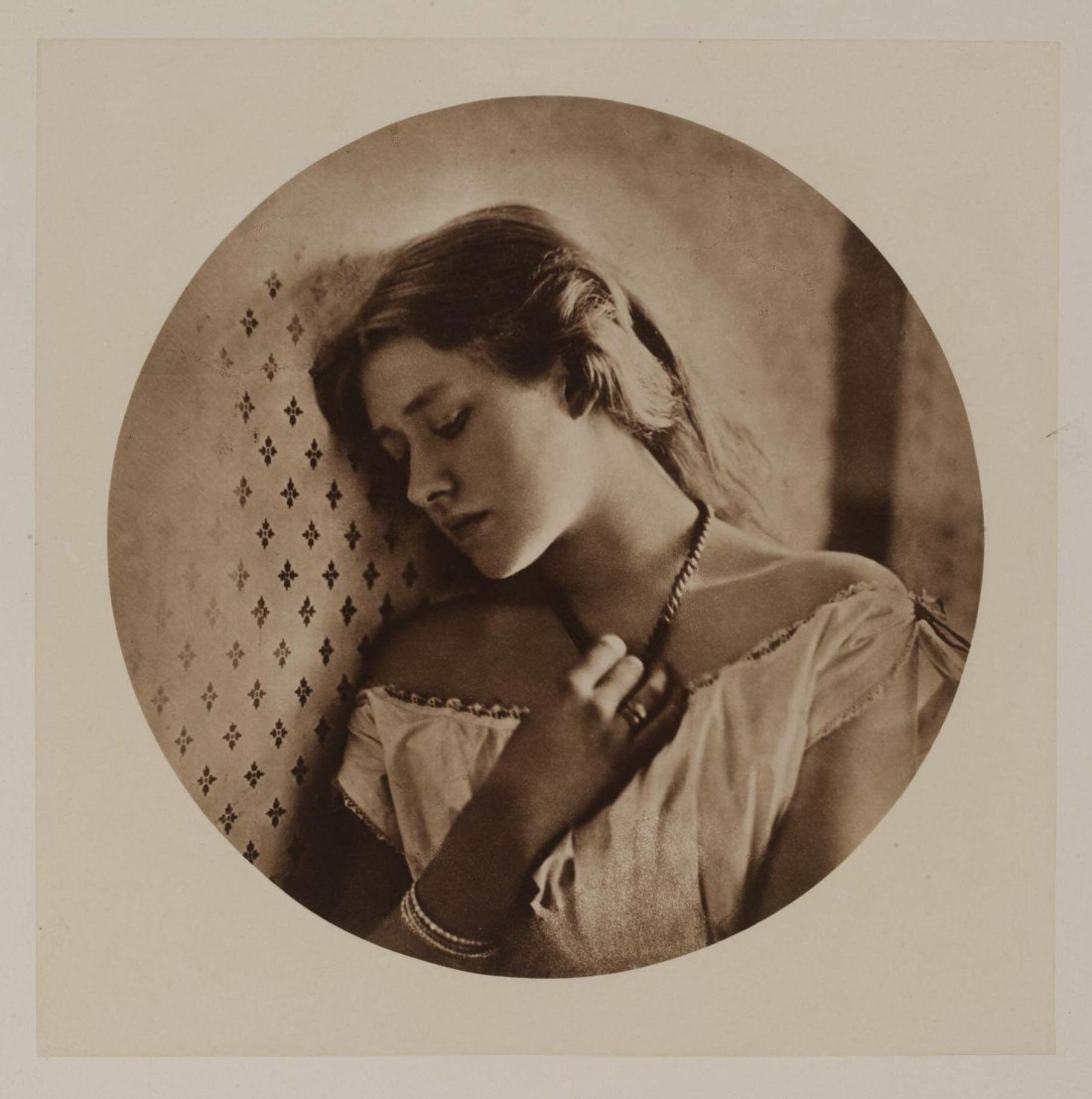
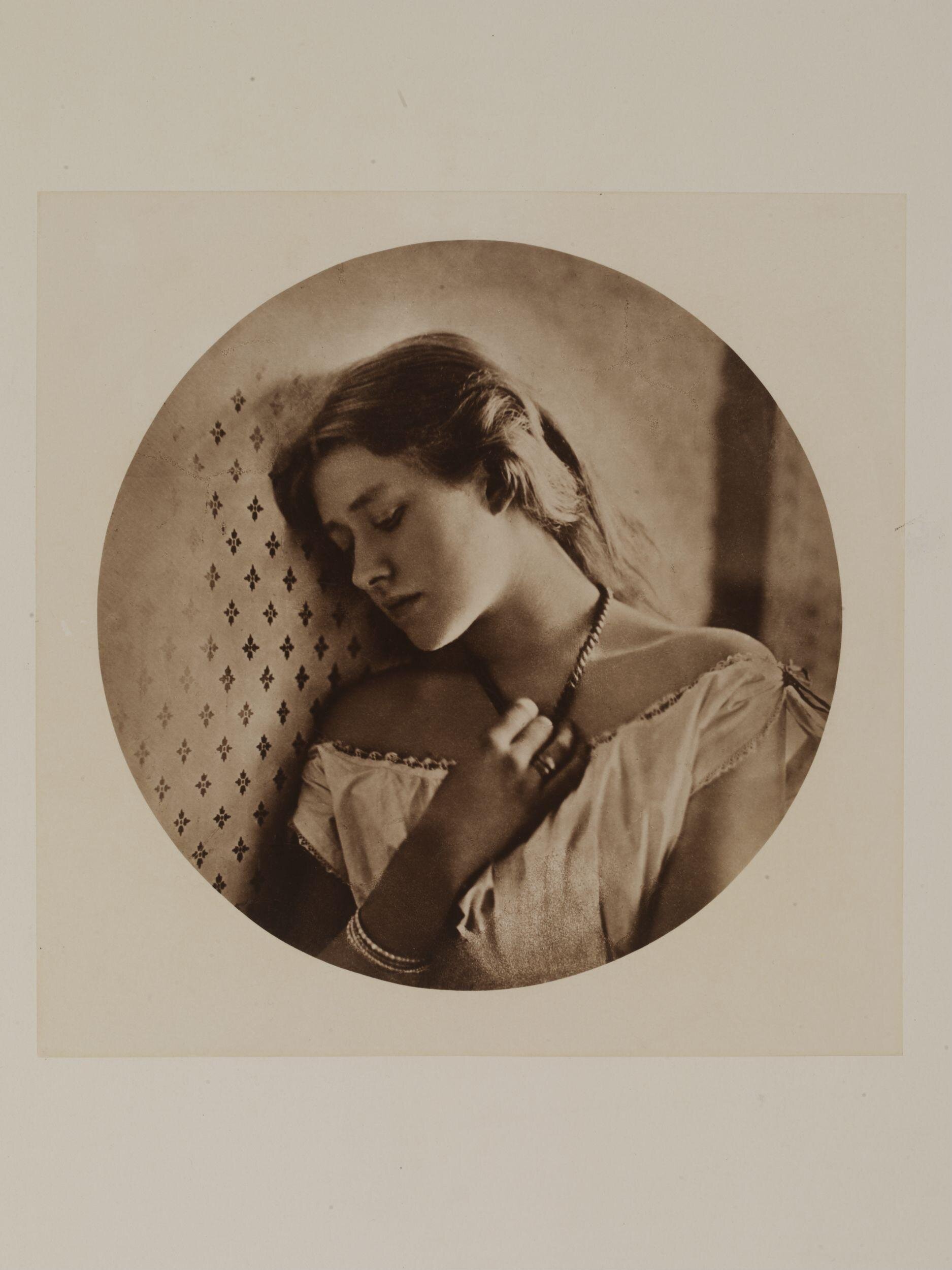
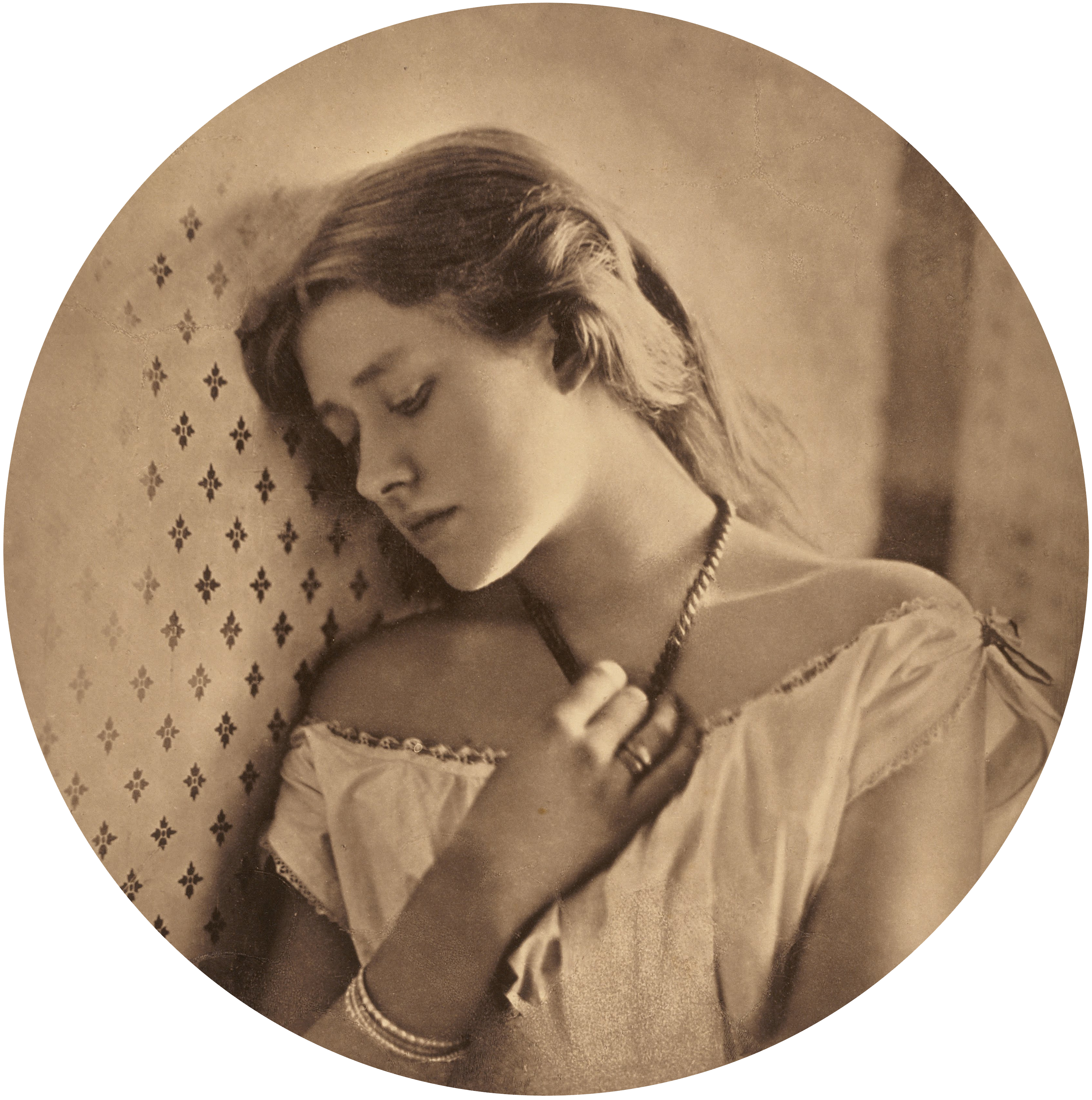
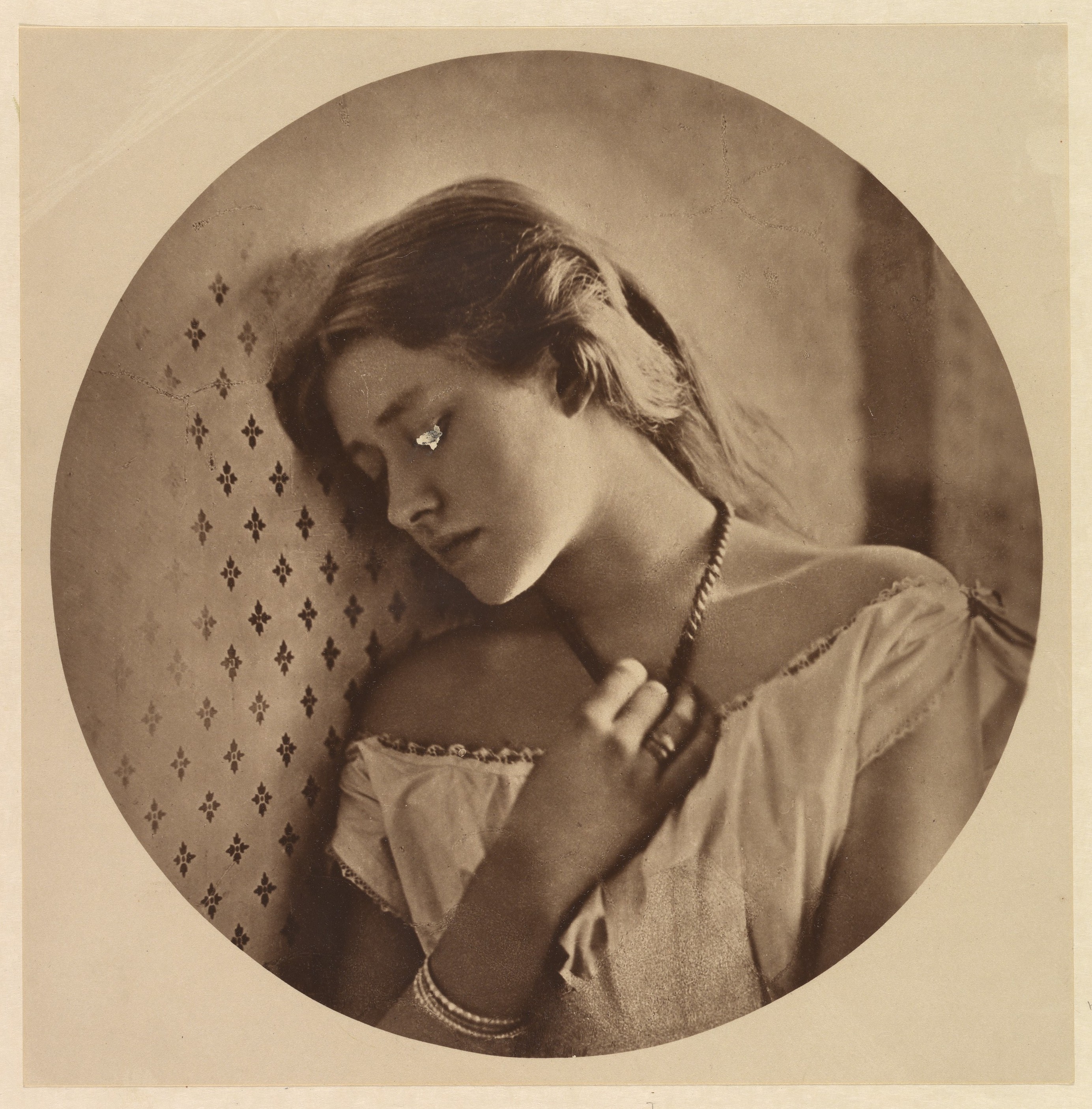
Circular-shaped photograph of a standing woman, shown in profile from the waist up. Her head is leaning against an interior patterned wall and one of her hands is placed at her throat tugging at her necklace.

Julia Margaret Cameron :: Sadness, 1863-64 (Shakespearean Actress Dame Ellen Terry, Age 16) | Victoria & Albert Museum
Julia Margaret Cameron :: Sadness, 1863-64 (Shakespearean Actress Dame Ellen Terry, Age 16) Carbon print [full size] | V&A Museum
Julia Margaret Cameron :: Ellen Terry at Age Sixteen, 1864. Carbon print. LL/6758
Julia Margaret Cameron :: Ellen Terry at Age Sixteen, 1864. Carbon print. | src Luminous Lint: LL/6758
Julia Margaret Cameron :: [Ellen Terry at Age Sixteen] negative 1864; print about 1875. Carbon print. | The J. Paul Getty Museum

This image of Ellen Terry (1847-1928) is one of the few known photographs of a female celebrity by Julia Margaret Cameron. Terry, the popular child actress of the British stage, was sixteen years old when Cameron made this image. This photograph was most likely taken just after she married the eccentric painter, George Frederick Watts (1817-1904), who was thirty years her senior. They spent their honeymoon in the village of Freshwater on the Isle of Wight where Cameron resided.

Terry came from a theatrical family and had her stage debut at age nine. In 1862 she was introduced to Watts, who painted a double portrait of her with her elder sister Kate. In a union engineered by Cameron and her own sisters, Terry and Watts were married on February 20, 1864, when she was just sixteen. Within a year the couple had separated; they were formally divorced in 1877.

The pair spent their honeymoon at Freshwater, and most likely it was at this time that the portrait was made. While the possibility exists that Terry, as an actress, was striking a pose for Cameron, the picture’s title suggests the realization of a mismatched marriage. Terry’s anxiety is plainly evident—she leans against an interior wall and tugs nervously at her necklace. The lighting is notably subdued, leaving her face shadowed in doubt. In The Story of My Life (1909), Terry recalls how demanding Watts was, calling upon her to sit for hours as a model and giving her strict orders not to speak in front of distinguished guests in his studio.

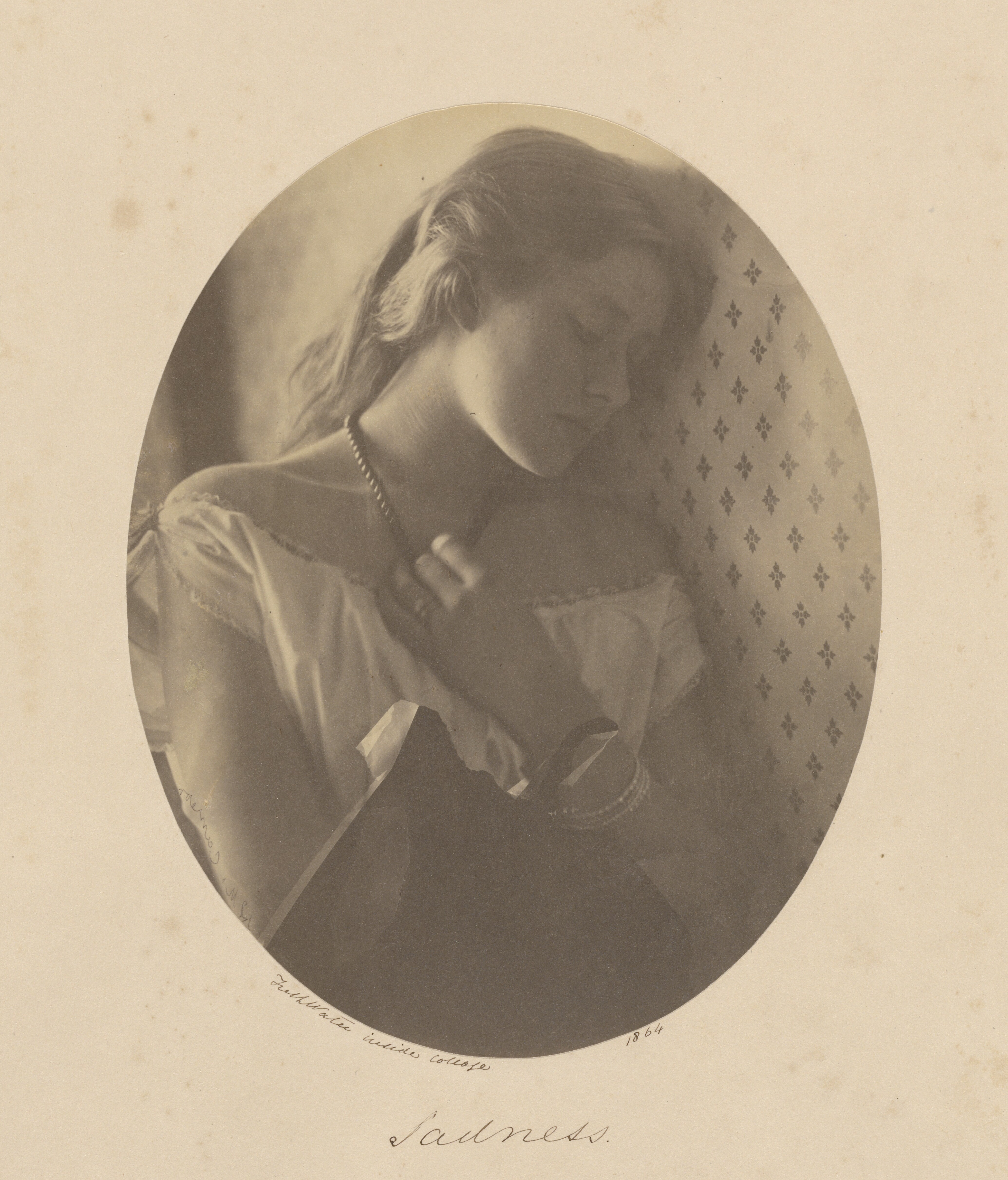
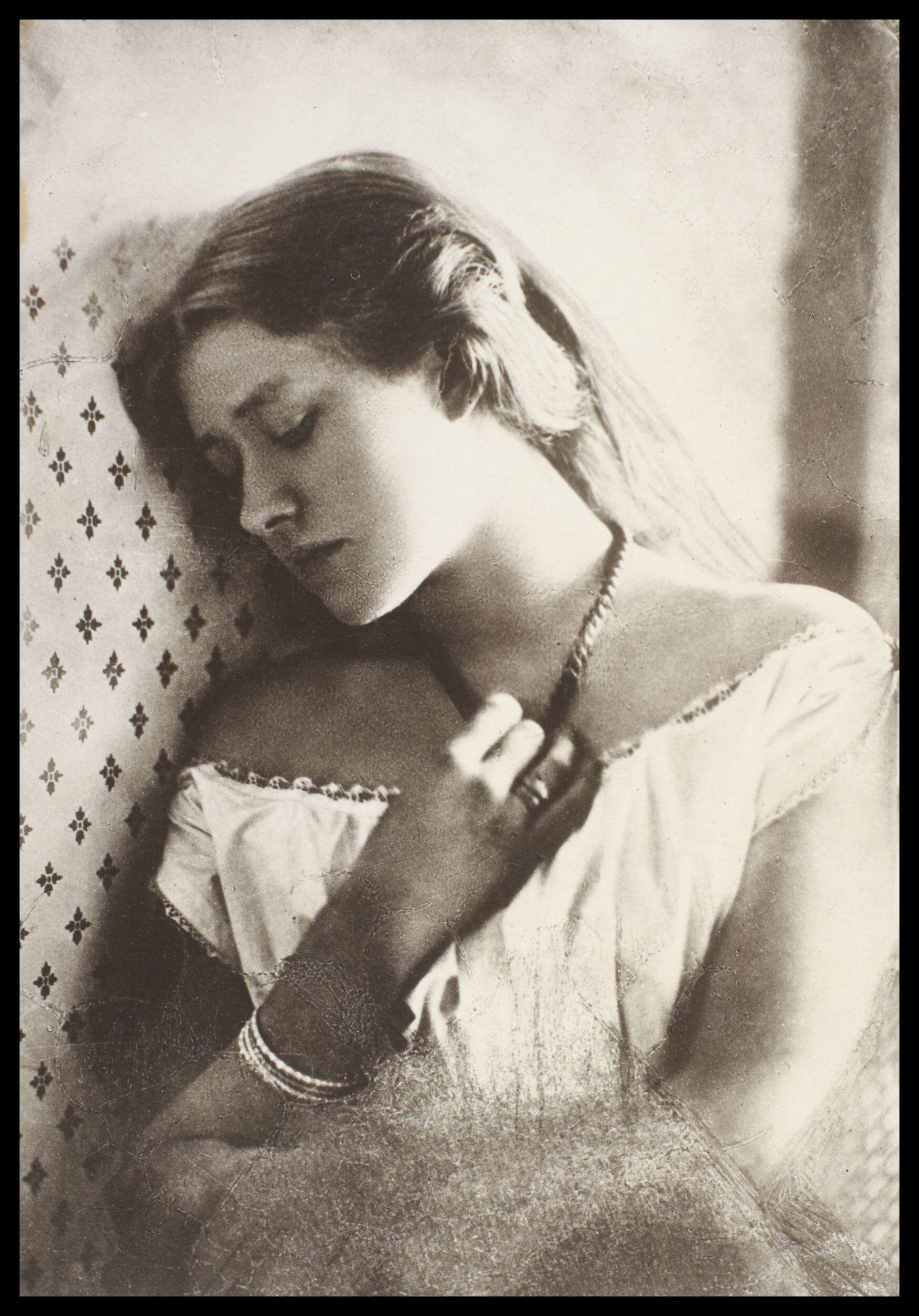
Cameron’s uncertain technique is evidenced by the image loss at the lower center of the picture, where the collodion emulsion peeled away from the glass-plate negative. She must have created only a single negative at this sitting, since she presented this particular print as is in the Overstone Album. The negative was later rephotographed (with the damage repaired) and distributed commercially as a carbon print by the Autotype Company of London (see image above). This later version was also reproduced in 1913 in Alfred Stieglitz’s Camerawork. (*)

Cameron’s portrait echoes Watt’s study of Terry titled Choosing (1864, National Portrait Gallery, London). As in the painting, Terry is shown in profile with her eyes closed, an ethereal beauty in a melancholic dream state. In this guise, Terry embodies the Pre-Raphaelite ideal of womanhood rather than appearing as the wild boisterous teenager she was known to be. The round (“tondo”) format of this photograph was popular among Pre-Raphaelite artists. (*)

Julia Margaret Cameron :: Sadness, a study of Shakespearean actress Ellen Terry (1847-1928), 1864. Inscribed recto mount in ink "FreshWater, inside cottage" and dated. Albumen silver print. | The J. Paul Getty Museum
Julia Margaret Cameron :: Sadness, a study of Shakespearean actress Ellen Terry (1847-1928), 1864. Inscribed recto mount in ink “FreshWater, inside cottage” and dated. Albumen silver print. | The J. Paul Getty Museum

Cameron titled another print of this image Sadness (see image above), which may suggest the realization of a mismatched marriage. Terry’s anxiety is plainly evident—she leans against an interior wall and tugs nervously at her necklace. The lighting is notably subdued, leaving her face shadowed in doubt. In The Story of My Life (1909), Terry recalls how demanding Watts was, calling upon her to sit for hours as a model and giving her strict orders not to speak in front of distinguished guests in his studio.

This particular version was printed eleven years after Cameron first made the portrait. In order to distribute this image commercially, the Autotype Company of London rephotographed the original negative after the damage had been repaired. The company then made new prints using the durable, non-fading carbon print process. Thus, this version is in reverse compared to Sadness. Terry’s enduring popularity is displayed by the numerous photographs taken of her over the years. (*)

Julia Margaret Cameron :: Ellen Terry, at the age of sixteen, 1864 (taken) 1913 (ca, print). Carbon print. The Metropolitan Museum of Art: Accession Number: 49.55.323
Julia Margaret Cameron :: Ellen Terry, at the age of sixteen, 1864 (taken) 1913 (ca, print). Carbon print. | The Metropolitan Museum of Art
Julia Margaret Cameron :: Actress Ellen Terry,   27th February 1864. |  Guy Little Theatrical Photographs  V&AM
Julia Margaret Cameron :: Actress Ellen Terry, 27th February 1864. | Guy Little Theatrical Photographs V&AM

(*) quotations are from The J. Paul Getty Museum, links can be followed from the captions of image 5 and 6 of this post

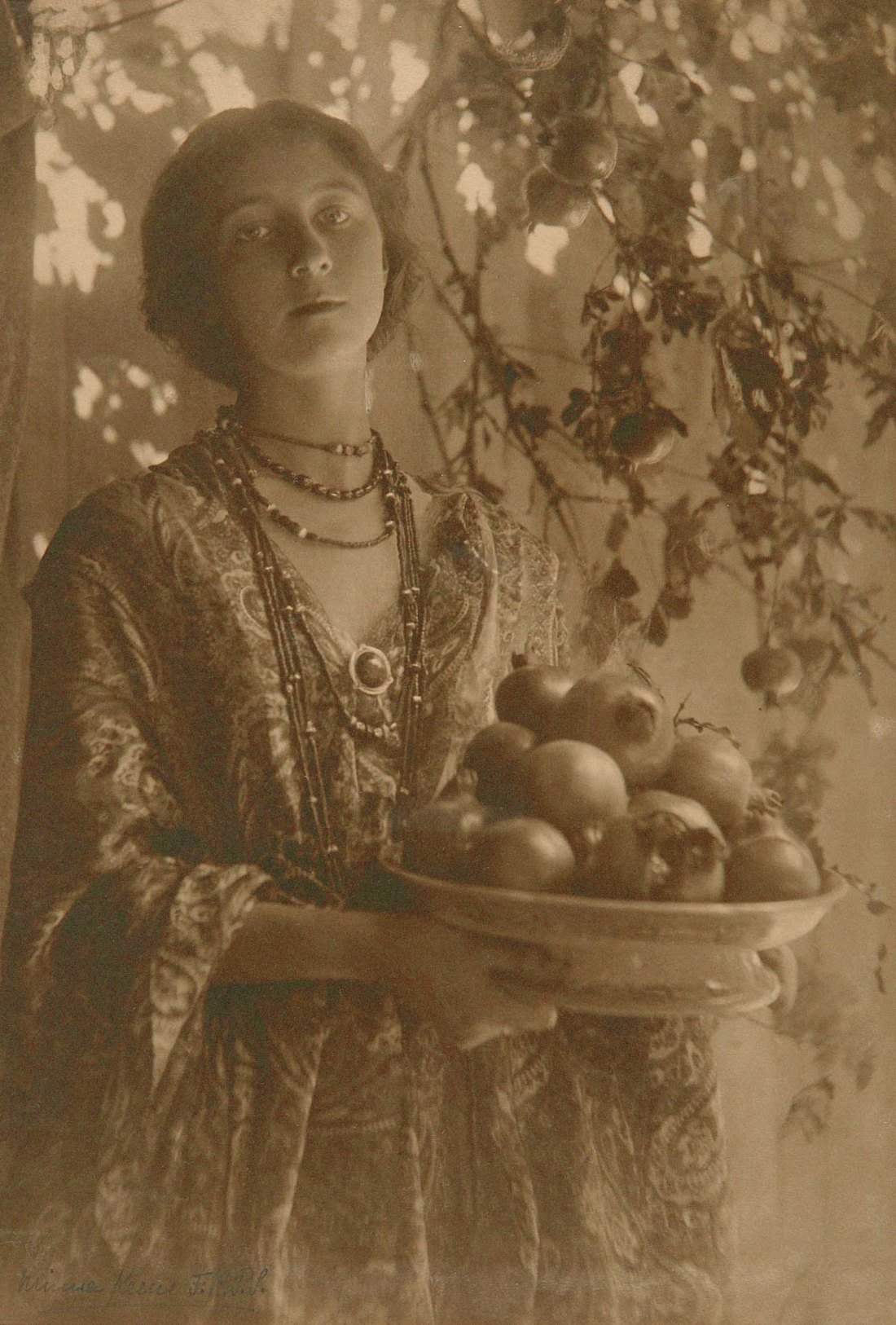
Decorative Study: Pomegranates

Minna Keene (née Bergmann, Canadian born Germany, 1861-1943) :: Pomegranates, ca. 1910. Carbon print with some details reduced by hand. | src Stephen Bulger Gallery
Minna Keene (née Bergmann, Canadian born Germany, 1861-1943) :: Pomegranates (aka Decorative Study), ca. 1910. Green carbon print by Minna Keene. | src The Royal Photographic Society Collection, Victoria and Albert Museum, London via Getty Images

The subject of this photograph is believed to be of Violet Keene, Minna Keene’s daughter, according to Getty Images.

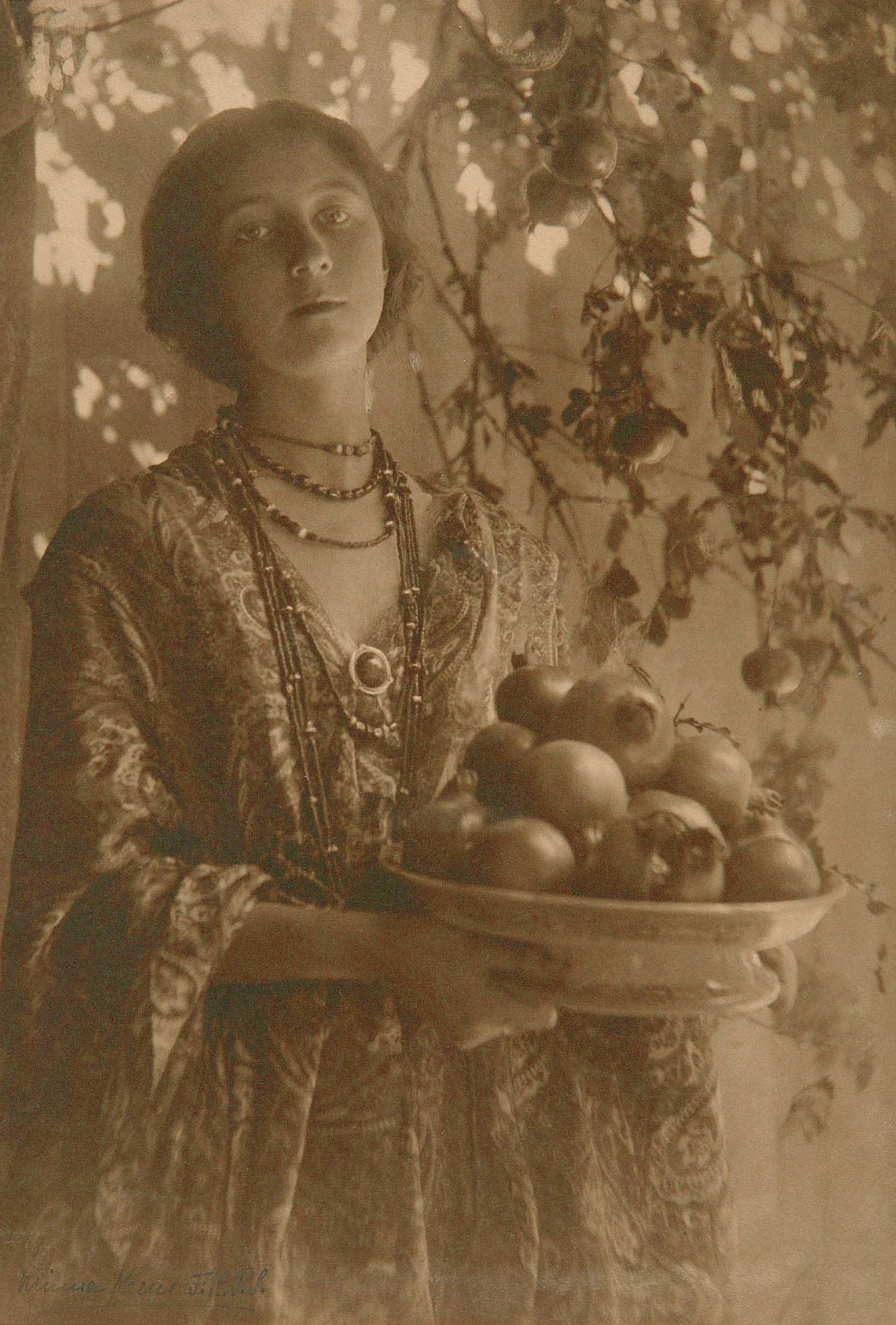
Minna Keene (née Bergmann, Canadian born Germany, 1861-1943) :: Decorative Study nº 1. Pomegranates, Cape Town, South Africa, ca. 1906. Carbon print, mounted on exhibition board. Original photograph. | src Bonhams

A fine example of a signed exhibition-quality image of one of Minna Keene’s most famous of images, taken at her home in Cape Town. Using her young daughter Violet as the model, she created an iconic Pre-Raphaelite image, combining the beauty of a young girl with nature. This image was included in the famous Tate London Exhibition in 2016, Painting with Light alongside Julia Margaret Cameron, Millais, Emerson, Goodall, Hacker, Rossetti, and others. In 1911, “Pomegranates” was awarded Picture of the Year at the London Photographic Salon. [quoted from source]

Minna Keene (née Bergmann, Canadian born Germany, 1861-1943) :: Decorative Study nº 1. Pomegranates, Cape Town, South Africa, ca. 1906. Carbon print, mounted on exhibition board. Original photograph. | src Bonhams