Photogenic drawing, 1830s

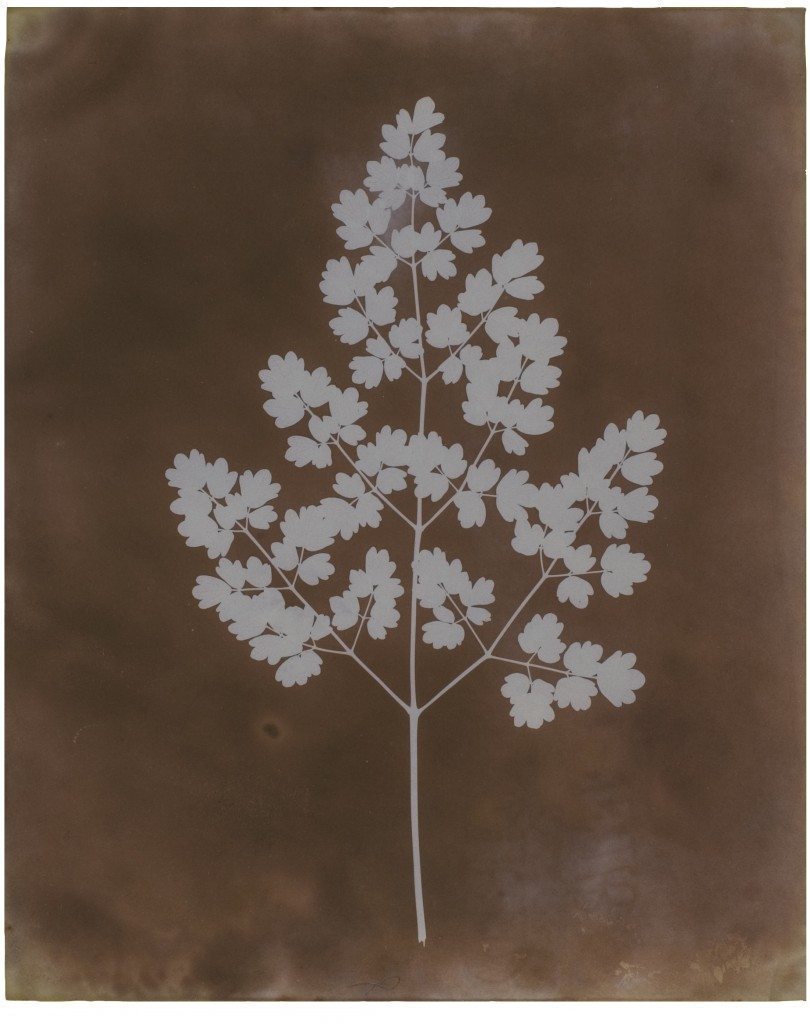
William Henry Fox Talbot :: Adiantum Capillus-Veneris (Maidenhair Fern), probably early 1839. Photogenic drawing negative. Courtesy of Hans P. Kraus Jr., New York. | src diptyqueparis
William Henry Fox Talbot :: Adiantum Capillus-Veneris (Maidenhair Fern), probably early 1839. Photogenic drawing (salted paper negative). Courtesy of Hans P. Kraus Jr., New York. | src diptyqueparis

This image of a fern was an experiment by Englishman William Henry Fox Talbot. It probably dates back to 1839, the year in which he publically announced his invention of paper photography. But back then, this did not mean taking a snap using a camera in the sense that we understand it today. This was a photogram. Talbot took a small object with delicate contours like a piece of lace or a plant specimen and exposed it to light on a sheet of paper that had been bathed in a solution of salt and silver nitrate. When the object was removed after having been exposed to sunlight (a trial and error process to determine how long it should be exposed to best effect), a clear silhouette would emerge from the darkened background of the paper.

Talbot is the English inventor of photography, just as Niépce and Daguerre were the French inventors of the same. While Daguerre was working alongside Niépce and fine-tuning the daguerreotype process, Talbot, who didn’t have a clue about their research, was experimenting with photography on paper himself in his property at Lacock Abbey in Wiltshire. His early interest in botany, maths, travel and a meeting with the great scientist John Herschel in 1824 fuelled his passion for the physical and chemical sciences. His light bulb moment came in 1833 when on honeymoon at Lake Como. His idea was to chemically fix the images produced by the camera obscura used by artists at the time to create sketches from nature. He succeeded around mid 1830. It was the first time that an image had been created without human intervention, hence the word photogenic drawings followed by the expression photography, a word created from two Greek words meaning «written with light».

The story goes that these delicate little silhouettes that look like herbarium plants or sketches by naturalists became the first manifestations of the invention – and great revolution – of photography. [quoted from src]

Karl Blossfeldt ::

Acer rufinerve, 1910′s-1920′s / src: Michael Hoppen Gallery

“What made Blossfeldt’s work unique was his extreme technical mastery of photography. He specialised in macrophotography to enlarge his plant specimens and even designed a camera for this purpose. As a result, everyday garden flowers are presented in such a way that their rhythmic forms are emphasised to the extreme and the plants take on new and exotic characteristics. Blossfeldt wanted his work to act as a teaching aid and inspiration for architects, sculptors and artists. It was his firm belief that only through the close study of the intrinsic beauty present in natural forms, that contemporary art would find its true direction.”

more [+] by this photographer

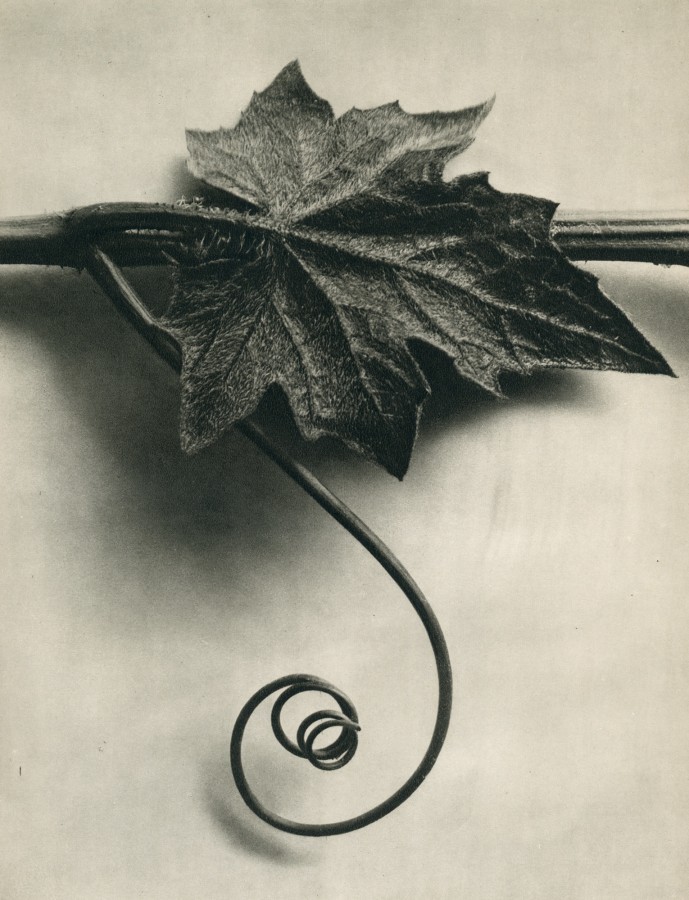
Karl Blossfeldt :: Bryonia alba (White bryony, with leaf) B, 1920′s. Pinakothek der Moderne, München / src: Michael Hoppen Gallery

“From 1898-1932, Blossfeldt taught sculpture based on natural plant forms at the Royal School of the Museum of Decorative Arts (now the Hochschule für Bildende Künste) in Berlin. In his lifetime Blossfeldt’s work gained praise and support from critics such as Walter Benjamin, artists of the Neue Sachlichkeit (New Realism) and the Paris Surrealists. The words of Walter Benjamin repositioned the artist in modern art and photography and prior to publishing his photographic book in 1926, Blossfeldt was sent an invitation to exhibit his work at the Karl Nierendorf’s gallery.” 

more [+] by this photographer

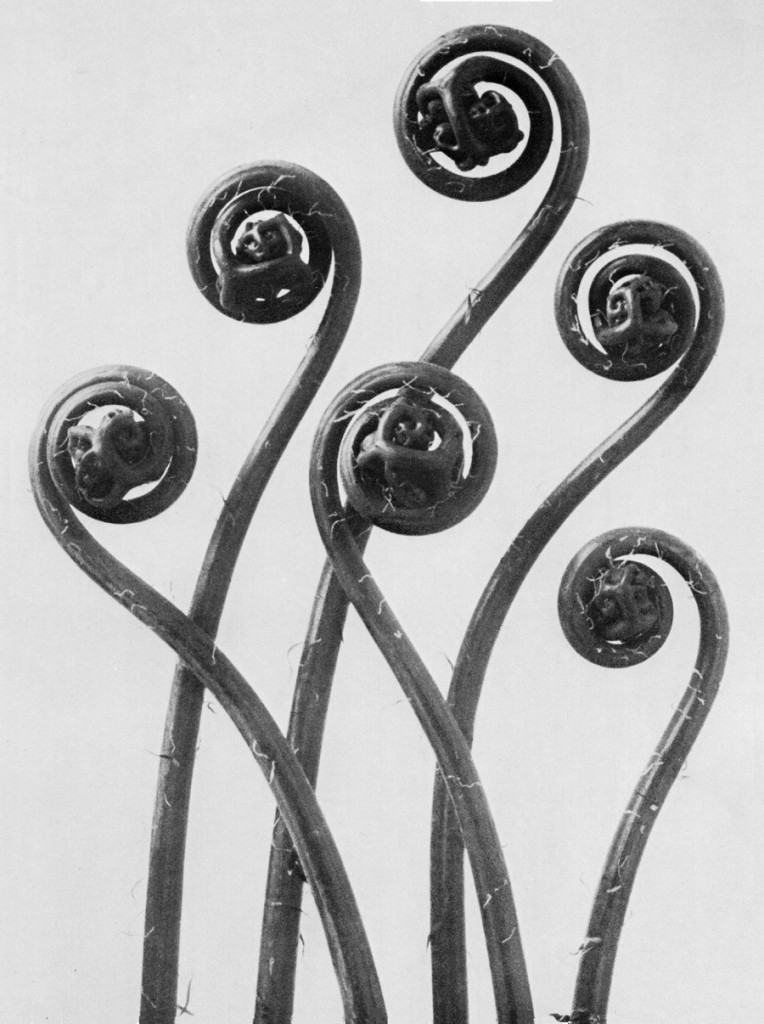
Karl Blossfeldt :: Adiantum pedatum

(Maiden hair fern), 1928.

/ src: memento

“Working
at the Hochschule für die Bildenden Künste (Berlin School for Decorative Arts),
he undertook a long-term project – collecting, classifying and drawing plants
in order to produce a unique portfolio of vegetation. In Berlin, Rome, Greece
and Africa, he puts together a photographic inventory of reality and flora.
[…] But Blossfeldt sees the form of a plant and its growth as an integral
universal part and pattern that can be applied to not only understanding human
beings but to architecture and industrial arts. A thistle brings to mind the
tympanum of a Gothic church, the stalk of a horsetail – an ancient column, the
coiled ends of ferns – a bishop’s crosier.” 

more [+] by this photographer