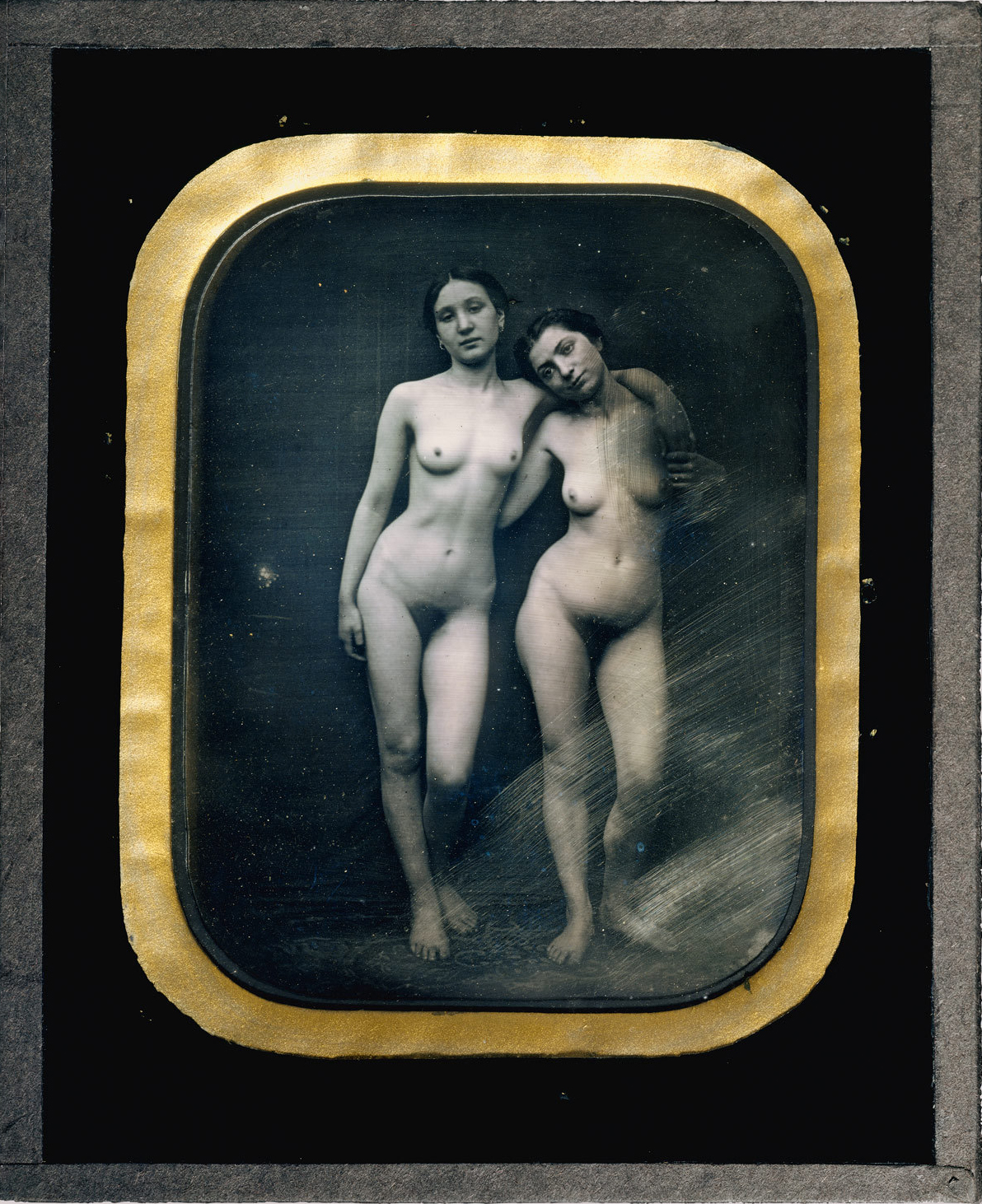
Félix-Jacques-Antoine Moulin ~ Two Standing Female Nudes, ca. 1850. Daguerreotype. | src The Rubel Collection (at The Met)
Although Moulin was sentenced in 1851 to a month in jail for producing images that, according to court papers, were “so obscene that even to pronounce the titles . . . would be to commit an indecency,” this daguerreotype seems more allied to art than to erotica. Instead of the boudoir props and provocative poses typical of hand-colored pornographic daguerreotypes, Moulin depicted these two young women utterly at ease, as unselfconscious in their nudity as Botticelli’s Venus. [quoted from The Met]
Félix-Jacques Moulin ~ Two Standing Female Nudes, ca. 1850. Daguerreotype
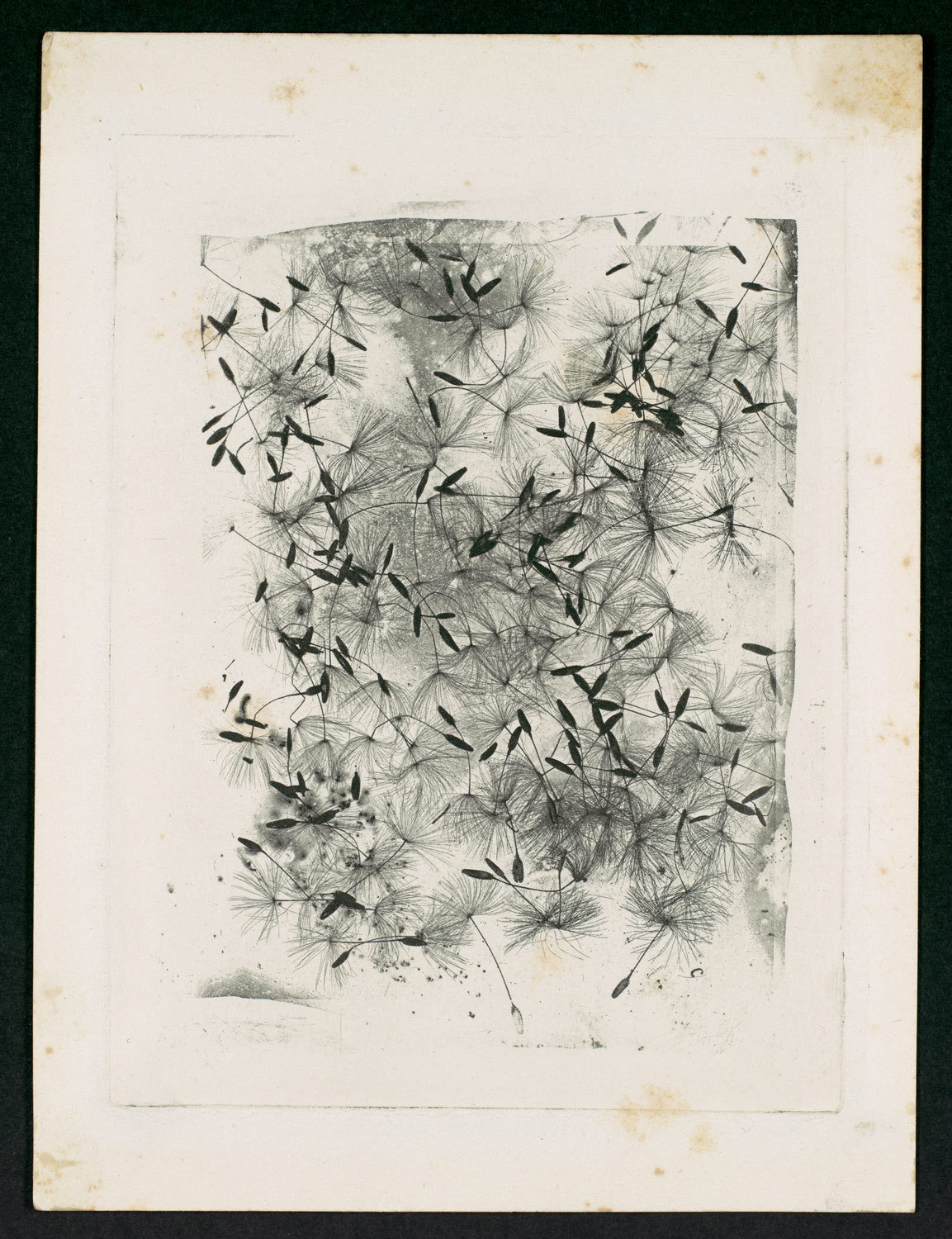
William Henry Fox Talbot :: Dandelion Seeds, 1858 or later. Photogravure (photoglyphic engraving from a copper plate). | source The Metropolitan Museum of Art
This experimental proof is a fine example of the capacity of Talbot’s “photoglyphic engraving” to produce photographic results that could be printed on a press, using printer’s ink-a more permanent process than photographs made with light and chemicals. Like Talbot’s earliest photographic examples, the image here was photographically transferred to the copper engraving plate by laying the seeds directly on the photosensitized plate and exposing it to light, without the aid of a camera. Equally reminiscent of Talbot’s early experiments, this image is part of Talbot’s lifelong effort to apply his various photographic inventions to the field of botany. In a letter tipped into the Bertoloni Album, Talbot wrote, “Je crois que ce nouvel art de mon invention sera d’un grand secours aux Botanistes” (“I think that my newly invented art will be a great help to botanists”). Such uses were still prominent in Talbot’s thinking years later when developing his photogravure process; he noted in 1863 that “if this art [of photoglyphic engraving] had been invented a hundred years ago, it would have been very useful during the infancy of botany.” Had early botanists been able to print fifty copies of each engraving, he continued, and had they sent them to distant colleagues, “it would have greatly aided modern botanists in determining the plants intended by those authors, whose descriptions are frequently so incorrect that they are like so many enigmas, and have proved a hindrance and not an advantage to science.” [quoted from The Met]
Related
Choiselat and Ratel [
Marie-Charles-Isidore Choiselat and
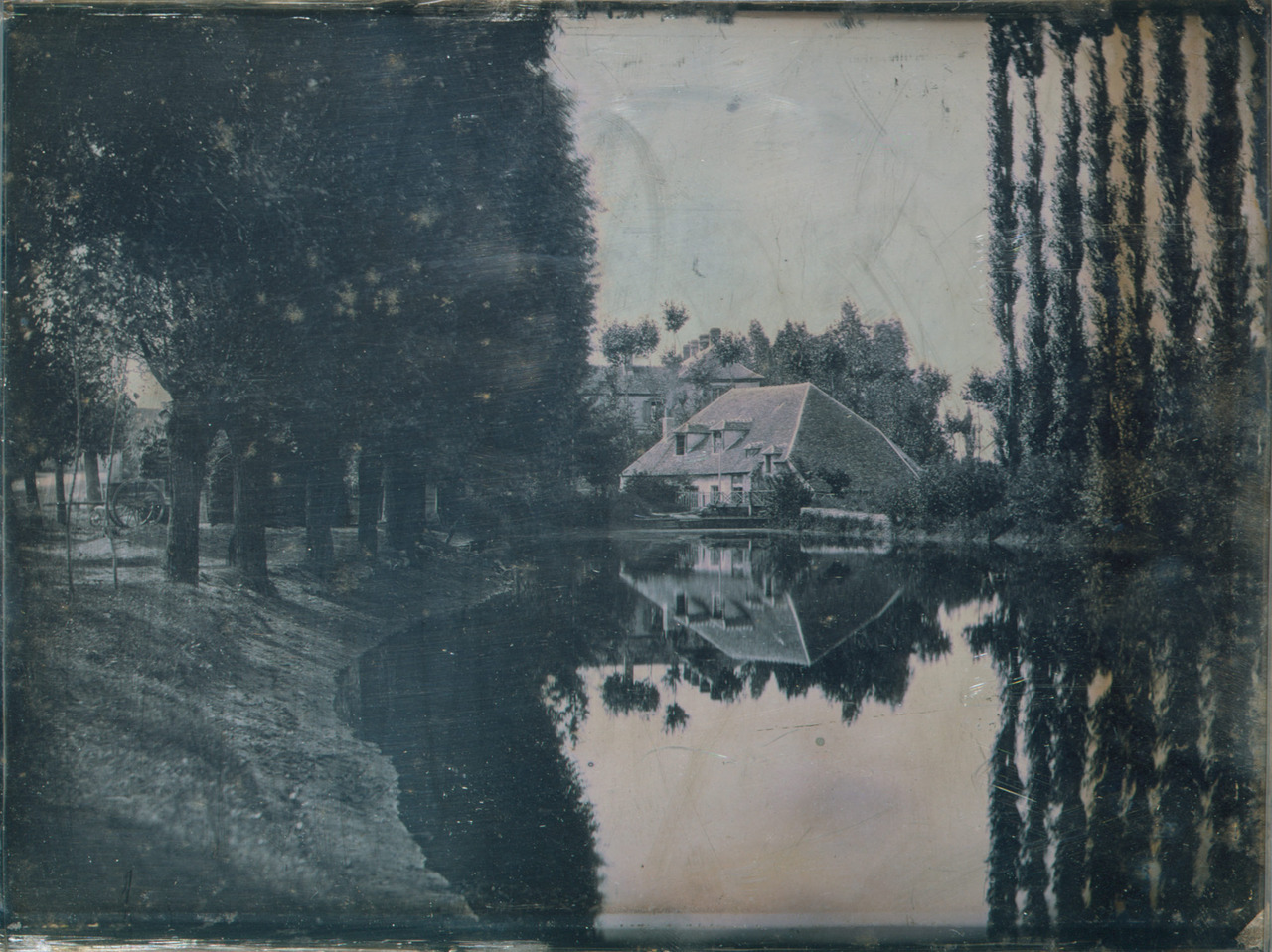
Stanislas Ratel] :: Landscape with Cottage, 1844.
Daguerreotype. / src: The Met
Choiselat and Ratel emphasized the two-dimensional organization of the
picture’s surface. The poplars, reflected in the water, seem to stretch
across the plate from top to bottom instead of sitting on the far side
of the pond; the cottage forms, with its reflection, a single geometric solid
floating in space. (Quoted from source)


 un regard oblique