Doe and fawns by Shiras

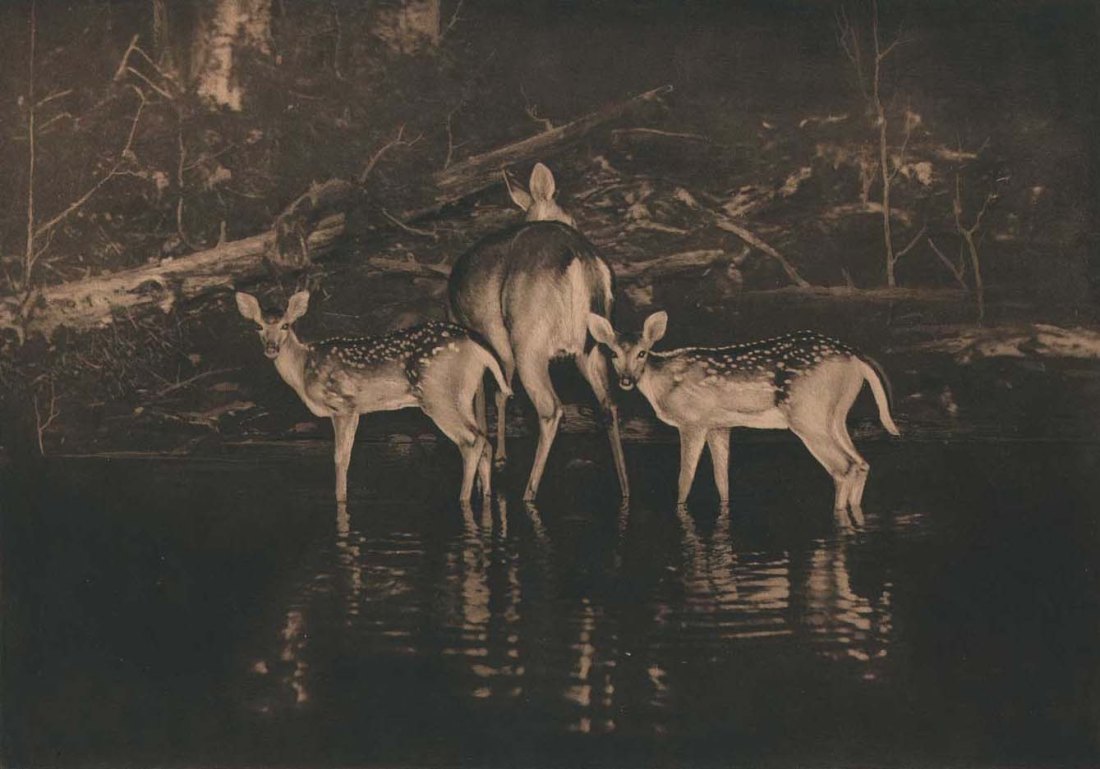
George Shiras, 3rd :: “A Doe and Twin Fawns” aka “Innocents Abroad” (taken 1896), printed 1916. Vintage photogravure published by the National Geographic Society, Washington, D.C. | src PhotoSeed

This groundbreaking photograph depicting three deer was taken at night in 1896 on one of the many lakes making up Michigan’s Upper Peninsula. It was eventually issued in 1916 as a large-format hand-pulled photogravure by the National Geographic Society, Washington, D.C. (it had previously appeared several times in the journal as a halftone-one a full-page gatefold). [quoted from PhotoSeed]

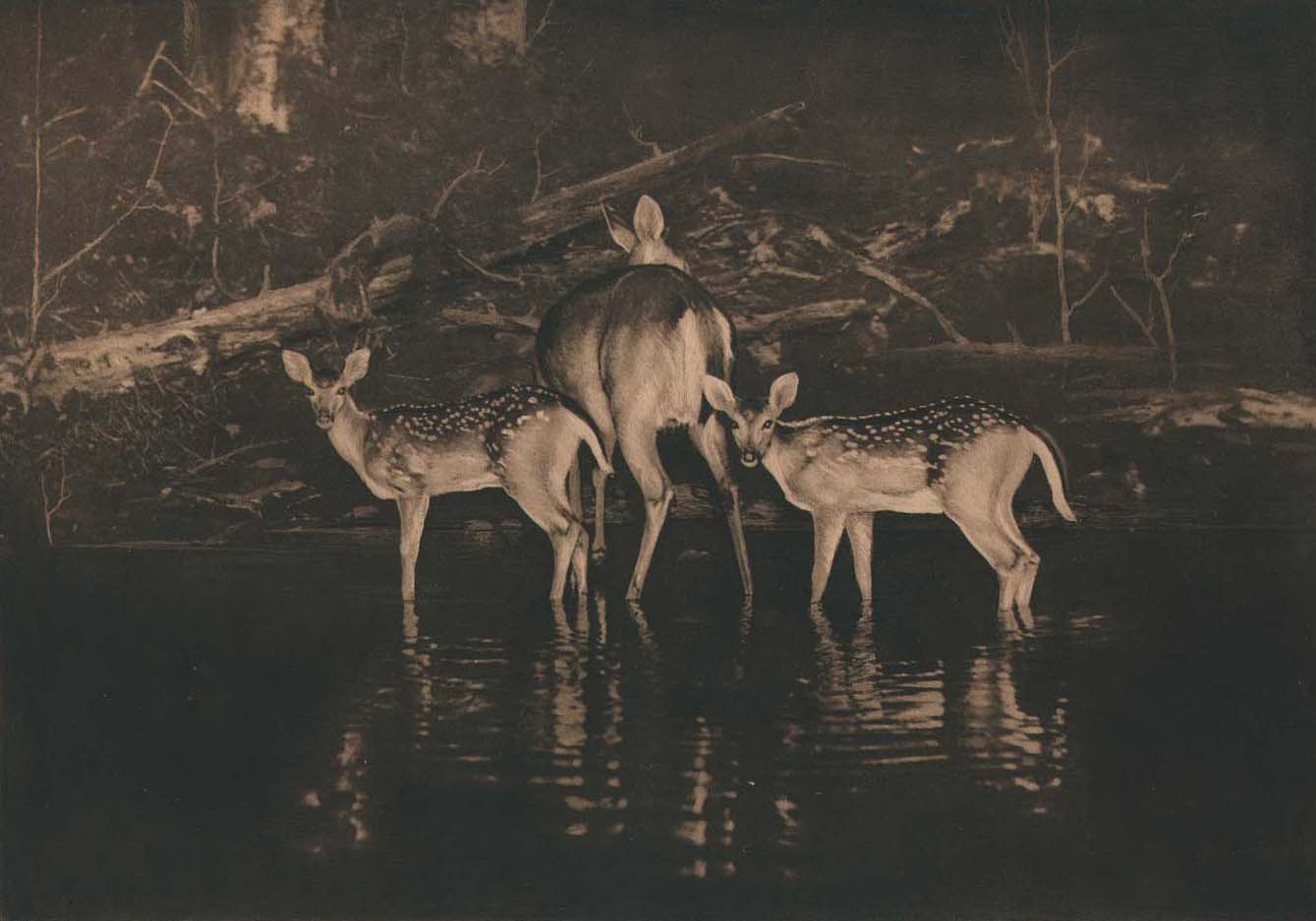
George Shiras, 3rd :: “A Doe and Twin Fawns” aka “Innocents Abroad” (taken 1896), printed 1916. Vintage photogravure published by the National Geographic Society, Washington, D.C. | src PhotoSeed
A Doe and Twin Fawns -also known as Innocents Abroad, would earn Shiras international acclaim and many important awards.

A pioneer of using flashlight photography to record wildlife in their natural environments at night, Shiras used the method of “Jacklighting”, a form of hunting using a fixed continuous light source mounted in the bow of a canoe to draw the attention of wildlife: in this case three deer, utilizing magnesium flash-powder to freeze the scene in-camera. His series of twelve midnight views, including A Doe and Twin Fawns -also known as Innocents Abroad, would earn Shiras international acclaim and many important awards.

A one-term Congressman for the state of Michigan, (his father George Shiras Sr. was a former Justice of the U.S. Supreme Court) he was also an important naturalist who helped placed migratory birds and fish under Federal control. (The eventual 1918 Migratory Bird Treaty Act had groundings in legislation Shiras introduced to Congress in 1903 as the first comprehensive migratory bird law not voted on.) For additional background, see article by Matthew Brower in the journal History of Photography, Summer, 2008: George Shiras and the Circulation of Wildlife Photography. [quoted from PhotoSeed]

George Shiras (III) :: A doe and her twin fawns feeding on a lake in northern Michigan, published 1935

A doe and her twin fawns feeding on a lake in northern Michigan. From: Hunting wild life with camera and flashlight : a record of sixty-five years’ visits to the woods and waters of North America. Volume I, National Geographic Society, 1935. | src Memorial University of Newfoundland
Draped female nude by Day

Fred Holland Day (1864-1933) ~ [Draped female nude lounging on the grass], ca. 1897 (detail)
Fred Holland Day (1864-1933) ~ [Draped female nude lounging on the grass], ca. 1897. Platinum print | src The Met
Fred Holland Day (1864-1933) ~ [Girl in sheer drapery on leopard skin, in nature, reclining], ca. 1897 (detail)
Fred Holland Day (1864-1933) ~ [Girl in sheer drapery on leopard skin, in nature, reclining], ca. 1897. Platinum print | src Library of Congress

Model: Elizabeth Chamberlin (1886–1960)

Right panel of the triptych Armageddon. The central panel of Day’s triptych was his iconic photo: An Ethiopian Chief

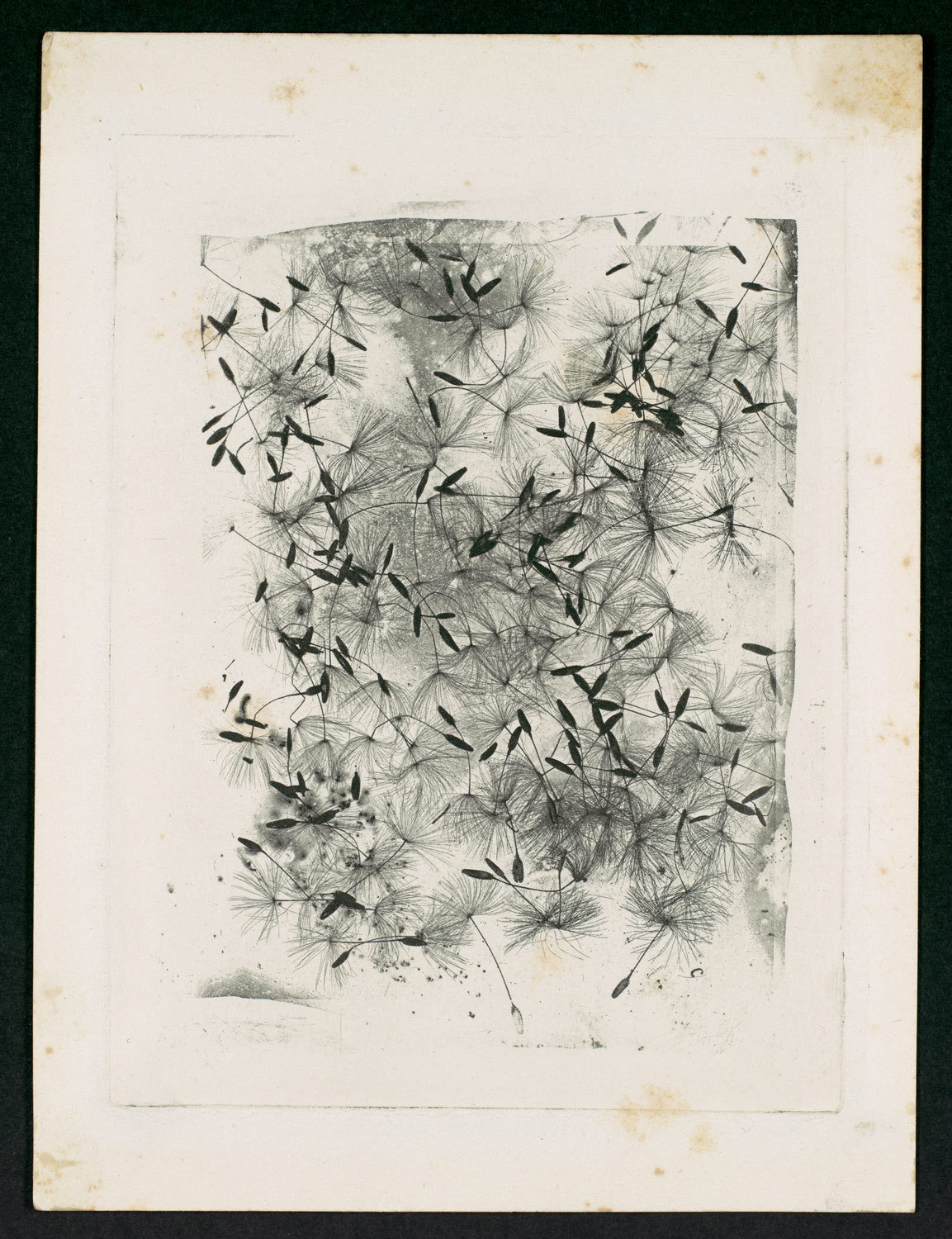
Dandelion Seeds, ca. 1858

William Henry Fox Talbot :: Dandelion Seeds, 1858 or later. 
Photogravure (photoglyphic engraving from a copper plate). | source The Metropolitan Museum of Art
William Henry Fox Talbot :: Dandelion Seeds, 1858 or later.
Photogravure (photoglyphic engraving from a copper plate). | source The Metropolitan Museum of Art

This experimental proof is a fine example of the capacity of Talbot’s “photoglyphic engraving” to produce photographic results that could be printed on a press, using printer’s ink-a more permanent process than photographs made with light and chemicals. Like Talbot’s earliest photographic examples, the image here was photographically transferred to the copper engraving plate by laying the seeds directly on the photosensitized plate and exposing it to light, without the aid of a camera. Equally reminiscent of Talbot’s early experiments, this image is part of Talbot’s lifelong effort to apply his various photographic inventions to the field of botany. In a letter tipped into the Bertoloni Album, Talbot wrote, “Je crois que ce nouvel art de mon invention sera d’un grand secours aux Botanistes” (“I think that my newly invented art will be a great help to botanists”). Such uses were still prominent in Talbot’s thinking years later when developing his photogravure process; he noted in 1863 that “if this art [of photoglyphic engraving] had been invented a hundred years ago, it would have been very useful during the infancy of botany.” Had early botanists been able to print fifty copies of each engraving, he continued, and had they sent them to distant colleagues, “it would have greatly aided modern botanists in determining the plants intended by those authors, whose descriptions are frequently so incorrect that they are like so many enigmas, and have proved a hindrance and not an advantage to science.” [quoted from The Met]

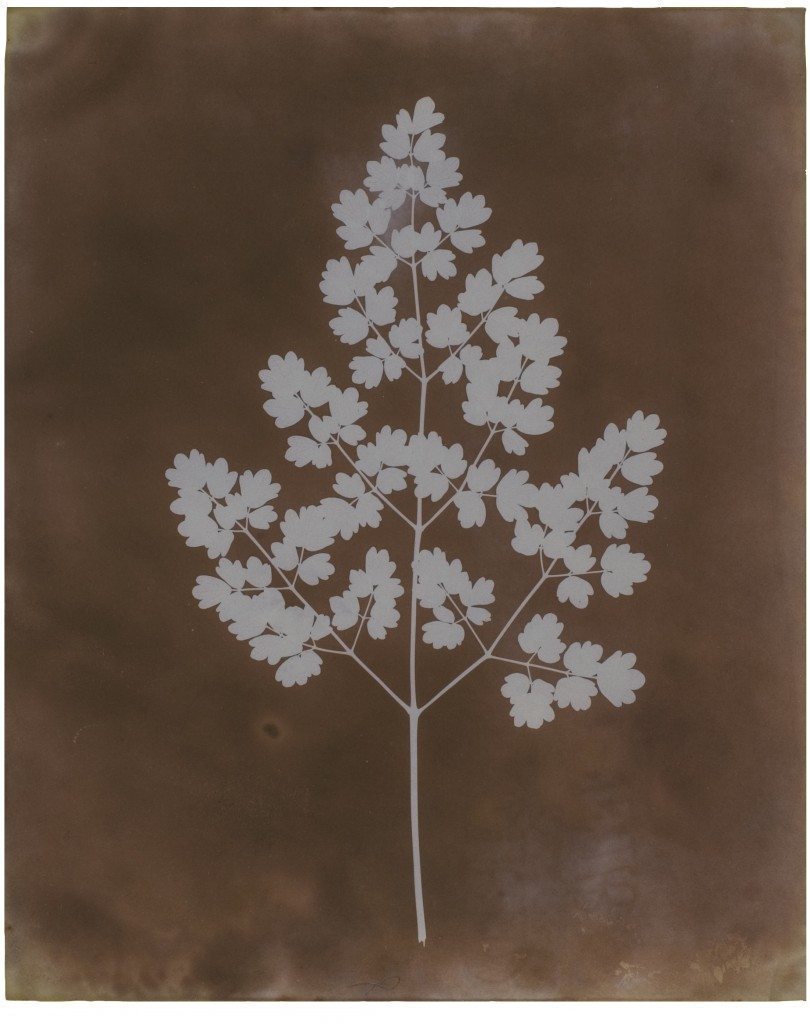
Photogenic drawing, 1830s

William Henry Fox Talbot :: Adiantum Capillus-Veneris (Maidenhair Fern), probably early 1839. Photogenic drawing negative. Courtesy of Hans P. Kraus Jr., New York. | src diptyqueparis
William Henry Fox Talbot :: Adiantum Capillus-Veneris (Maidenhair Fern), probably early 1839. Photogenic drawing (salted paper negative). Courtesy of Hans P. Kraus Jr., New York. | src diptyqueparis

This image of a fern was an experiment by Englishman William Henry Fox Talbot. It probably dates back to 1839, the year in which he publically announced his invention of paper photography. But back then, this did not mean taking a snap using a camera in the sense that we understand it today. This was a photogram. Talbot took a small object with delicate contours like a piece of lace or a plant specimen and exposed it to light on a sheet of paper that had been bathed in a solution of salt and silver nitrate. When the object was removed after having been exposed to sunlight (a trial and error process to determine how long it should be exposed to best effect), a clear silhouette would emerge from the darkened background of the paper.

Talbot is the English inventor of photography, just as Niépce and Daguerre were the French inventors of the same. While Daguerre was working alongside Niépce and fine-tuning the daguerreotype process, Talbot, who didn’t have a clue about their research, was experimenting with photography on paper himself in his property at Lacock Abbey in Wiltshire. His early interest in botany, maths, travel and a meeting with the great scientist John Herschel in 1824 fuelled his passion for the physical and chemical sciences. His light bulb moment came in 1833 when on honeymoon at Lake Como. His idea was to chemically fix the images produced by the camera obscura used by artists at the time to create sketches from nature. He succeeded around mid 1830. It was the first time that an image had been created without human intervention, hence the word photogenic drawings followed by the expression photography, a word created from two Greek words meaning «written with light».

The story goes that these delicate little silhouettes that look like herbarium plants or sketches by naturalists became the first manifestations of the invention – and great revolution – of photography. [quoted from src]