
Andrea Kiss, 2015 / via
images that haunt us

Karl Blossfeldt (1865-1932) was a German instructor of sculpture and a self-taught photographer, who used his photographs of plant studies to educate his students about design elements in nature.
more [+] by this photographer
“The plant never lapses into mere arid functionalism; it fashions and shapes according to logic and suitability, and with its primeval force compels everything to attain the highest artistic form.” source: TEG

Harold Edgerton :: Bullet Passing Through Gas-filled Soap Bubble, 1970. Gelatin silver print. / src: Metropolitan Museum

Karl Blossfeldt ::
Cornus-Kousa (Dogwood), 1920′s / Stiftung Ann und Jürgen Wilde, Pinakothek der Moderne, München./ src: Michael Hoppen Gallery
more [+] by this photographer
Karl Blossfeldt :: Unknown, Cucurbita (Tendrils of a pumpkin),
Centaurea Ruthenica,
Dryopteris filix mas (Common male fern), 1920′s / src: Michael Hoppen Gallery
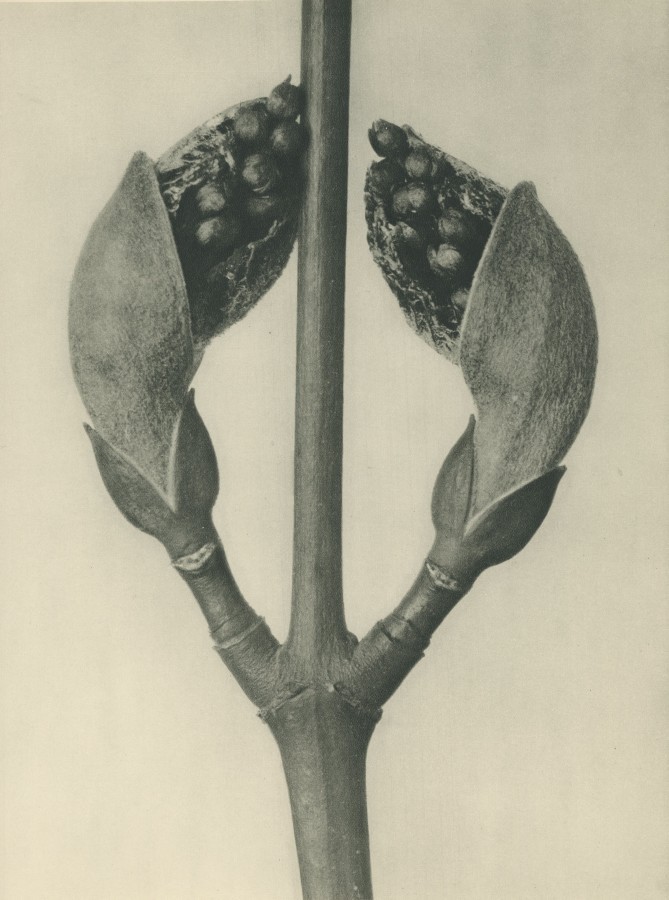
Karl Blossfeldt ::
Acer rufinerve, 1910′s-1920′s / src: Michael Hoppen Gallery
“What made Blossfeldt’s work unique was his extreme technical mastery of photography. He specialised in macrophotography to enlarge his plant specimens and even designed a camera for this purpose. As a result, everyday garden flowers are presented in such a way that their rhythmic forms are emphasised to the extreme and the plants take on new and exotic characteristics. Blossfeldt wanted his work to act as a teaching aid and inspiration for architects, sculptors and artists. It was his firm belief that only through the close study of the intrinsic beauty present in natural forms, that contemporary art would find its true direction.”
more [+] by this photographer

 un regard oblique