Leonetto Cappiello · Dancers

Leonetto Cappiello (1875-1942) ~ A dancer in motion wearing a futuristic headpiece and billowing wide pants, 1928. Watercolor and pencil drawing | src invaluable
Leonetto Cappiello (1875-1942) ~ Folies Bergere poster, 1900s | src RetroGraphik

Leonetto Cappiello: The Father of Modern Advertising Poster

Leonetto Cappiello (1875 – 1942) was an Italian poster artist who lived much of his life in Paris, France. With no formal training in art, he emerged as one of the leading Italian artist and caricaturist in Paris that eventually succeeded the other famous lithographers such as Henri Toulouse-Lautrec (1864-1901), Jules Cheret (1836-1932) and Alphonse Mucha (1860-1939) as the leading advertising poster designer in Paris.

Talented Cappiello started his arts career as a caricature artist in 1896 illustrating for French journals like Le Rire, Le Cri de Paris, Le Sourire, L’Assiette au Beurre, La Baionnette, Femina, and others. His first album of caricatures, Lanterna Magica, was made in 1896. His early caricature style was seen to be influenced by Henri Toulouse-Lautrec, which was already the most famous artist of the time.

Today, arts historians list him as one of the most influential poster artist in the history of poster art as many would agree that he is also known as the “Father of Modern Advertising Poster”. As advertising posters were the main medium of communication during the time, Paris streets were saturated with many types of advertising posters, all trying hard to engage the increasingly distracted eyes. There was a need to rethink how poster as a medium need to be relevant and engage the faster pace of the 20th century. 
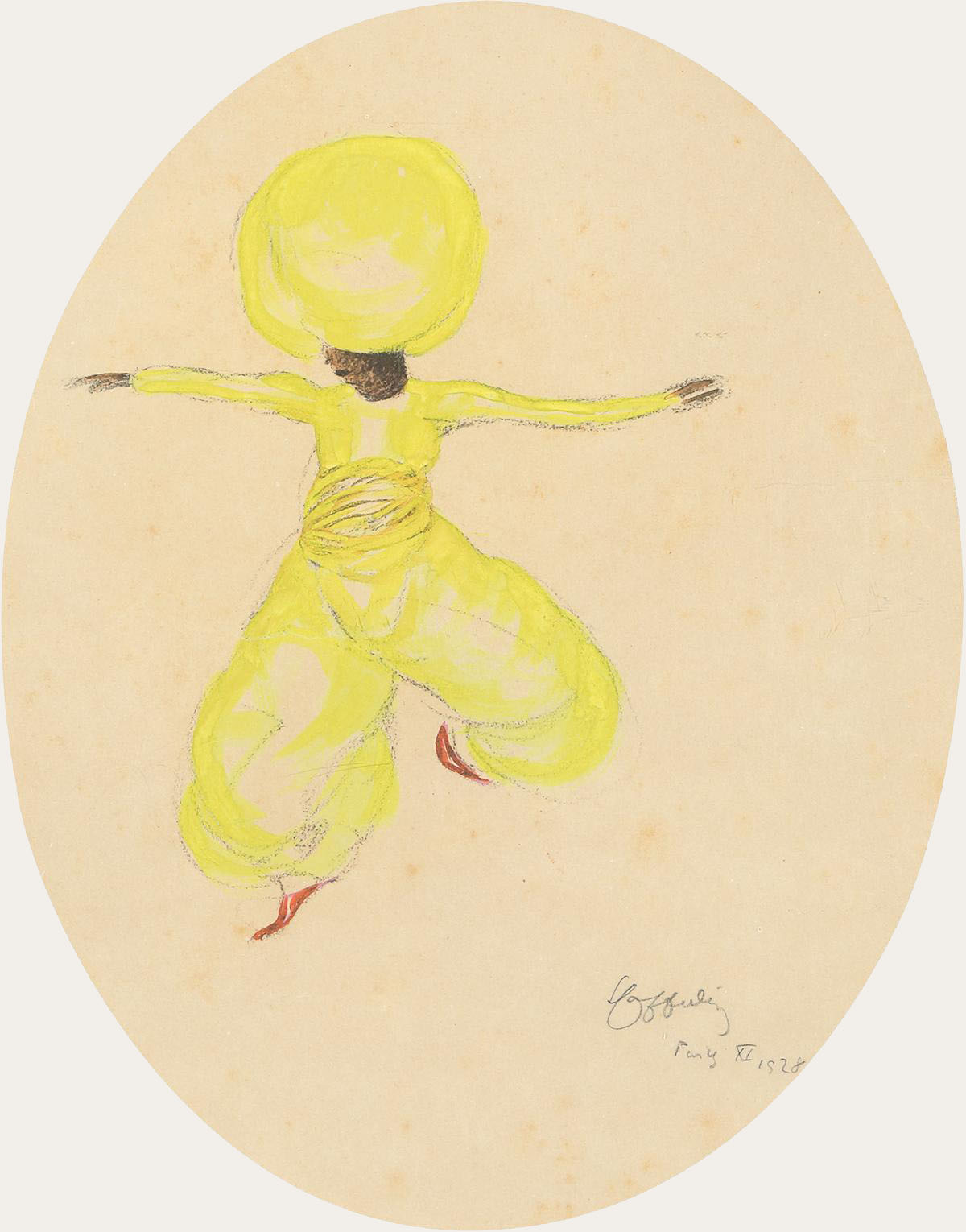
Leonetto Cappiello (1875-1942) ~ Turbaned dancer in midair wearing a bright yellow outfit, 1928. Watercolor and charcoal drawing | src invaluable
Leonetto Cappiello (1875-1942) ~ Asti Cinzano poster, 1910s | src RetroGraphik

The Cappiello Style

Cappiello is credited to revolutionize the old thinking of poster illustration during his time. His concept of poster art was simple, to simply engage audience faster by creating unconventional visual impact. He was the first poster artist to boldly experiment and innovate new graphical styles at the time. His presentation was straight forward with use of enlarged bold subjects with unconventional colors,contrasted by the very dark background, which make his art “pop out”. By doing so he moved away from illustrating intricate details in his artworks, which was famous at the time as Art Nouveau movement was popular.

Between 1901 and 1914, he created several hundred posters in a style that revolutionized the art of poster design. Cappiello redesigned the fin-de-siècle pictures into images more relevant to the faster pace of the 20th century.

His new functionalist style of graphic art, in which a single bold image would be used to grab the viewer’s attention. This graphic design proved highly effective, not only in drawing attention to the product but also in building a brand. It made Cappiello the acknowledged master of the advertising poster in his time for almost 20 years. | src RetroGraphik

Death of Sophie Blanchard 1819

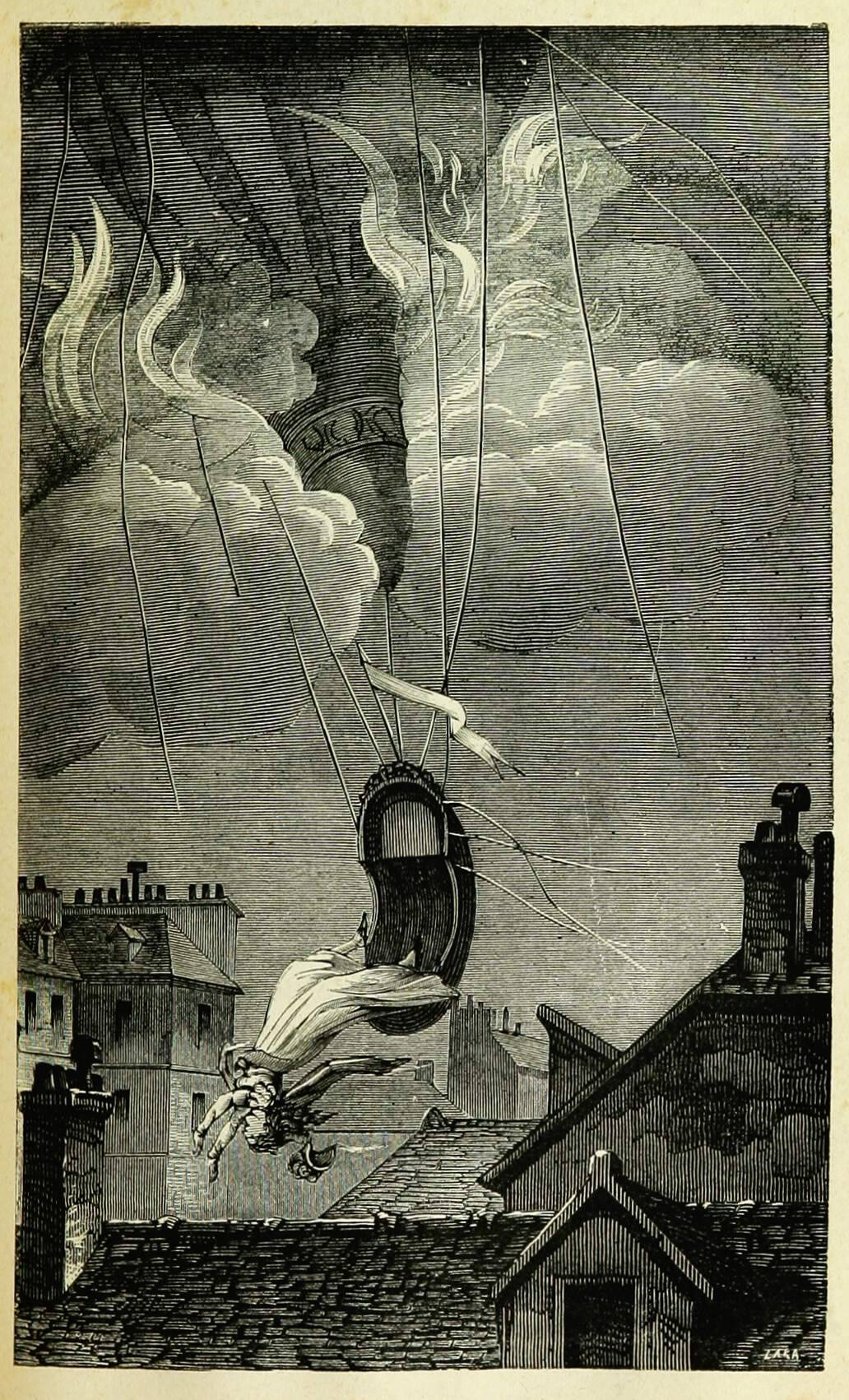
Death of French aeronaut Madame Sophie Blanchard after fireworks ignited her balloon, Paris, 1819. Woodblock engraving. From Louis Figuier’s “Les Merveilles de la Science: Aerostats” (Marvels of Science: Air Balloons), Paris : Librairie Furne, Jouvet et Cie., 1867. | src old book illustrations and internet archive

A woman is falling from the gondola of a hot-hair balloon flying over the roofs. She is Sophie Blanchard was the widow of aeronaut Pierre Blanchard, and an aeronaut herself.

On July 6, 1819, Madame Blanchard was taking part in an exhibition in the Tivoli garden in the rue Saint-Lazare. She carried with her a parachute full of fireworks in order to give the public the spectacle of fireworks descending from the middle of the air. She held a fire lance in her hand to light the fireworks she was supposed to launch from the balloon gondola. A false movement brought the orifice of the balloon into contact with the fire lance: the hydrogen gas ignited. Immediately an immense pillar of fire rose above the machine. Madame Blanchard was then distinctly seen trying to extinguish the fire by compressing the lower orifice of the balloon: then, recognizing the uselessness of her efforts, she sat down in the basket and waited. The gas burned for several minutes, without communicating with the balloon gondola. The rapidity of the descent was very moderate, and there is no doubt that, had she been directed towards the country, Madame Blanchard would have reached land without accident. Unfortunately it was not so: the balloon fell on Paris; it fell on the roof of a house in the rue de Provence. The gondola slid down the slope of the roof, on the side of the street. “A moi!” cried Madame Blanchard. These were her last words. As it slid down the roof, the gondola encountered an iron spike; it stopped abruptly, and, as a result of this shock, the unfortunate aeronaut was thrown out, and fell, head first, on the pavement. (quoted from scanned book at internet archive)

The caption reads in the original French: “Mort de madame Blanchard”. IA

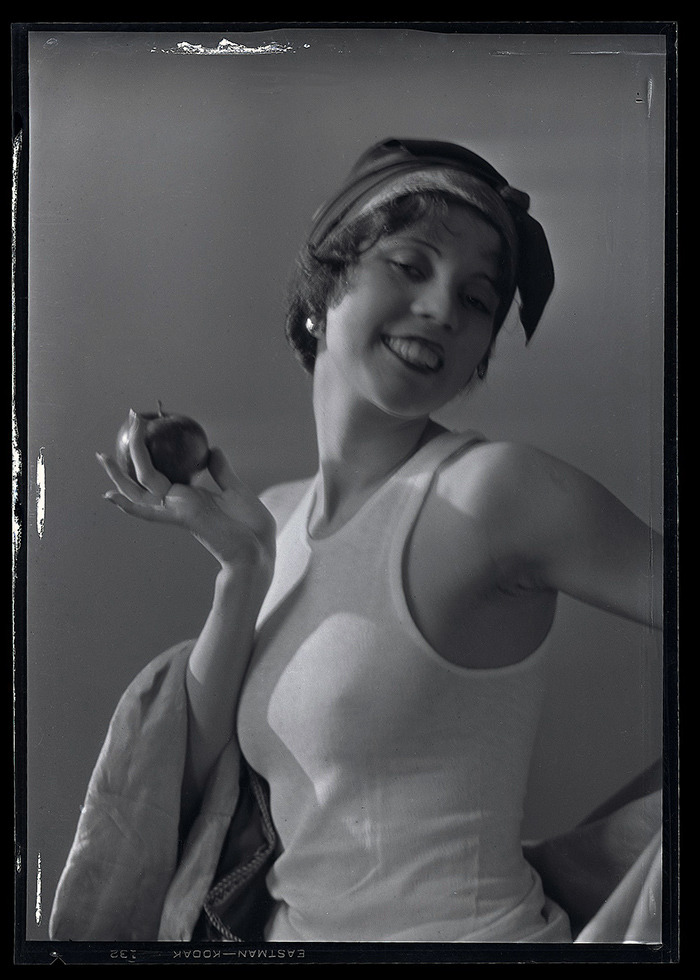
Charles Gates Sheldon :: Portrait of silent film and stage actress Olive Borden. Nicknamed ‘The Joy Girl’, 1920′s. (Camera negative.) Borden was known for her jet black hair and overall beauty.

This photograph was taken by the American illustrator and amateur photographer as an aid for his pastel portraiture work. It was from this sitting that Sheldon created the pastel that went on to be the cover of the August 1927 issue of Photoplay Magazine. A beautiful jazz age still. / src: Grapefruit Moon Gallery on eBay

more [+] by this photographer

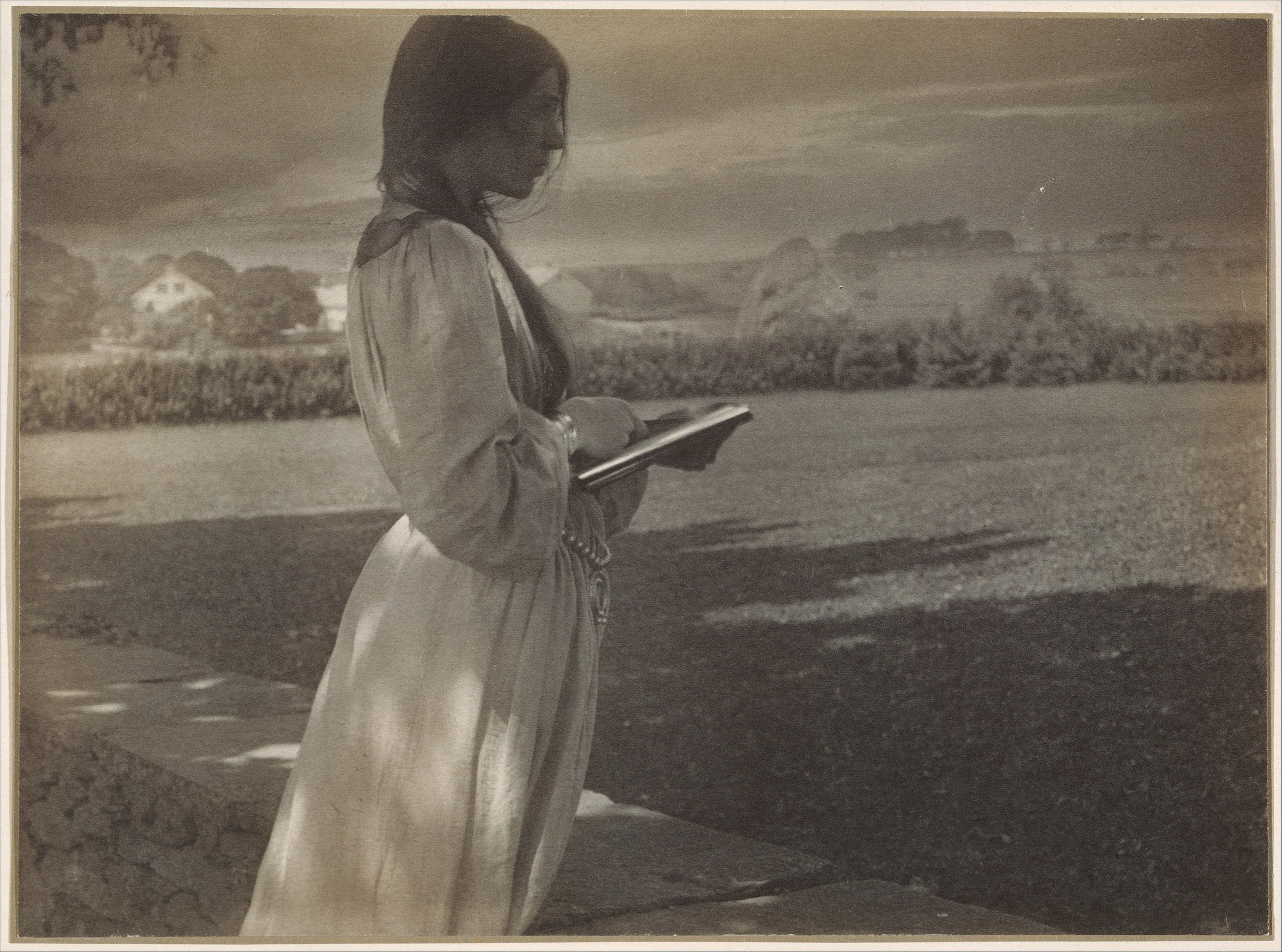
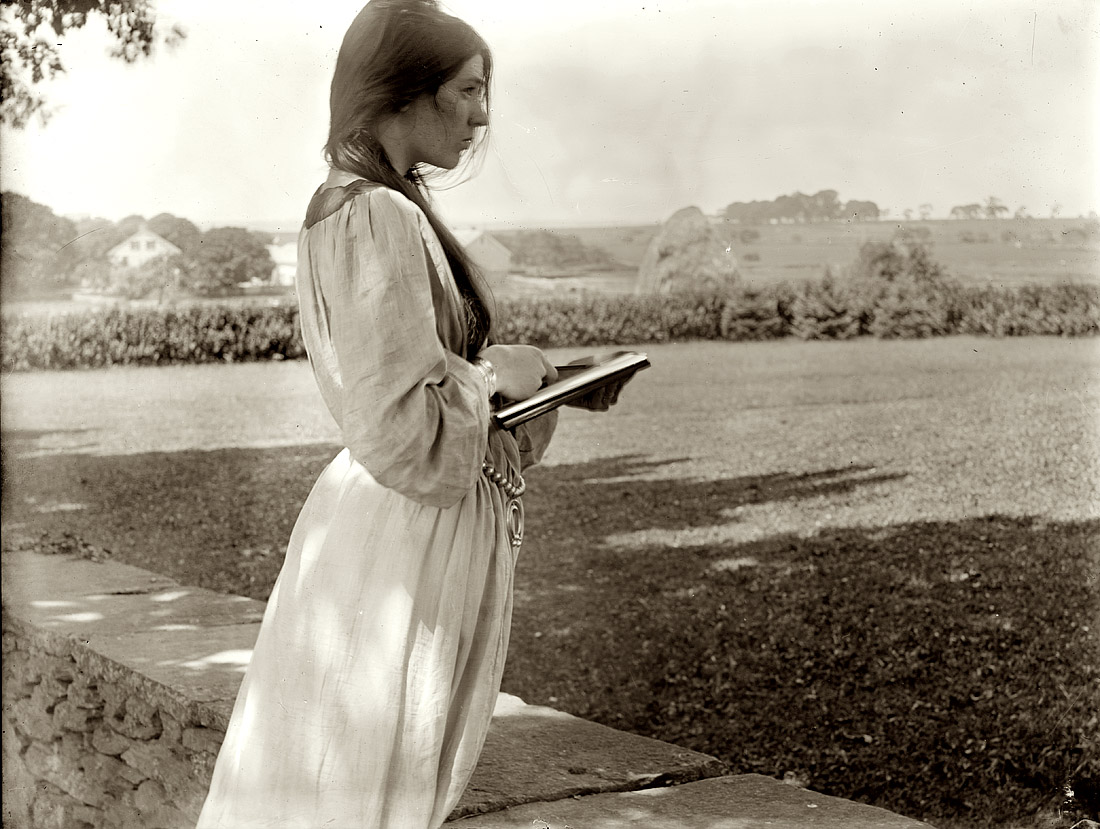
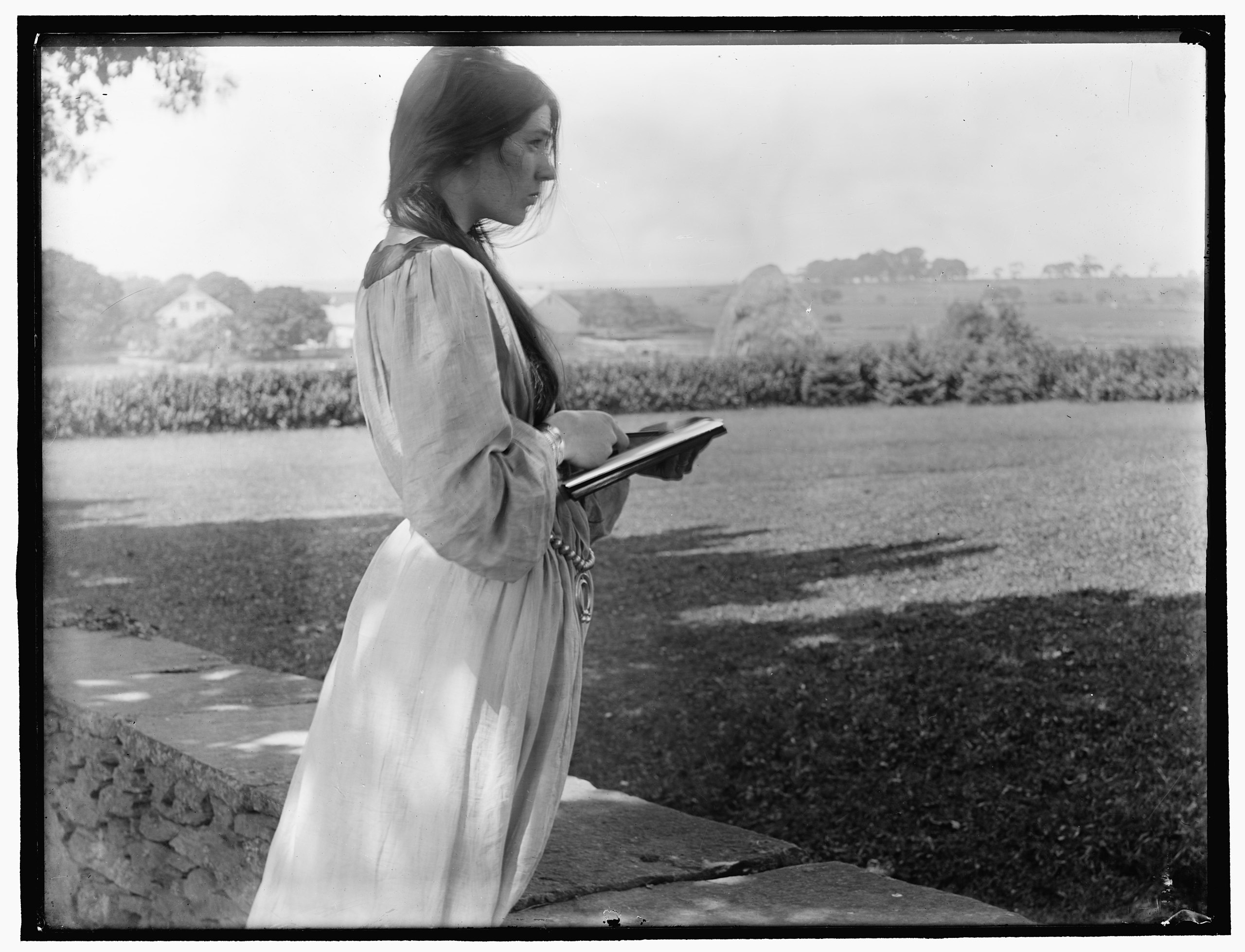
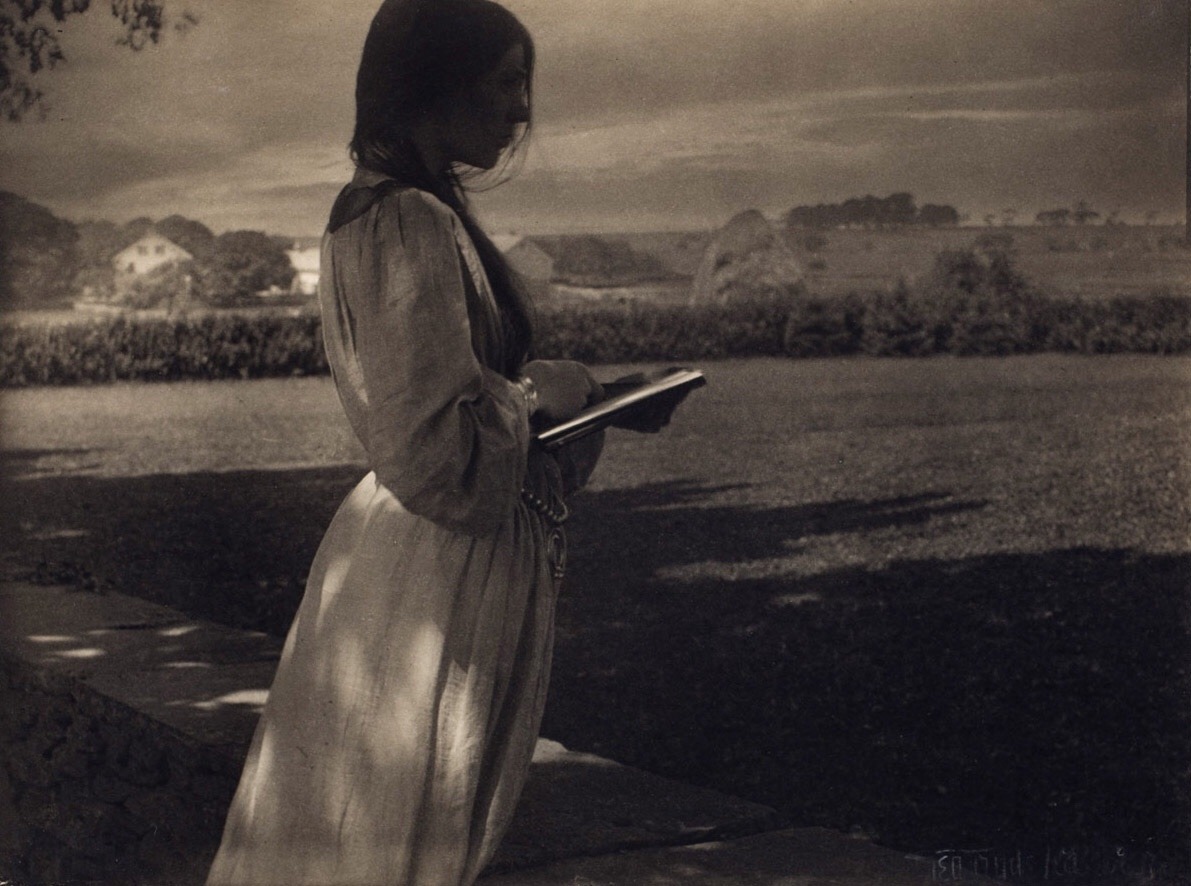
Beatrice Baxter by Käsebier

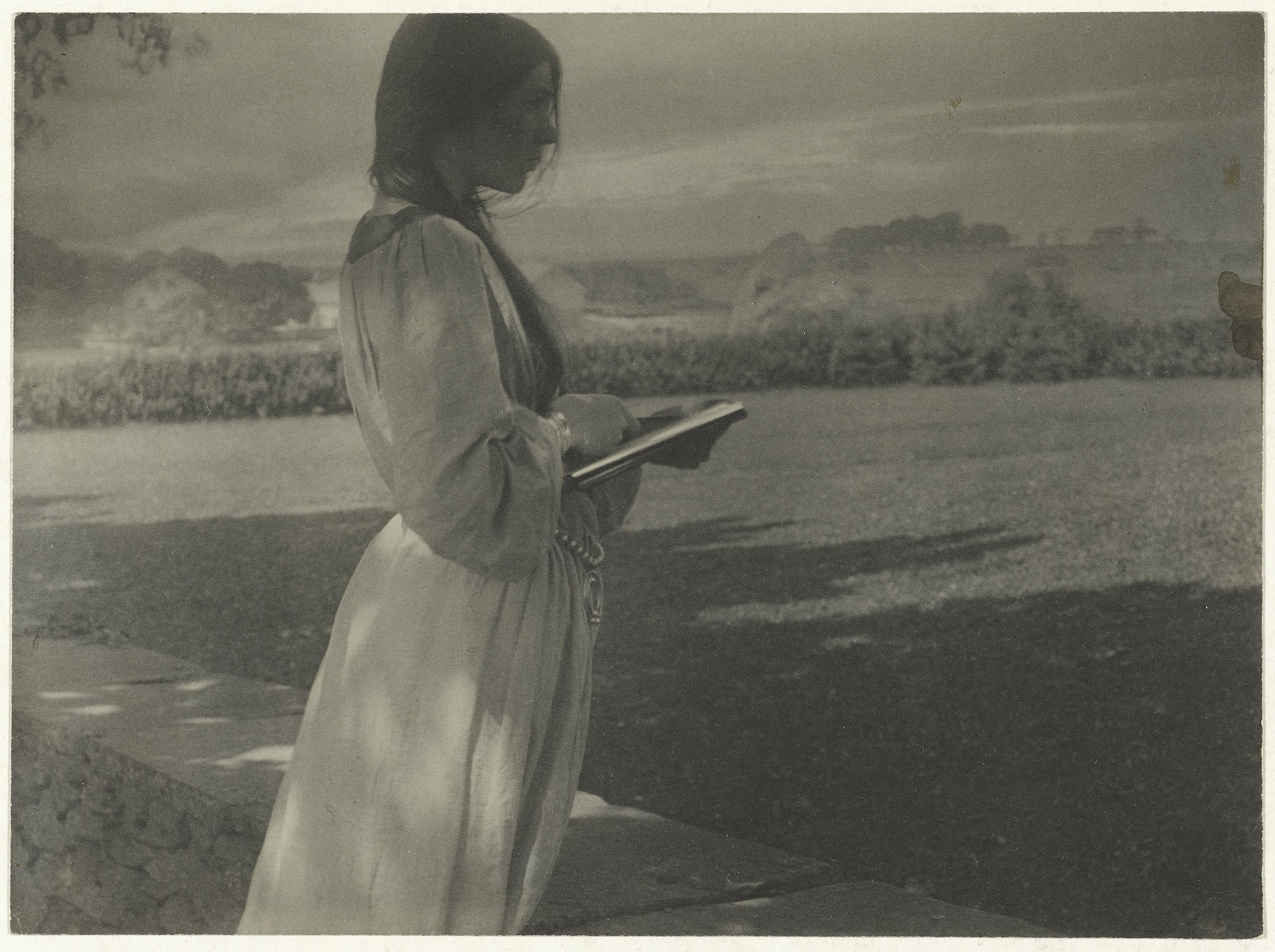
Gertrude Käsebier ~ The sketch (Beatrice Baxter Ruyl), 1902 | src Rijksmuseum
Gertrude Käsebier (1852-1934) ~ The Sketch, 1903. Platinum print. | src The Met

A frequent model for Käsebier and F. Holland Day, Beatrice Baxter Ruyl, who posed here, made illustrations for children’s books and the Boston Herald.

Gertrude Käsebier ~ The Sketch (Beatrice Baxter), 1903. Platinum print
Gertrude Kasebier ~ The Sketch, posed by Beatrice Baxter in Newport, Rhode island, 1902. Glass negative | src Library of Congress
Gertrude Käsebier ~ The Sketch (Beatrice Baxter), 1903. Platinum print. | Collection of George Eastman House