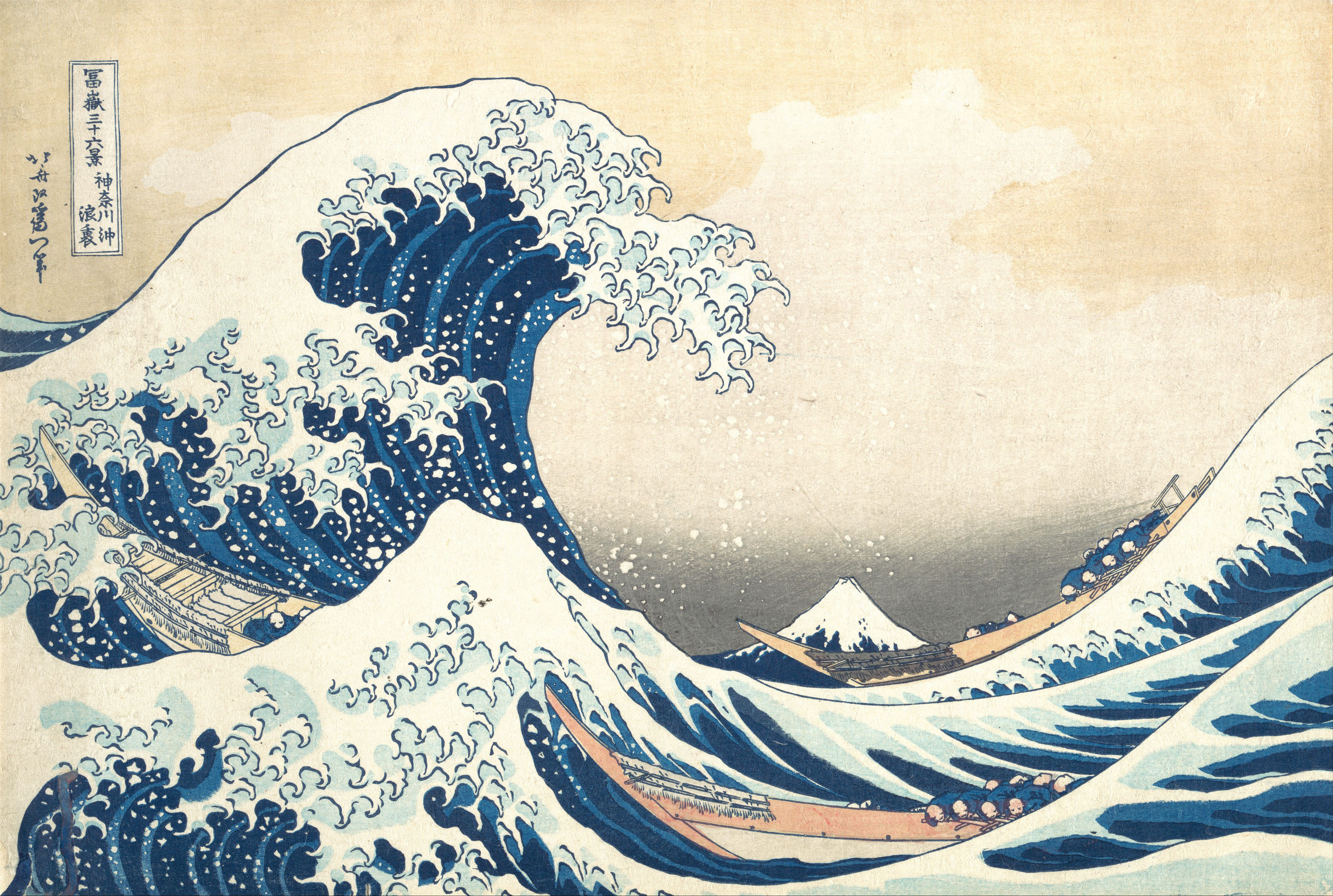
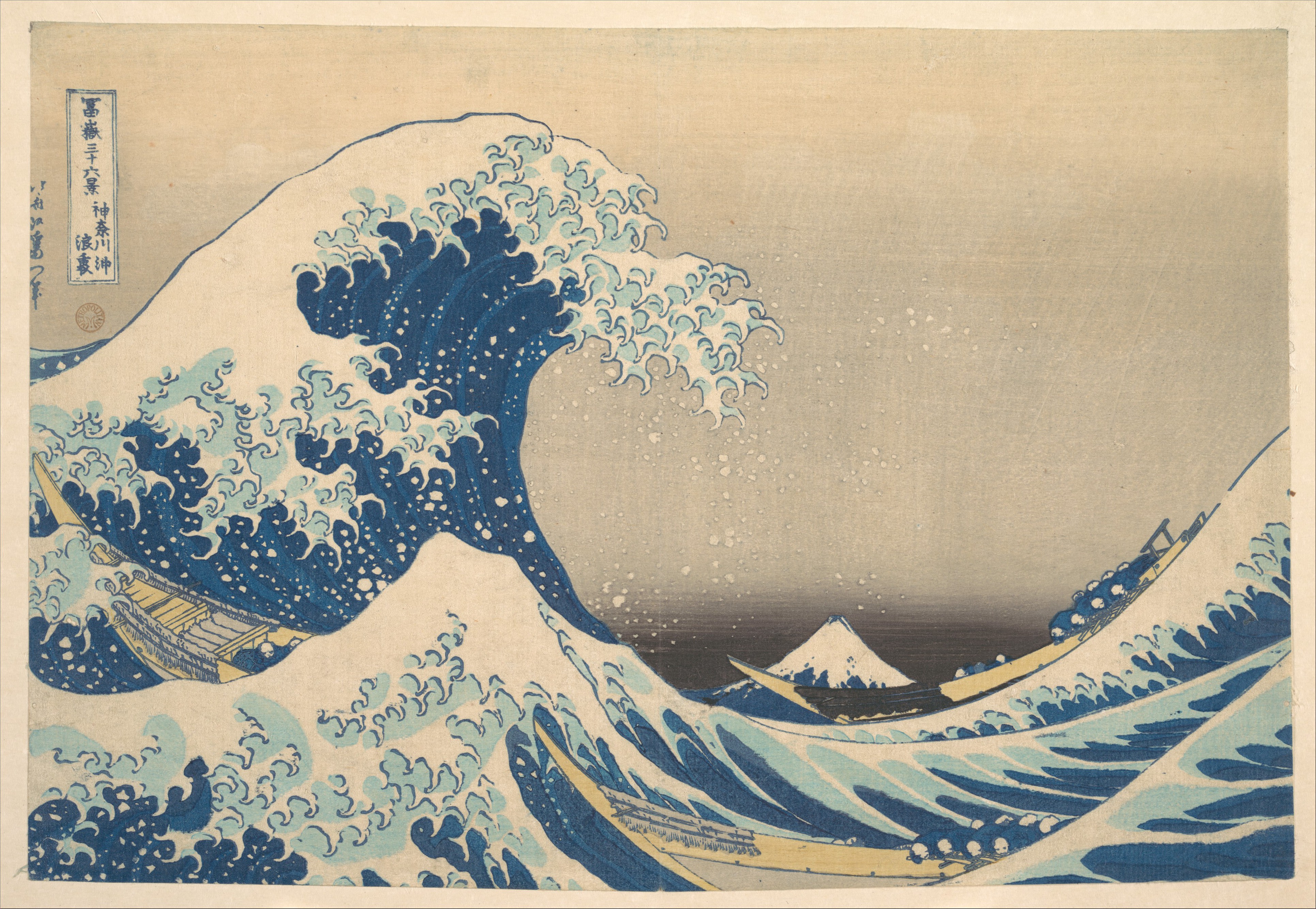
Die Bayerische Staatsbibliothek hat eines der bekanntesten grafischen Kunstwerke der Welt erworben die Große Welle von Katsushika Hokusai (1760-1849). Read more at Monopol Magazin

images that haunt us
Die Bayerische Staatsbibliothek hat eines der bekanntesten grafischen Kunstwerke der Welt erworben die Große Welle von Katsushika Hokusai (1760-1849). Read more at Monopol Magazin


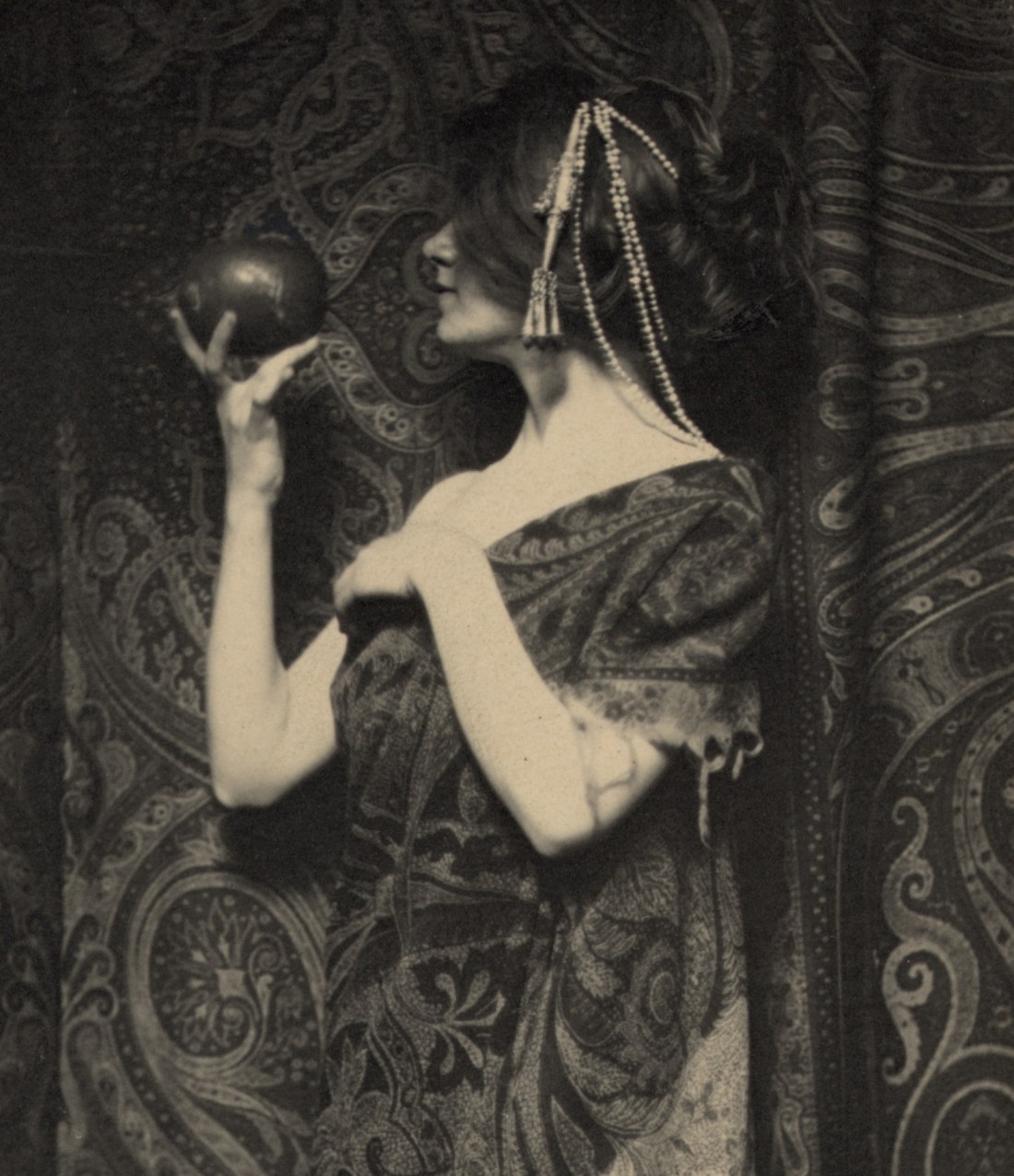

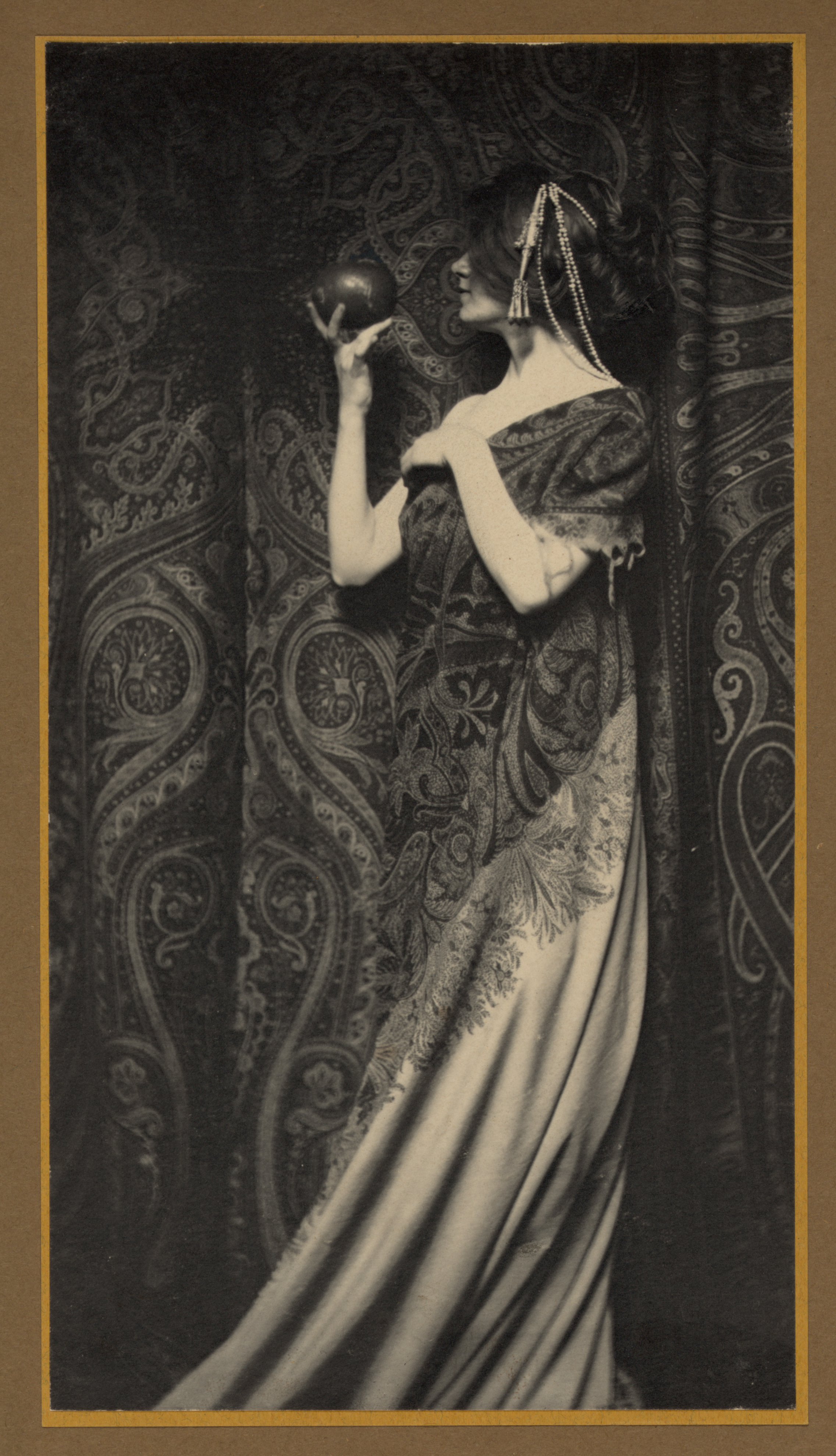
The Odor of Pomegranates is more than simply a portrait, the image represents Ben-Yusuf’s effort to use photography to explore a larger theme: in this case, the seductiveness and potential danger of something desirous.
Ben-Yusuf’s artistic explorations within the tradition of portraiture continued alongside her commercial work. One of the prints she felt was more successful was The Odor, a work that she exhibited on at least half a dozen occasions in the years immediately after its completion in 1899. No other photograph by her was displayed or reproduced as often. This portrait shows an unidentified young woman holding a pomegranate only inches before her face. The subject is dressed in an ornately decorated garment and stands erect in profile against a similarly patterned fabric that serves as the backdrop for the photograph. A string of pearls is interwoven in her hair. As the photographer and critic Joseph Keiley observed in his review of this “especially striking” image, “the figure was posed against a darker piece of heavy oriental drapery, figured with curved lines that resembled writhing serpents, and into which the draped figure almost melted.” Others, including the photographer Alvin Langdon Coburn, also commented on Ben-Yusuf’s effort to meld the her subject into the folds of the backdrop. The effect of this compositional strategy is a radical flattening of the picture plane so that the figure appears like a mythological personage carved on to a frieze. Capturing likeness is not the goal of the composition; instead, Ben-Yusuf is more concerned with the larger creative possibilities of photography. (…)
Ben-Yusuf was closely allied with those [photographers] who saw photography as a medium of artistic expression. To her and other like-minded practitioners, much could be learned from the world of the fine arts and literature, and this new class of photographers went to great lengths to create prints that incorporated this lessons. As the scholar Naomi Rosenblum has shown, The Odor of Pomegranates owes much stylistically to such works as John White Alexander’s painting, Isabella and the Pot of Basil [image below]. Ben-Yusuf admired Alexander, and two years later completed a series of portraits of the artist. In its subject matter, its composition, and its presentation, Ben-Yusuf’s image reveals the influence of the late nineteenth-century avant-garde. (…)
In The Odor of Pomegranates, Ben-Yusuf herself experiments with creating a photographic portrait that is as much about Classical mythology as it is about modern life. The pomegranate that the woman holds before her provides a key to unlocking the work’s larger symbolism. An odorless fruit, the pomegranate has long been a popular subject for artists and poets, many of whom have seen it as a symbol of the Resurrection. In Greek mythology, it figures prominently in the story of Persephone, the beautiful daughter of Zeus and Demeter, whose eating of a pomegranate given to her by Hades bound her for part of the year in the underworld over which he reigned. During those months, Demeter -the goddess of harvest- refused to allow anything to grow, and thus winter began. Ben-Yusuf depicts her Persephone-like figure observing closely -even contemplating- the fruit before her. Its “odor” relates not to its smell, but rather the tantalizing expectation that precedes the act of consuming the pomegranate.
Ben-Yusuf’s The Odor of Pomegranates is a departure from the professional photography that typically occupied her. Not concerned with capturing a sitter’s individuality, she explores in this portrait a more universal theme: the seductiveness and potential danger of something desirable. (…)
Although the long hair of Ben-Yusuf’s subject hides her eyes, it appears that this woman stares out at the pomegranate she holds as if pondering whether to act. Her other arm rises upward in a gesture that suggests a certain hesitation. The Odor of Pomegranates captures the tense moment of decision.
Quoted from: Goodyear, Frank H., III: Zaida Ben-Yusuf : New York portrait photographer. London : Merrell (2008) Published in association with the National Portrait Gallery, Smithsonian Institution, Washington, D.C. The book is available at internet archive
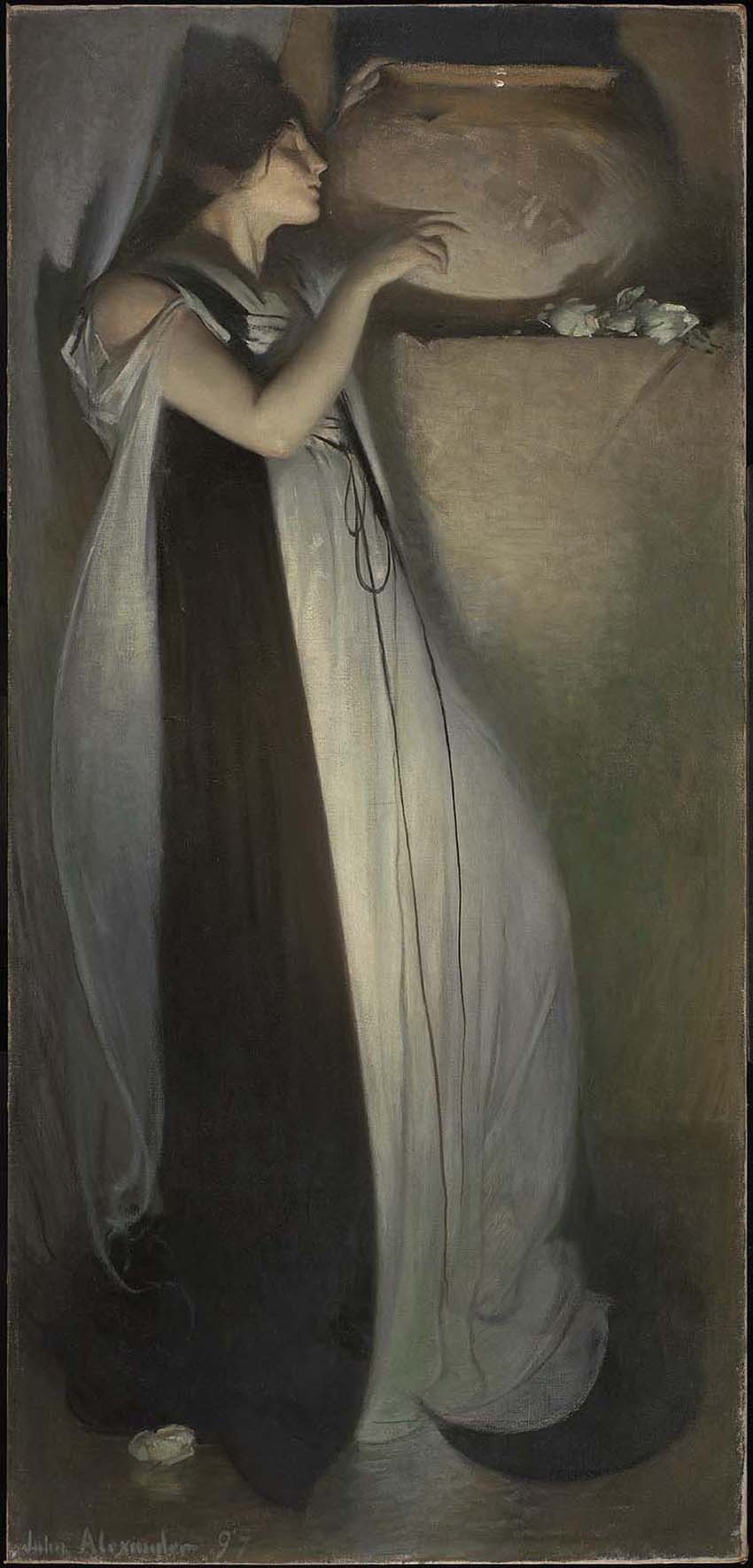
Isabella, or The Pot of Basil was a poem written in 1820 by the English poet John Keats, who borrowed his narrative from the Italian Renaissance poet Giovanni Boccaccio. Isabella was a Florentine merchant’s beautiful daughter whose ambitious brothers disapproved of her romance with the handsome but humbly born Lorenzo, their father’s business manager. The brothers murdered Lorenzo and told their sister that he had traveled abroad. The distraught Isabella began to decline, wasting away from grief and sadness. She saw the crime in a dream and then went to find her lover’s body in the forest. Taking Lorenzo’s head, she bathed it with her tears and finally hid it in a pot in which she planted sweet basil, a plant associated with lovers.
Alexander used theatrical effects to render this grim scene, isolating Isabella in a shallow niche and lighting her from below, as if she were an actor on a stage illuminated only with footlights. This eerie light, the cold monochromatic palette, and the sensuous curves of Isabella’s gown all draw the viewer’s eye to the loving attention Isabella gives the pot, which she gently caresses. Isabella seems lost in an erotic spectral trance, oblivious to the world and to observers. With his strange subject, Alexander created an extraordinary and mysterious image of love gone awry.
quoted from MFA and the text was adapted from Elliot Bostwick Davis et al., American Painting

Henk Jonker :: Volendam, The Netherlands, 1947

Clarence Hudson White :: Drops of rain (dew drops), ca. 1902 | A
young boy, possibly Maynard White, looking at a large glass ball, with
raindrops on a screen in the background. Published in Camera Work (1908). / src: Library of Congress
more [+] by this photographer
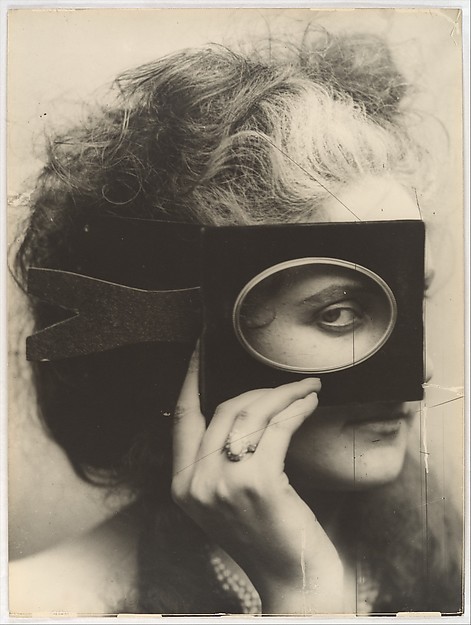
Pierre-Louis Pierson :: Scherzo di Follia (Game of Madness), 1861-67, printed ca. 1930. [Countess of Castiglione / Countess Virginia Oldoini Verasis di Castiglione ] / source: Metropolitan Museum
more [+] by this photographer
/ related post, here
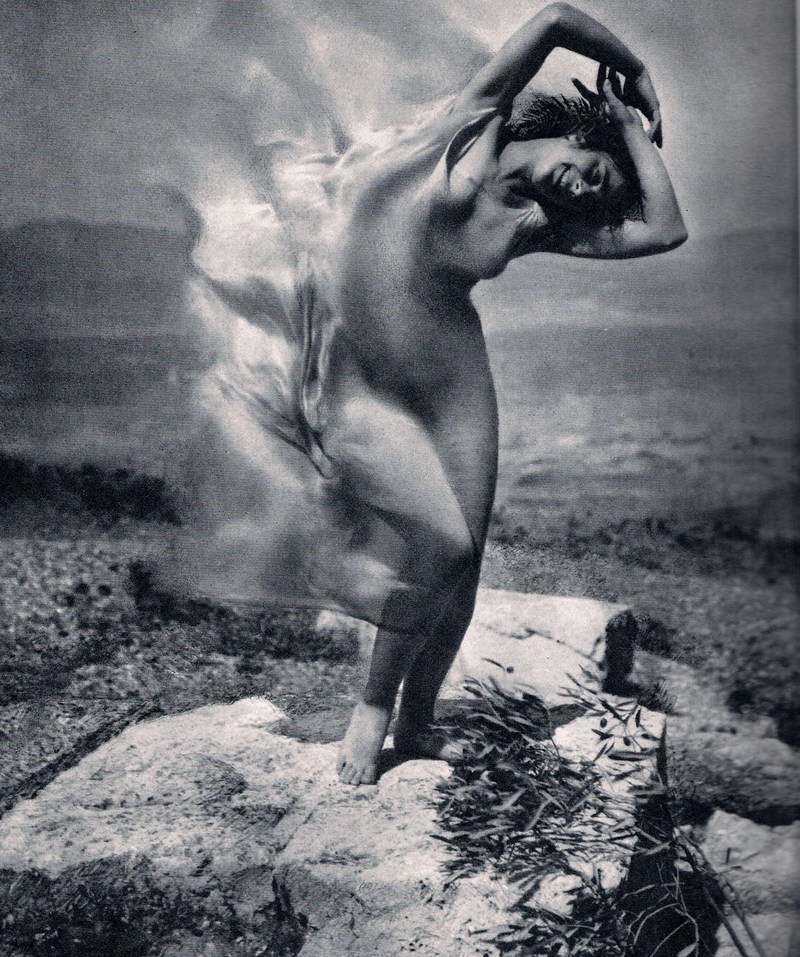
Edward Steichen :: Wind Fire –
Thérèse Duncan, adopted daughter of Isadora Duncan,
on the Acropolis, 1921 / source adski_kafeteri via
billyjane
more [+] by Edward Steichen / alternative version of this photograph, here

Unknown* :: ‘Lunch atop a Skyscraper’ / Construction workers eat their lunches atop a
steel beam 800 feet above ground, at the building site of the RCA
Building
(now the GE Building)
in Rockefeller Center, NYC, 20 Sep 1932.
(*) “the photographer and the identities of most of the subjects
remain a mystery—the photographers Charles C. Ebbets, Thomas Kelley and
William Leftwich were all present that day, and it’s not known which one
took it”
/
src: Metalocus
more [+] by
Charles C. Ebbets
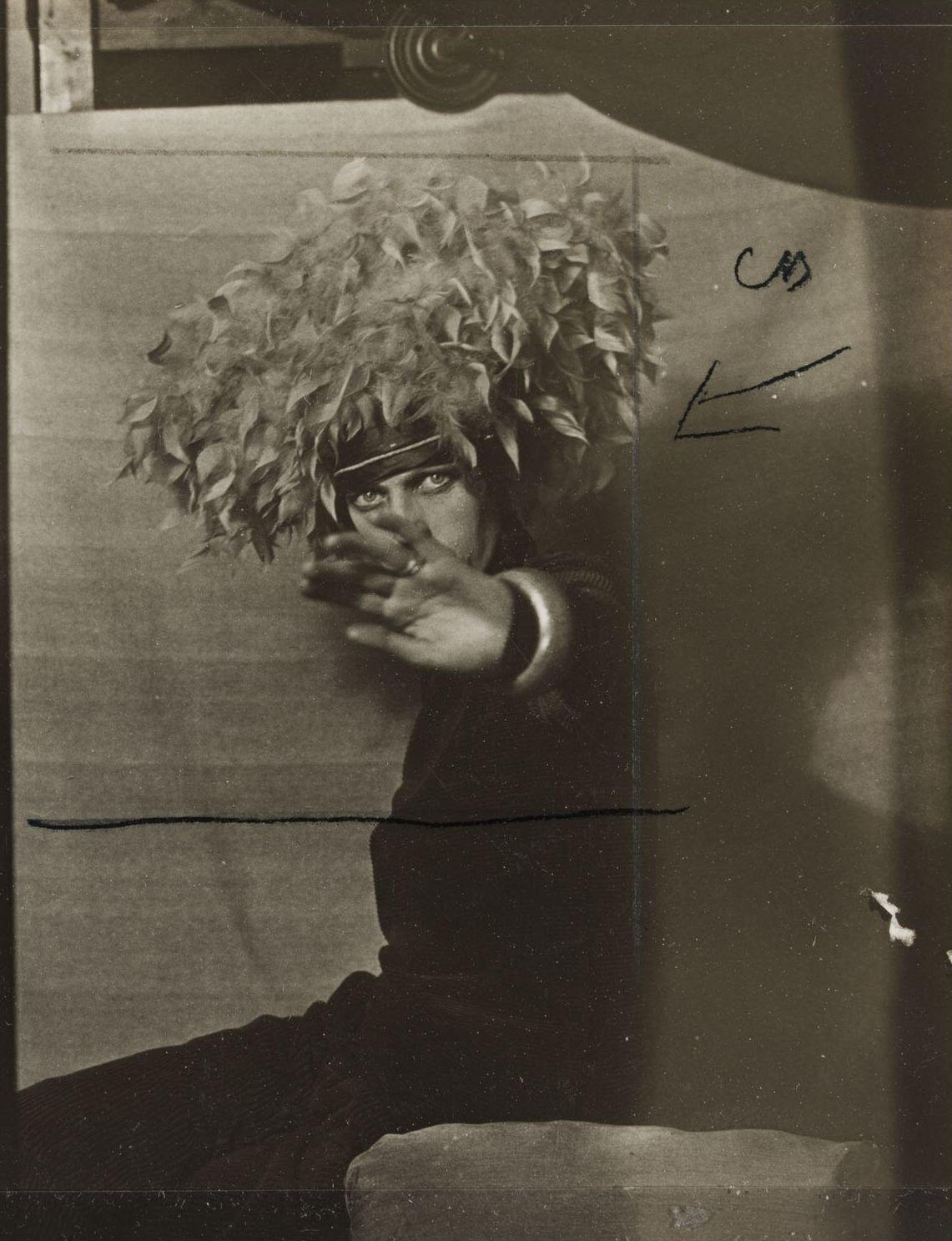
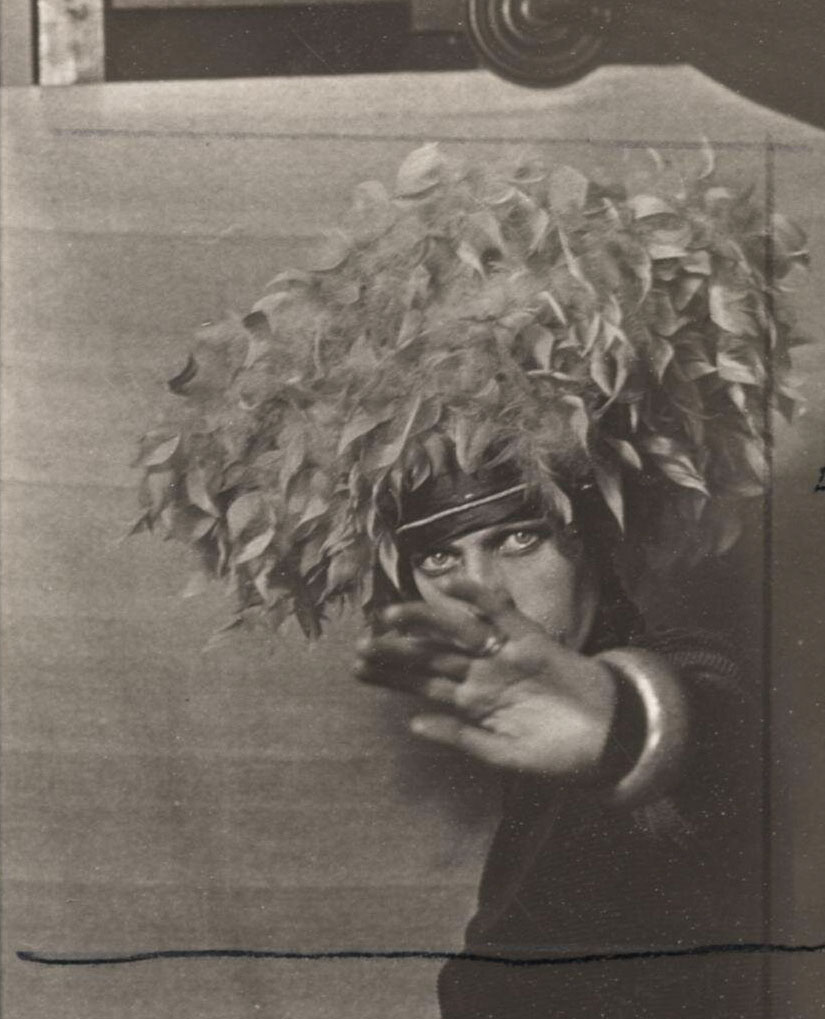
 un regard oblique
