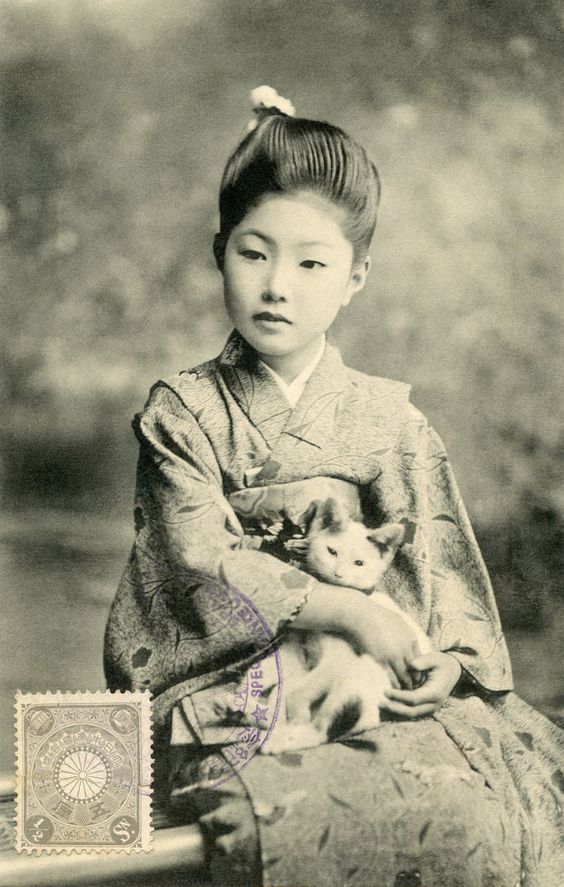
Bijin with a Kitten, 1907 / source and high resolution: Blue Ruin
images that haunt us
Bijin with a Kitten, 1907 / source and high resolution: Blue Ruin
 https://embedr.flickr.com/assets/client-code.js
Three Maiko, 1928. Three maiko (apprentice geisha), Takewaka on the left, Tomeko in the centre and Satogiku on the right. / src: Blue Ruin
 https://embedr.flickr.com/assets/client-code.js
Kyuzo Okamoto :: Geiko Yachiyo with an Insect Cage, vintage postcard, 1910
Insects as pets. Yachiyo was a famous Osaka geiko (geisha), known for her elegance and her lovely personality. People were said to weep with joy at the sight of her dancing. She joined the flower and willow world at the age of thirteen, left to marry at the age of twenty-nine. / source: Blue Ruin
 https://embedr.flickr.com/assets/client-code.js
Ashibe Odori, 1910′s
Maiko (apprentice geisha) Yachiyo II of Osaka, dressed for the Ashibe Odori, the public dances of the Nanchi Gokagai (Southern five geisha districts), which were first performed in November 1888. The geiko (geisha) of Osaka are known for their “hera-hera odori” or dances that feature acrobatic stunts such as handstands. / src: Blue Ruin
 https://embedr.flickr.com/assets/client-code.js
A Geisha biting a Tenugui, 1920′s
“[She] rises to one knee and puts one end of her [tenugui] hand towel in her teeth, pulling on it with her right hand. This is a typical Kabuki gesture for a female character in the throes of a deep emotion.” According to “The Art of Kabuki” edited by Samuel L. Leiter, first published in 1979, page 114. / src: Blue Ruin
 https://embedr.flickr.com/assets/client-code.js
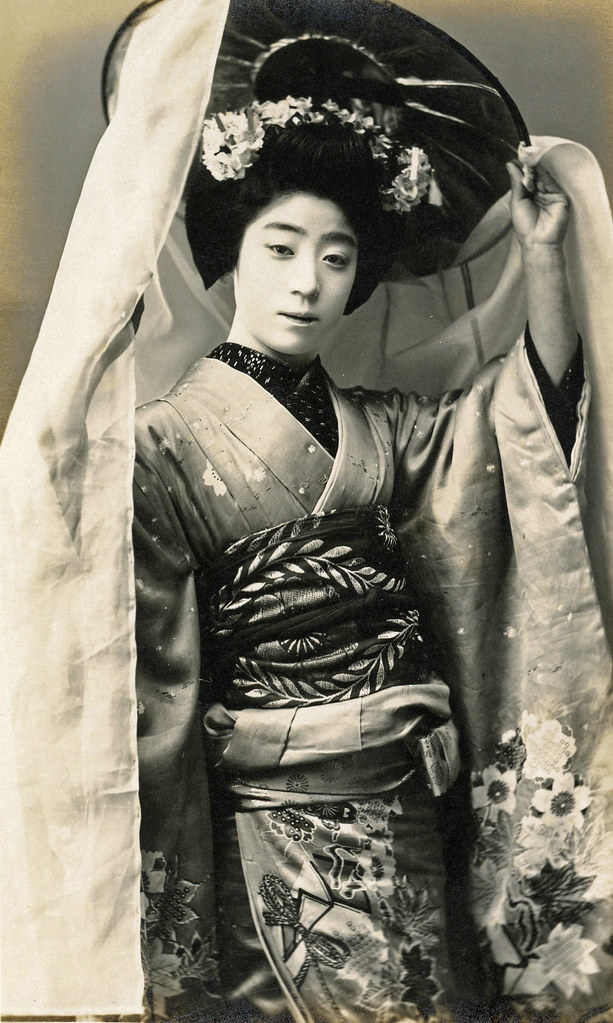
Geiko Yachiyo with a Heian Period Hat, 1910′s
Yachiyo dressed for the Ashibe odori (Ashibe public dance), holding a travelling hat from the Heian Period.
Yachiyo (1887-1924) was a famous geiko (geisha) from Osaka, known for her elegance and her lovely personality. People were said to weep with joy at the sight of her dancing. She became a maiko (apprentice geisha) at the age of thirteen and left the profession to marry the artist Suga Tatehiko at the age of twenty-nine. / src: Blue Ruin
 https://embedr.flickr.com/assets/client-code.js
Kichiya-musubi, 1905
A Geisha dressed in the Genroku style, fashionable among Tokyo Geisha around 1905-1908. She is showing her obi, tied in the Kichiya-musubi style, a knot named after Kamimura Kichiya (or Uemura Kichiya I) who was a popular Kabuki Actor during the Genroku period (1680′s).
The Kichiya-musubi was in fact a particularly famous and popular knot, mentioned specifically in a number of poems. The knot is a relatively simple one, but with small lead weights hidden in the obi, weighing down the ends of the bow, so they drooped “like the ears of a … Chinese lion-dog.” / src: Blue Ruin
 https://embedr.flickr.com/assets/client-code.js
Geiko Tomeko, sometime around the 1930′s / source: Blue Ruin
 https://embedr.flickr.com/assets/client-code.js
Geiko Tomigiku reading a Newspaper, 1921. The supremely stylish Tomigiku, dated 28/12/1921 on the reverse./ source: Blue Ruin
 https://embedr.flickr.com/assets/client-code.js
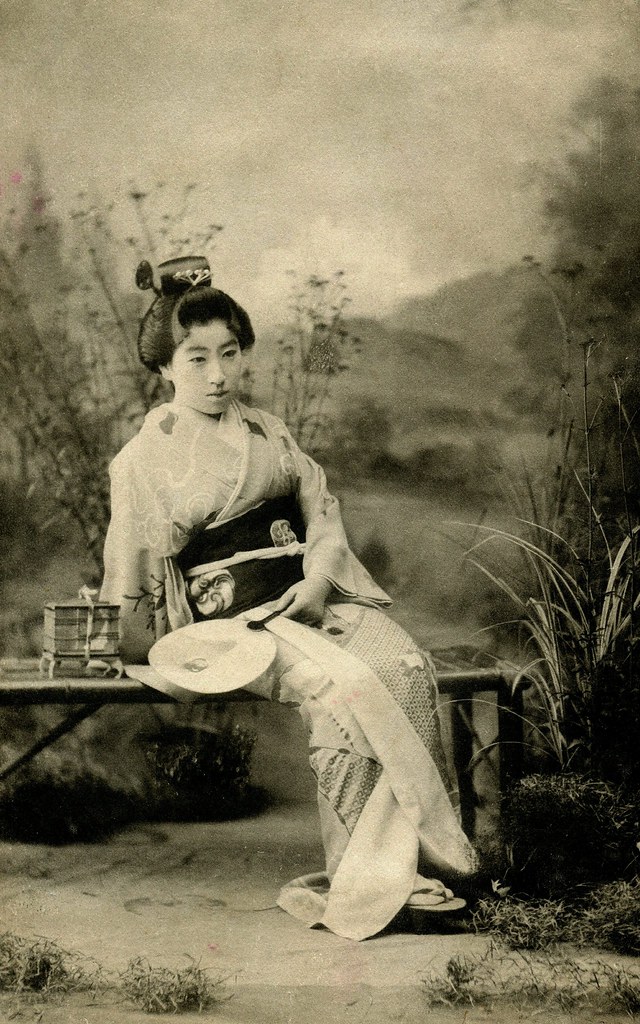
Shinbashi Geisha with a Cricket Cage, 1905. Insects as pets. / source: Blue Ruin
 un regard oblique