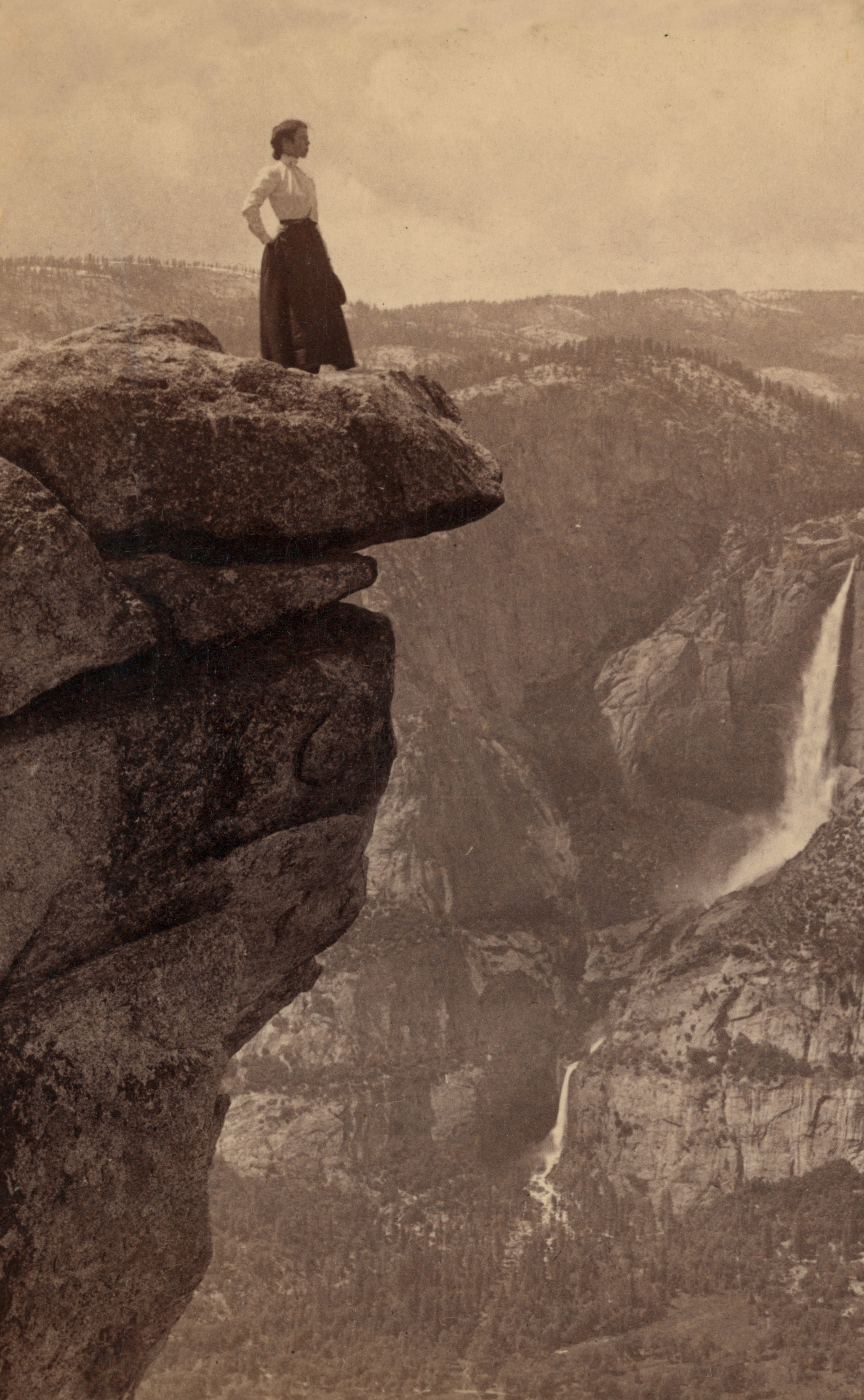
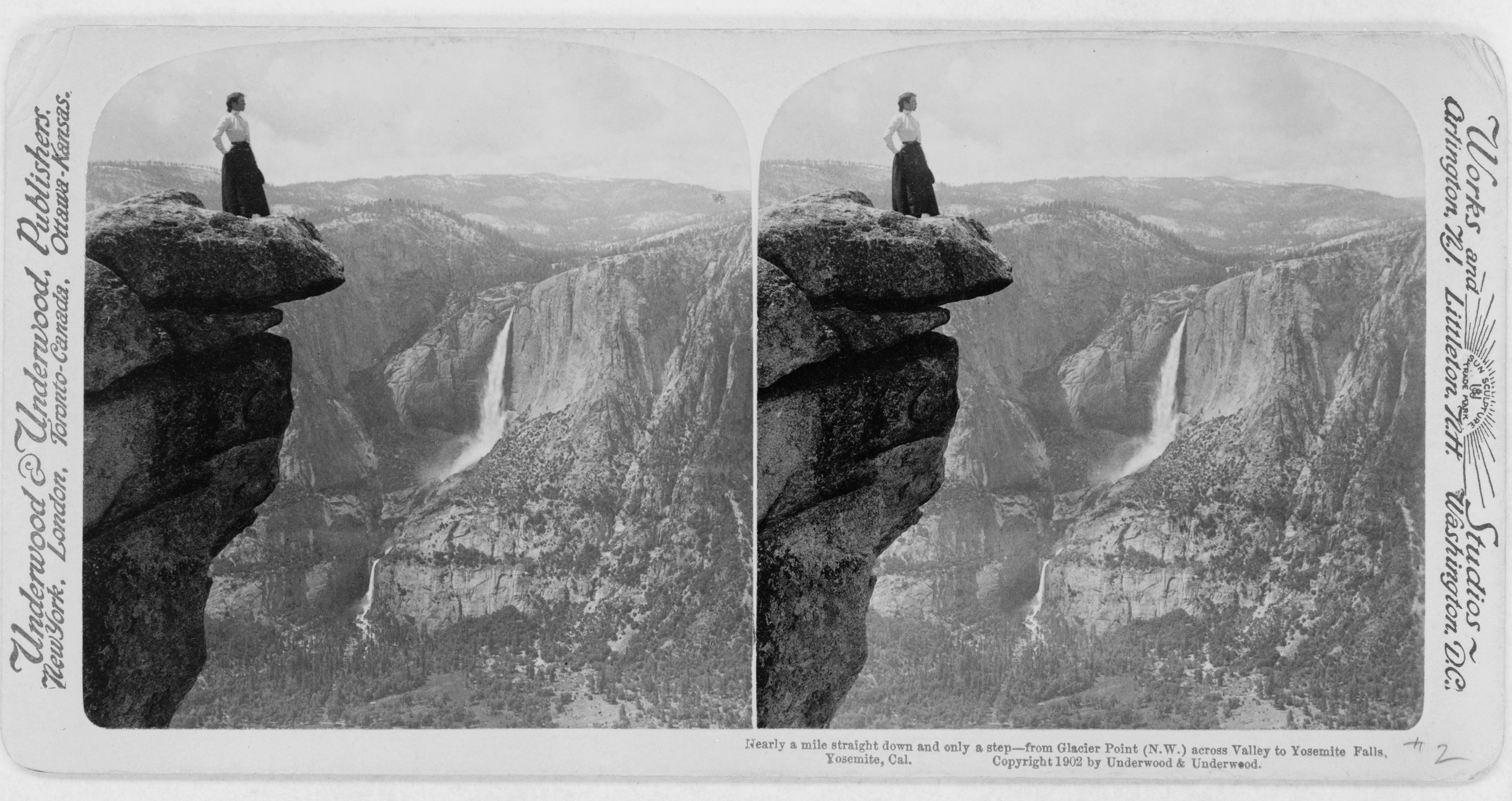
Nearly a mile straight down and only a step–from Glacier Point, Yosemite valley, ca. 1902 [detail]Nearly a mile straight down and only a step–from Glacier Point (N.W.) across valley to Yosemite Falls, Yosemite, Cal.,ca. 1902. Underwood & Underwood. Half stereo card.
Original title: Nearly a mile straight down and only a step–from Glacier Point (N.W.) across valley to Yosemite Falls, Yosemite, Cal. [Description: Woman standing on cliff overlooking deep valley.]. Underwood & Underwood, publishers, New York, ca. 1902. Digital file from original photo : photographic print on stereo card : stereograph. [scanned half stereo] | src Library of Congress
Underwood & Underwood :: Woman standing on cliff overlooking deep valley, 1900-1910B&W film copy negative from original stereo card | src Library of CongressView of woman standing on an overhanging rock at Glacier Point with Yosemite Falls seen in the distance. | src ALMA repository
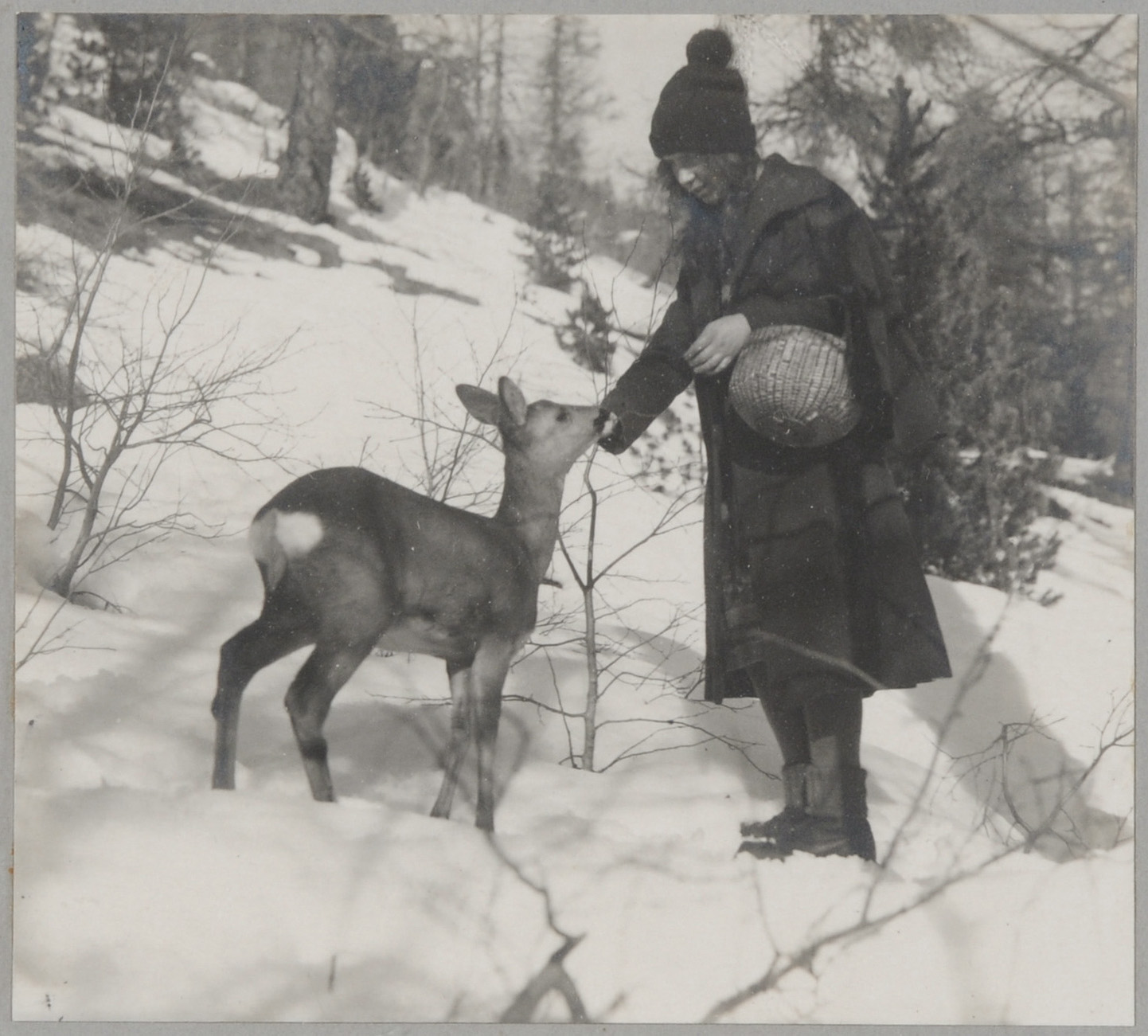
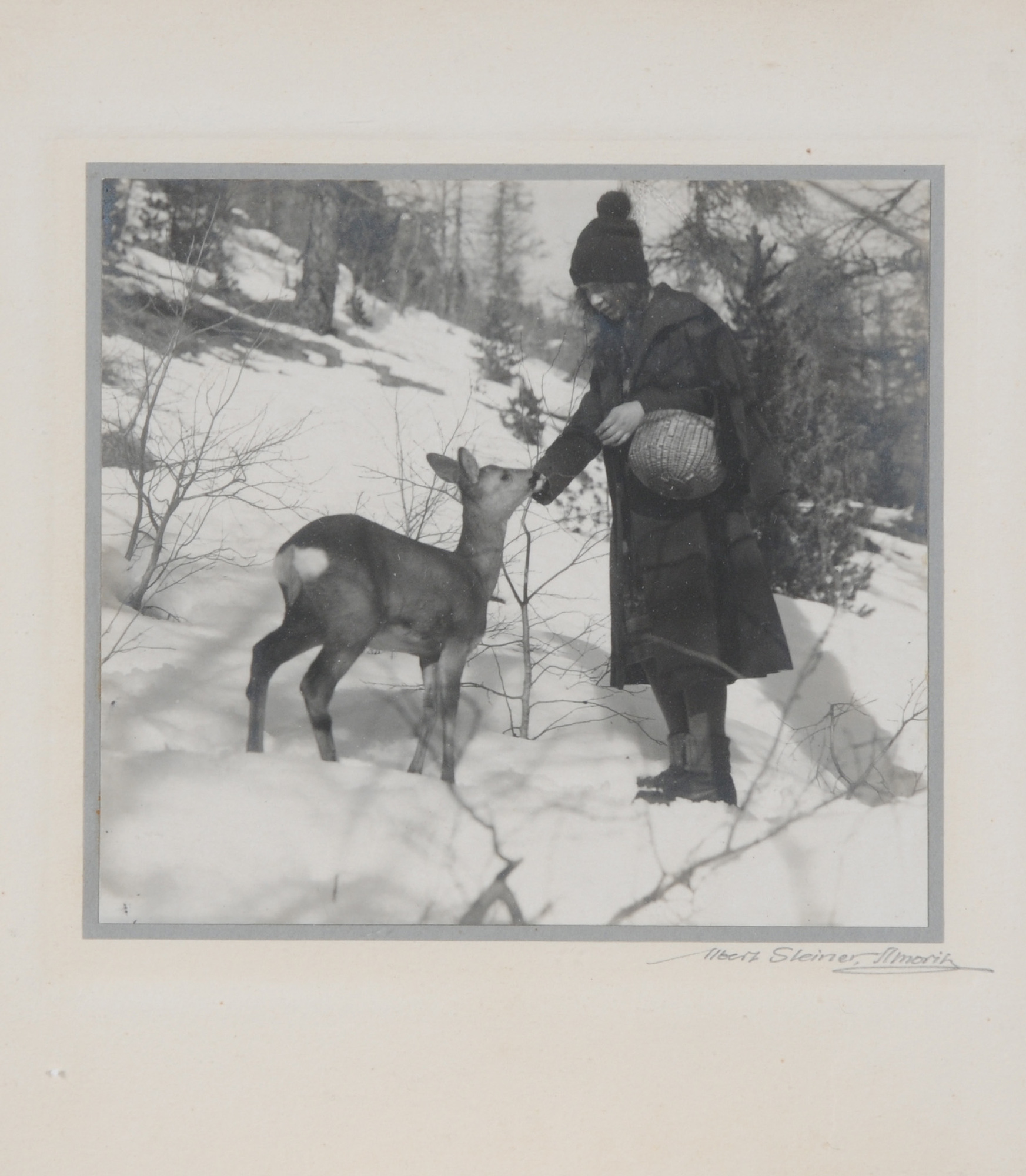
Albert Steiner (1877-1965) :: Frau mit Reh | Woman with Deer. | src Germann Auction House
Albert Steiner (1877-1965) is one of Switzerland’s outstanding 20th century photographers. His landscape photographs taken in the Engadine, where he lived and worked for 46 years, are unique on an international as well as a national level. They have had a major influence on an awareness of Switzerland as an unspoiled alpine country of surpassing beauty. Inspired by painters such as Giovanni Segantini and Ferdinand Hodler, Steiner took pictures that reveal a profound respect for and love of nature, as well as a tireless search for timeless beauty and metaphysical truth. His meticulously structured, light-saturated compositions are expressive witnesses of his experience of human insignificance in the face of the greatness and sublimity of the mountain world. Surprisingly, up till now Steiner’s work has not been accorded the appreciation it deserves.
Albert Steiner (1877-1965) :: Frau mit Reh | Woman with Deer. | src Germann Auction House
The exhibition “Albert Steiner, the photographic oeuvre”, which comprises around 150 photographs from various public and private collections, represents the first comprehensive overview of Steiner’s work, which reached its peak between 1910 and 1930. It also pays tribute to the different ways in which the photographer interpreted the mountain world. With his almost painterly photographs, associated as they were with pictorialism, he intensified the landscape almost to the point of unreality. With an objective and graphic visual language, his orientation in the 1920s was also based on the principles of the New Objectivity, and it was from this position that he created Switzerland’s first modern photography book (Schnee Winter Sonne, 1930), which may justifiably be compared with Albert Renger-Patzsch’s classic Die Welt ist schön (1928).
The origin of Steiner’s intensive, almost obsessive concern with the mountains was his own independent vision. More than any other Swiss photographer before him, Albert Steiner felt himself to be an artist. And, unlike many of his contemporaries, he regarded photography as a self-evidently appropriate means for creating works of art, an approach that effectively ensured the lasting relevanceof his work. [quoted from Fotostiftung Schweiz]
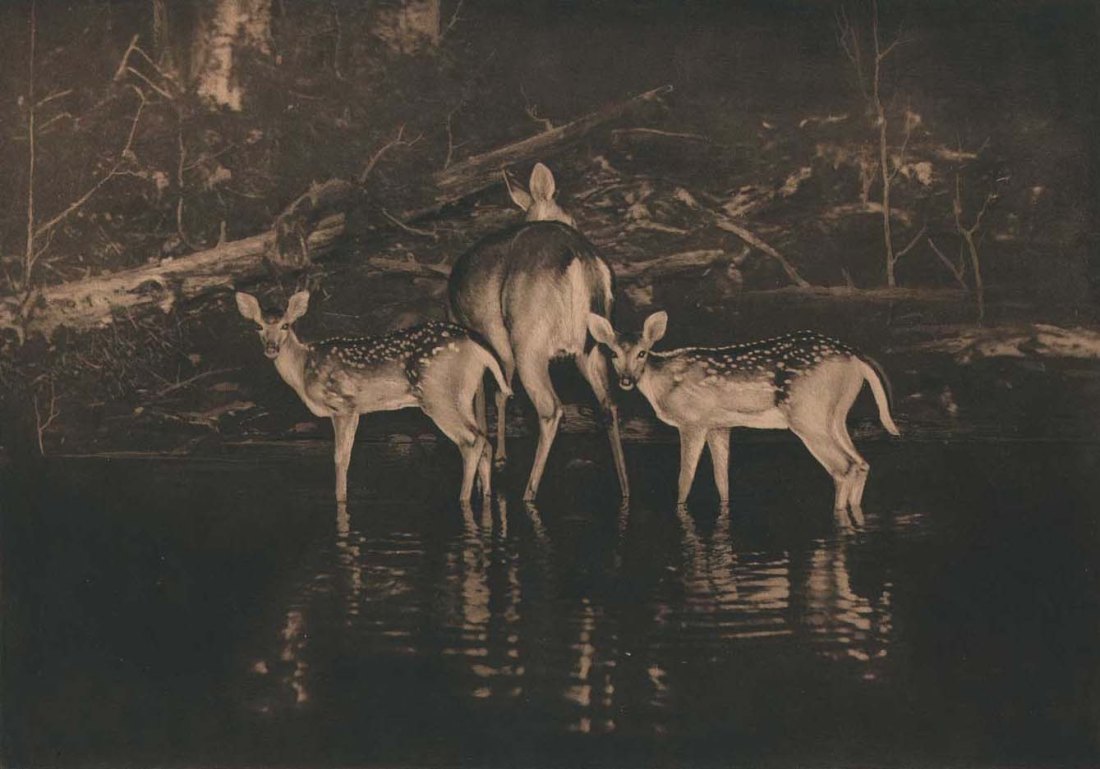
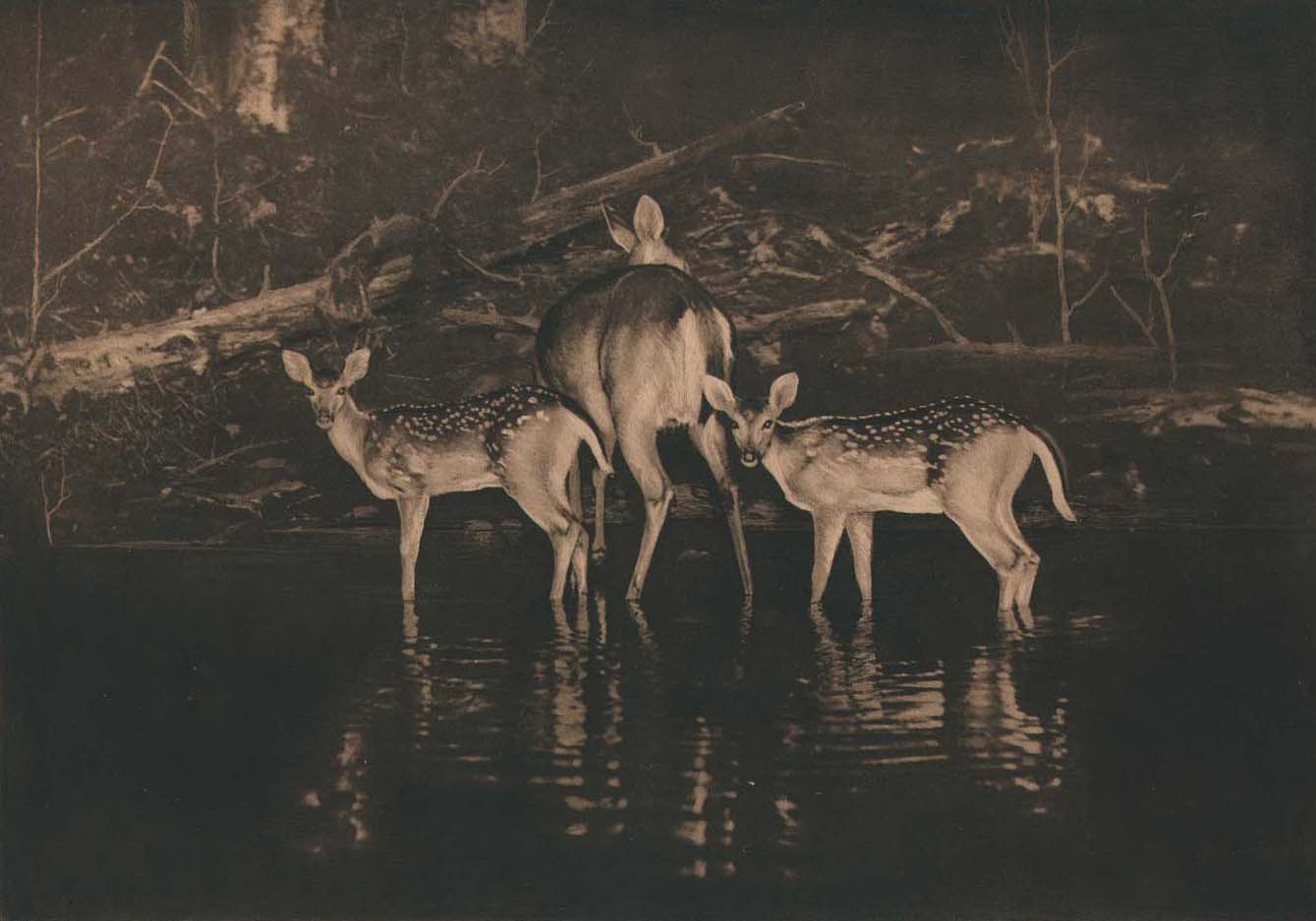
George Shiras, 3rd :: “A Doe and Twin Fawns” aka “Innocents Abroad” (taken 1896), printed 1916. Vintage photogravure published by the National Geographic Society, Washington, D.C. | src PhotoSeed
This groundbreaking photograph depicting three deer was taken at night in 1896 on one of the many lakes making up Michigan’s Upper Peninsula. It was eventually issued in 1916 as a large-format hand-pulled photogravure by the National Geographic Society, Washington, D.C. (it had previously appeared several times in the journal as a halftone-one a full-page gatefold). [quoted from PhotoSeed]
A Doe and Twin Fawns -also known as Innocents Abroad, would earn Shiras international acclaim and many important awards.
A pioneer of using flashlight photography to record wildlife in their natural environments at night, Shiras used the method of “Jacklighting”, a form of hunting using a fixed continuous light source mounted in the bow of a canoe to draw the attention of wildlife: in this case three deer, utilizing magnesium flash-powder to freeze the scene in-camera. His series of twelve midnight views, including A Doe and Twin Fawns -also known as Innocents Abroad, would earn Shiras international acclaim and many important awards.
A one-term Congressman for the state of Michigan, (his father George Shiras Sr. was a former Justice of the U.S. Supreme Court) he was also an important naturalist who helped placed migratory birds and fish under Federal control. (The eventual 1918 Migratory Bird Treaty Act had groundings in legislation Shiras introduced to Congress in 1903 as the first comprehensive migratory bird law not voted on.) For additional background, see article by Matthew Brower in the journal History of Photography, Summer, 2008: George Shiras and the Circulation of Wildlife Photography. [quoted from PhotoSeed]

George Shiras (III) :: A doe and her twin fawns feeding on a lake in northern Michigan, published 1935
A doe and her twin fawns feeding on a lake in northern Michigan. From: Hunting wild life with camera and flashlight : a record of sixty-five years’ visits to the woods and waters of North America. Volume I, National Geographic Society, 1935. | src Memorial University of Newfoundland










 un regard oblique