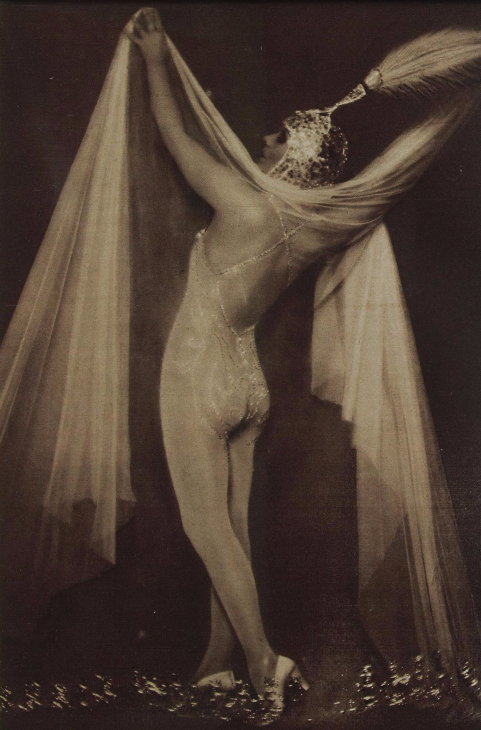
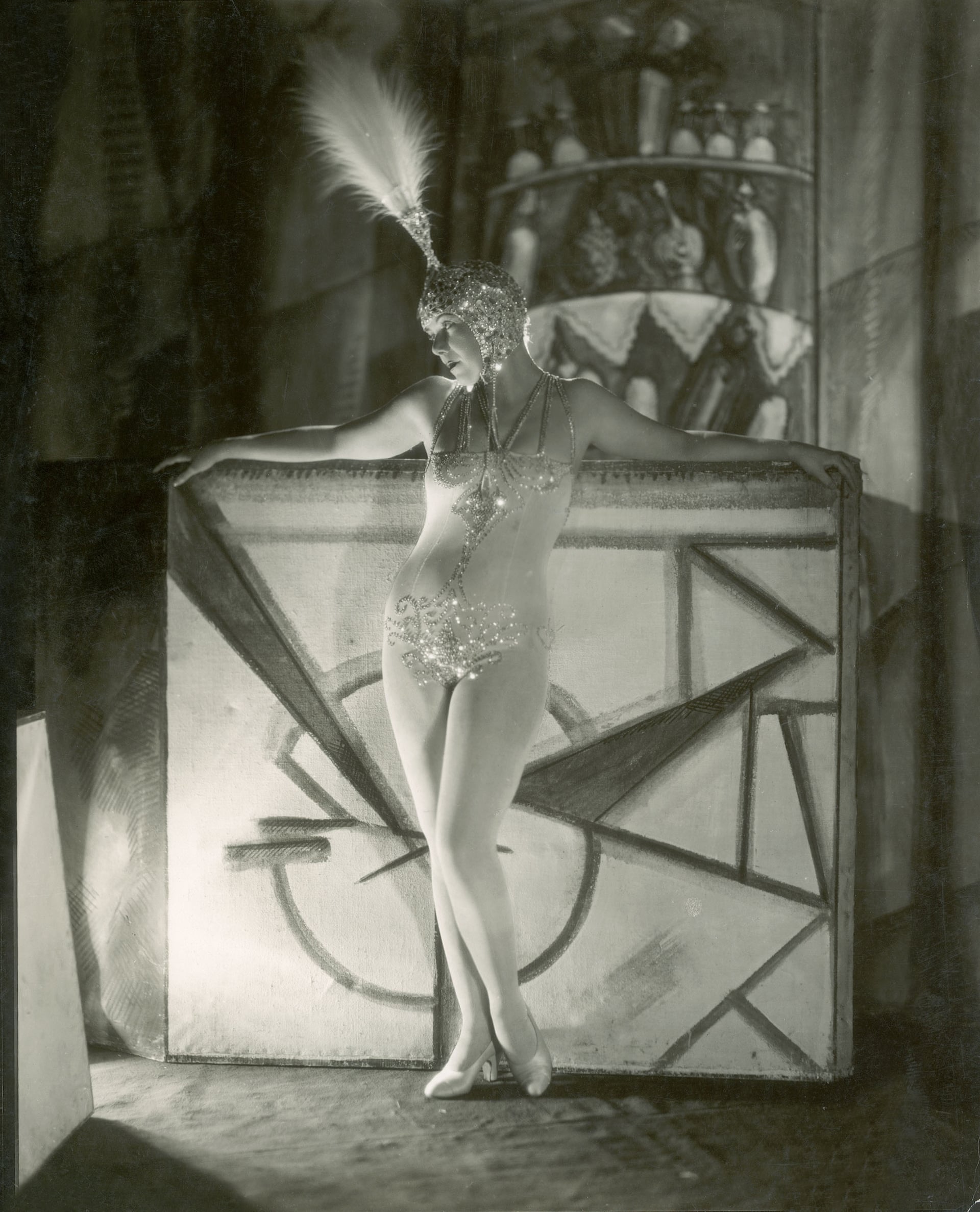
Andrée Spinelly, 1924-1927

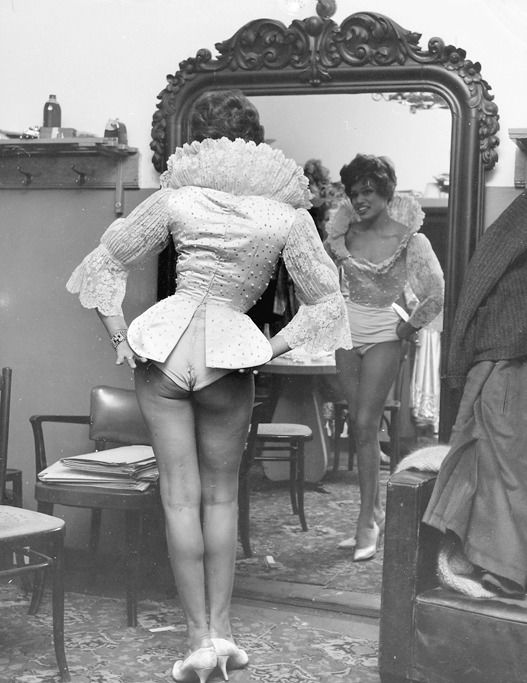
Andrée Spinelly, Paris, 1927 | src The Guardian: Fops and flappers: wild fashions of the 1920s
Madame d'Ora :: Andrée Spinelly, published in ‘Revue des Monats’, March 1927
Madame d’Ora :: Andrée Spinelly, published in ‘Revue des Monats’, March 1927
Andrée Spinelly, Paris, 1927. These bejewelled creations hit new heights of eroticism and sophistication in the outfits worn by dancers at Parisian nightclubs like the Moulin Rouge. src The Guardian: Fops and flappers: wild fashions of the 1920s
Andrée Spinelly, Paris, 1927. These bejewelled creations hit new heights of eroticism and sophistication in the outfits worn by dancers at Parisian nightclubs like the Moulin Rouge | src The Guardian: Fops and flappers: wild fashions of the 1920s
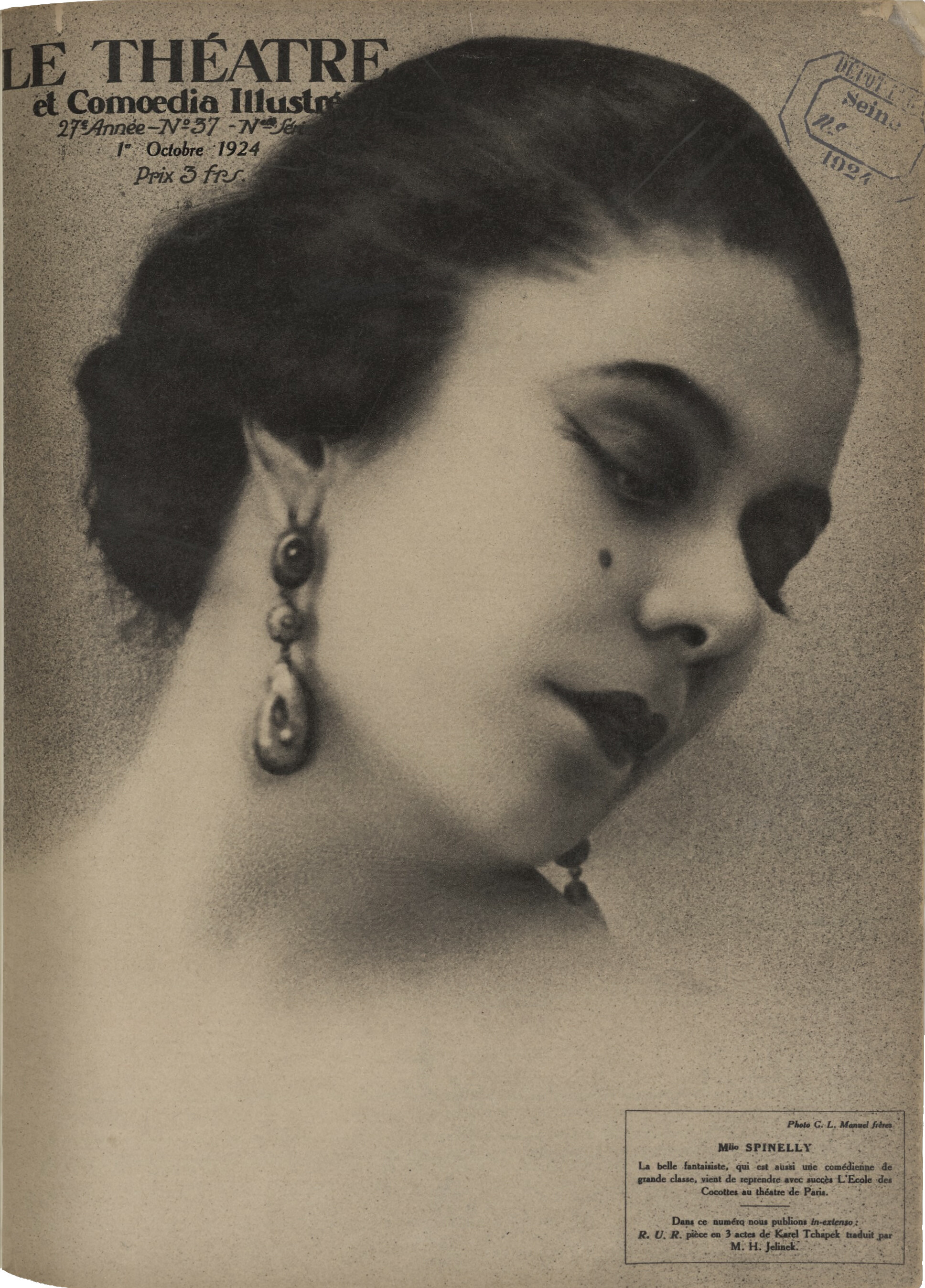
Photo G. L. Manuel frères. Mlle. Spinelly. The beautiful fantaisiste, who is also a high-class actress, has just successfully taken over L’Ecole des Cocottes at the Paris theater. Original: La belle fantaisiste, qui est aussi une comédienne de grande classe, vient de reprendre avec succès L’Ecole des Cocottes au théâtre de Paris. Le Théâtre et Comœdia illustré, Octobre 1924. | src BnF ~ Gallica
Photo G. L. Manuel frères. Mlle. Spinelly. The beautiful fantaisiste, who is also a high-class actress, has just successfully taken over L’Ecole des Cocottes at the Paris theater. Original: La belle fantaisiste, qui est aussi une comédienne de grande classe, vient de reprendre avec succès L’Ecole des Cocottes au théâtre de Paris. Le Théâtre et Comœdia illustré, Octobre 1924 | src BnF ~ Gallica
French actress Andrée Spinelly (1887-1966) known as Spinelly. Vintage French postcard. A.N. [Alfred Noyer], Paris, nº 49, 1920s. Photo by Studio G.L. Manuel Frères | src Flickr

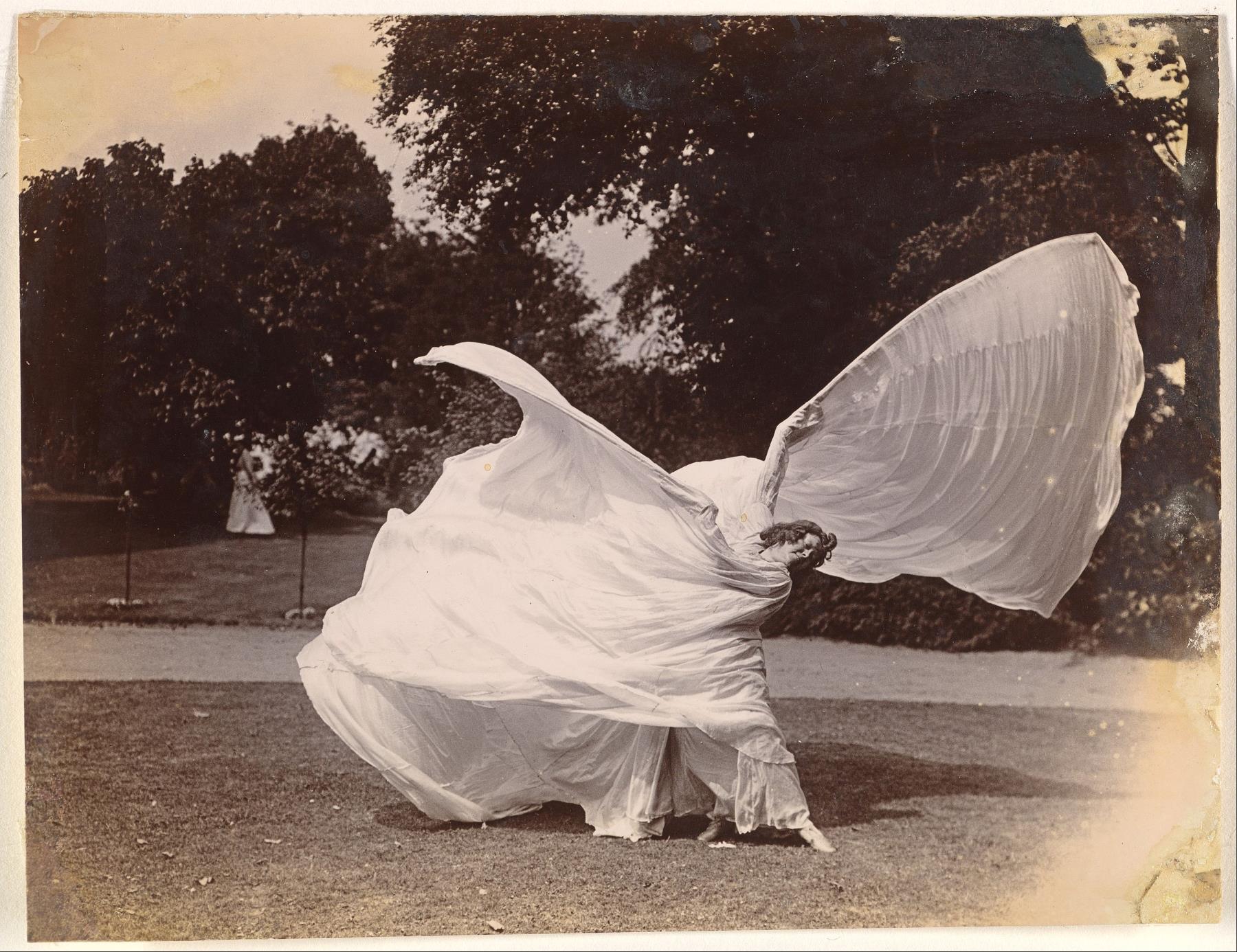
Loie Fuller by Beckett

Samuel Joshua Beckett (1870–1940) ~ Loïe Fuller (1862 – 1928) dancing, ca. 1900. Gelatin silver print | src the Met

The American dancer Loie Fuller (1862-1928) conquered Paris on her opening night at the Folies-Bergère on November 5, 1892. Manipulating with bamboo sticks an immense skirt made of over a hundred yards of translucent, iridescent silk, the dancer evoked organic forms –butterflies, flowers, and flames–in perpetual metamorphosis through a play of colored lights. Loie Fuller’s innovative lighting effects, some of which she patented, transformed her dances into enthralling syntheses of movement, color, and music, in which the dancer herself all but vanished. Artists and writers of the 1890s praised her art as an aesthetic breakthrough, and the Symbolist poet Stéphane Mallarmé, who saw her perform in 1893, wrote in his essay on her that her dance was “the theatrical form of poetry par excellence.” Immensely popular, she had her own theater at the 1900 Exposition Universelle in Paris, promoted other women dancers including Isadora Duncan, directed experimental movies, and stopped performing only in 1925.
Loie Fuller’s whirling, undulating silhouette, which embodied the fluid lines of Art Nouveau, inspired many images, from the portraits of Toulouse-Lautrec and the posters of Jules Chéret and Alphonse Mucha to the sculptures of Pierre Roche and Théodore Rivière, as well as the photographs of Harry C. Ellis and Eugène Druet.

The pictures shown here depict movements from such dances as “Dance of the Lily” and “Dance of Flame.” These images do not pretend to evoke the otherworldly effect of the performance, which took place on a darkened stage in front of a complex set of mirrors and whose magic was entirely dependent on lighting. Here, the strange shapes, reminiscent of chalices and butterflies, take form, incongruously, in the middle of an urban park, through the efforts of a short, stout figure. Arrested in crude natural light, they still retain, however, their spellbinding energy. Part of a group of thirteen photographs complemented by six others in the Musée d’Orsay, Paris, these images belonged to the sculptor Théodore Rivière (1857-1912), and were previously thought to have been made by him. They have now been reattributed to Samuel Joshua Beckett, a photographer working in London. / quoted from the Met
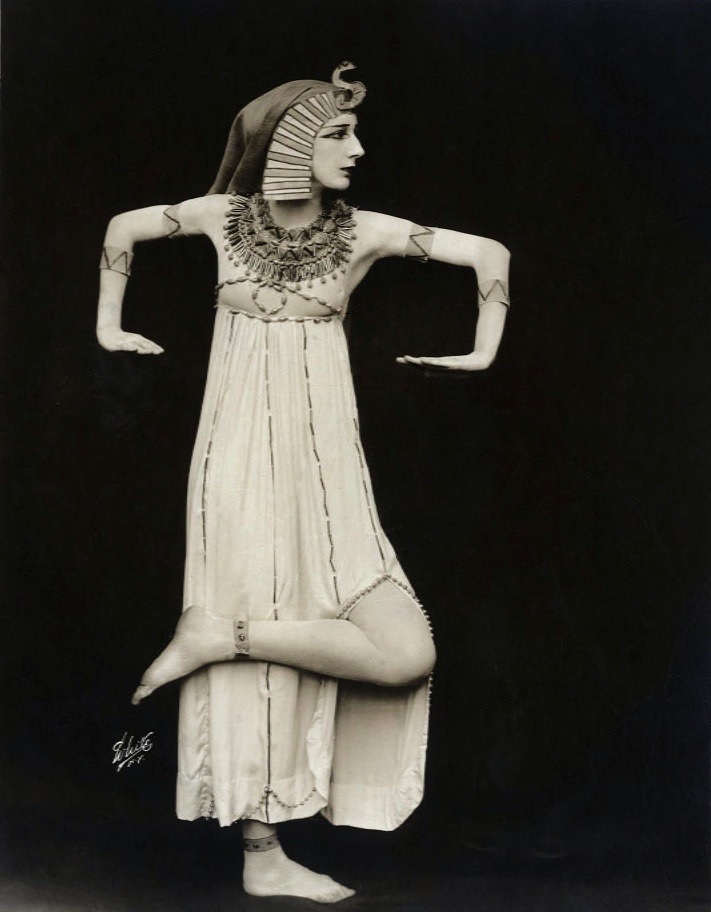
Lubovska as Cleopatra, 1915

White Studio (NY) :: Portrait of ‘Russian’ dancer Désirée Lubowska [aka Mme Lubowska or Lubovska], full-length portrait, standing, right profile, in Cleopatra costume, 1915. (Désirée Lubovska was not actually Russian. It was the stage name of American born dancer Winniefred Foote). | src Les sources d’une île

Sisters of Terpsichore, 1920

Hixon-Connelly Studio :: Sisters Miriam and Irene Marmein. Sisters of Terpsichore. Published in Shadowland, January 1920 issue. | src Internet Archive (LofC)

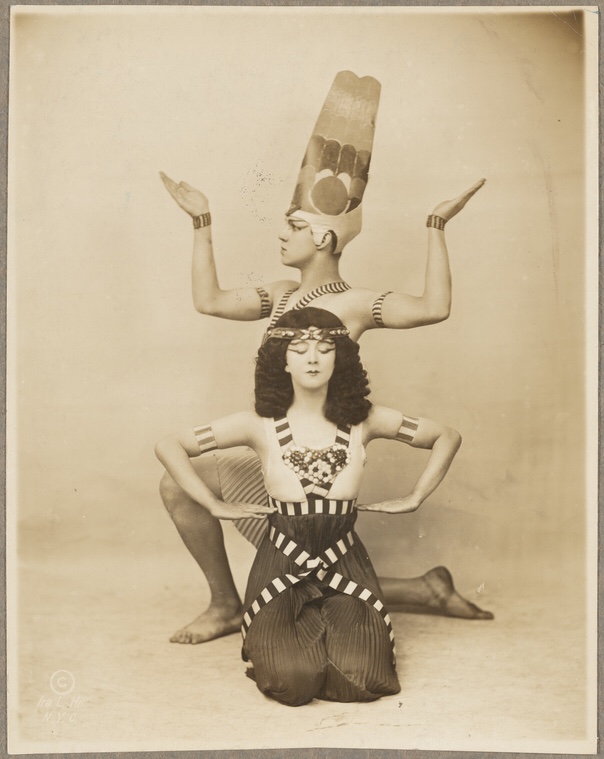
Ruth St Denis and Ted Shawn, 1916

Ira Lawrence Hill :: Ruth St Denis and Ted Shawn in Dance of the Rebirth from the Egyptian section of the Review of Dance Pageant, 1916. | src NYPL~Jerome Robbins Dance Division

Masquerade,1924

Maskerade, carnaval. Uit het maskerade-ballet ‘Sand und Wind’ door kunstenaarspaar Anna Wilström en Helmut Lotz, 1924. | Masquerade, carnival. From the masquerade ballet ‘Sand und Wind’ by artist couple Anna Wilström and Helmut Lotz, 1924. Het Leven magazine (leven 022) |src Nationaal Archief