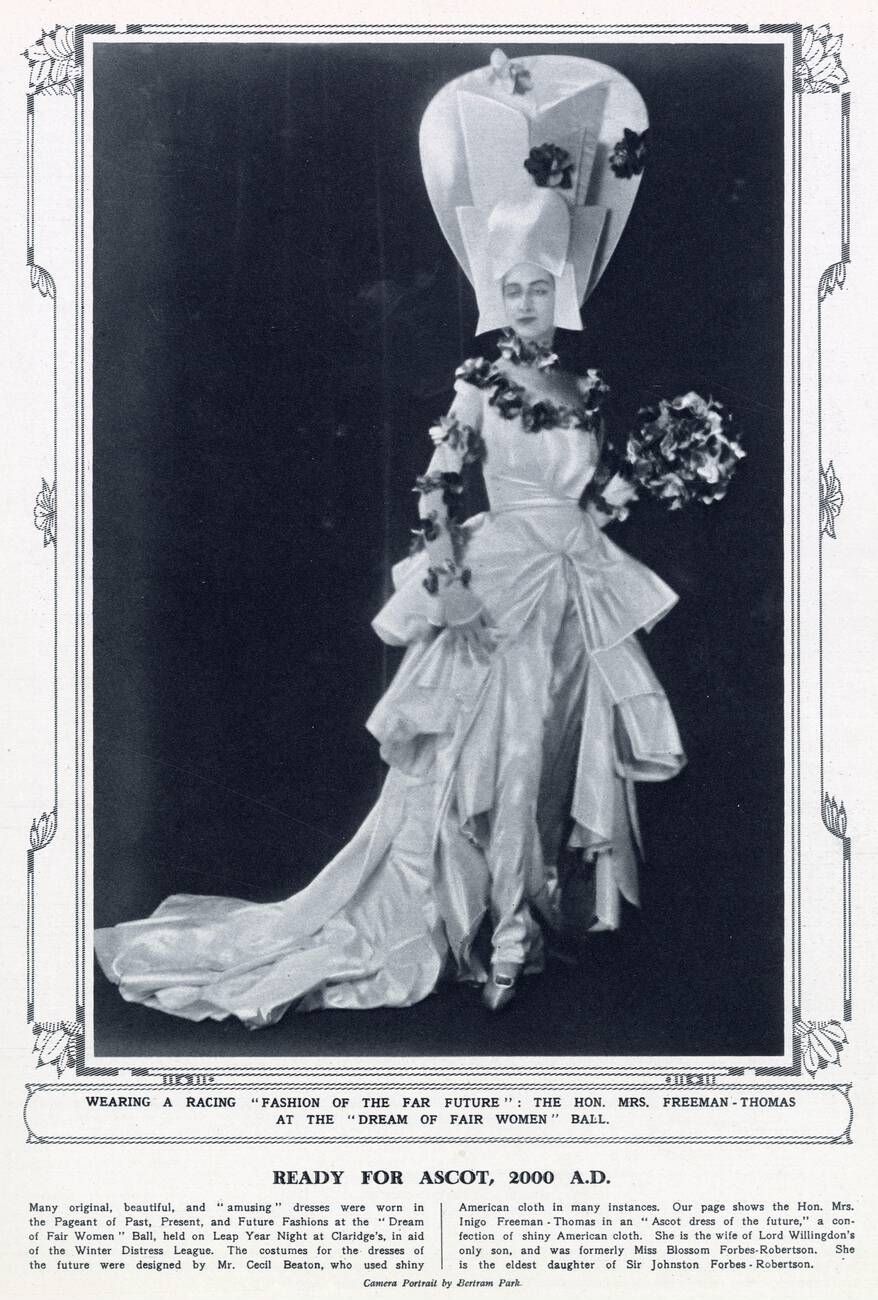
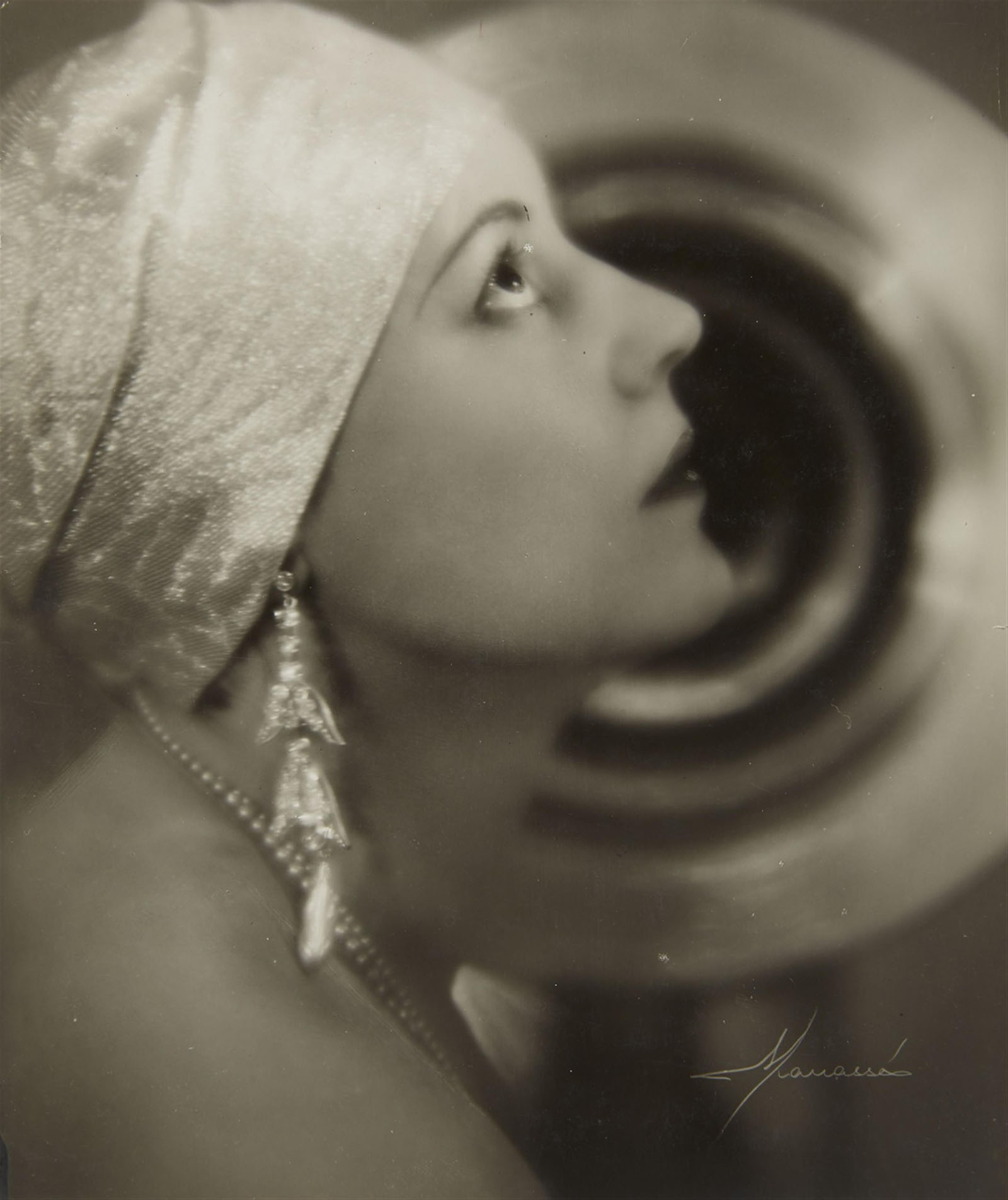
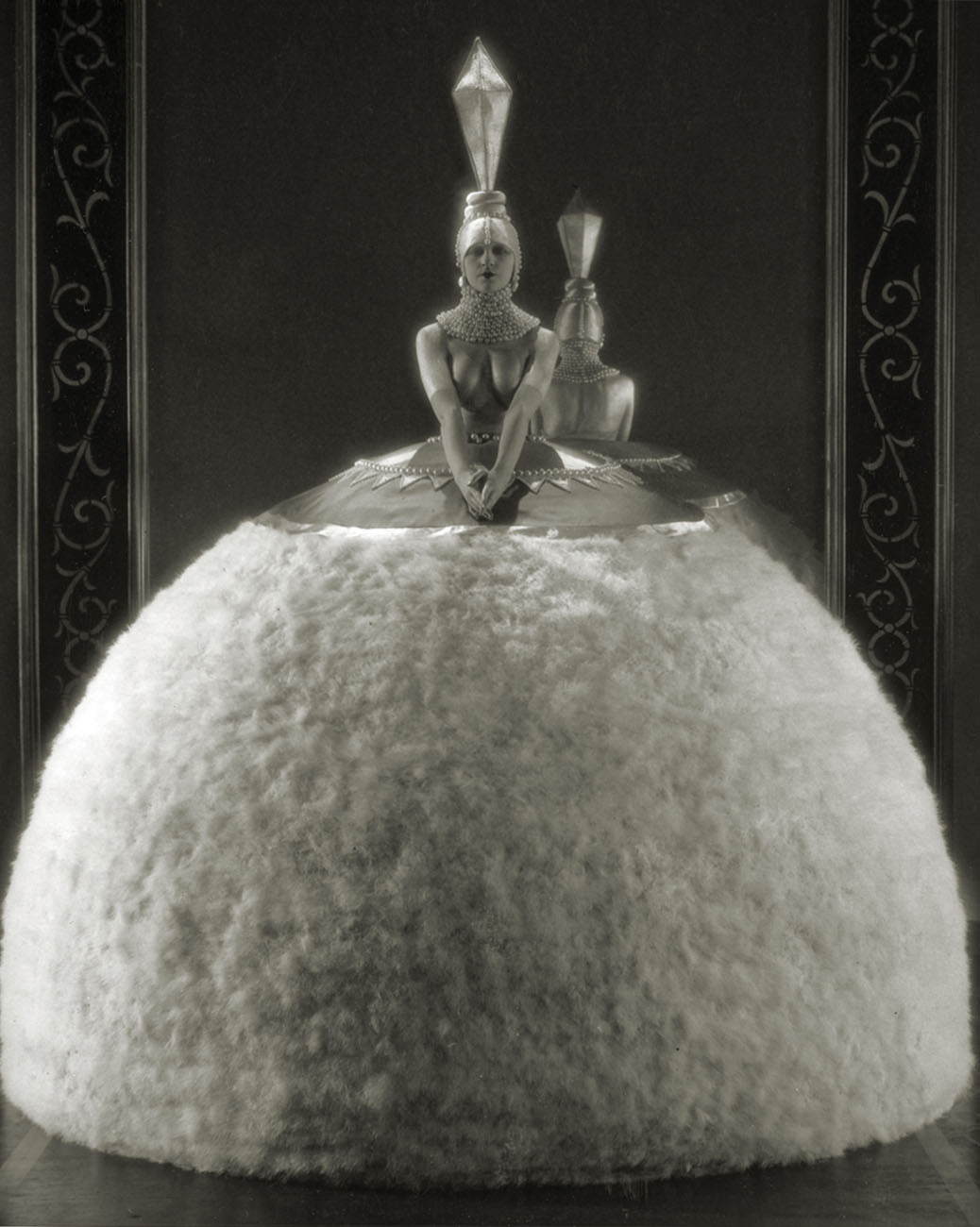
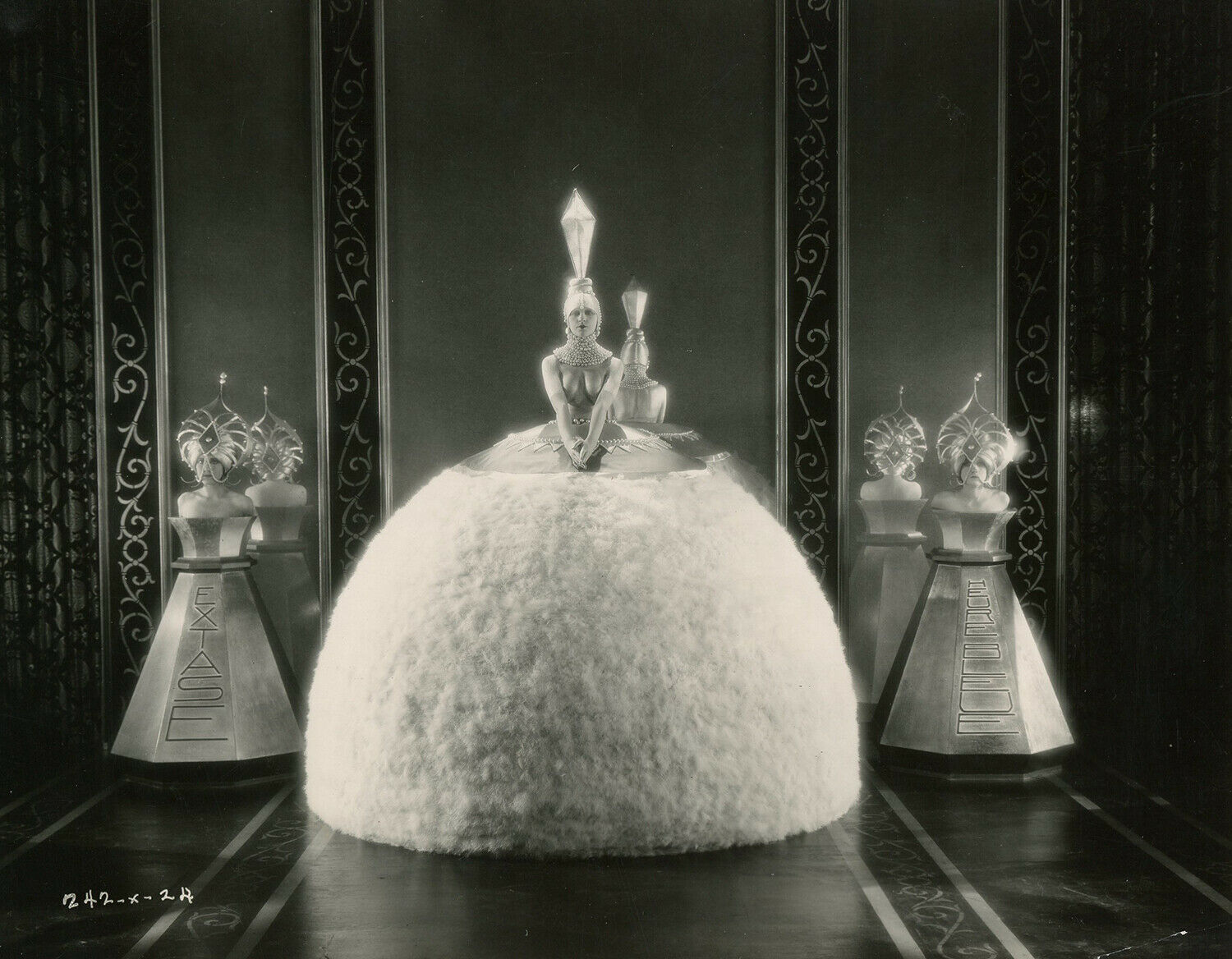
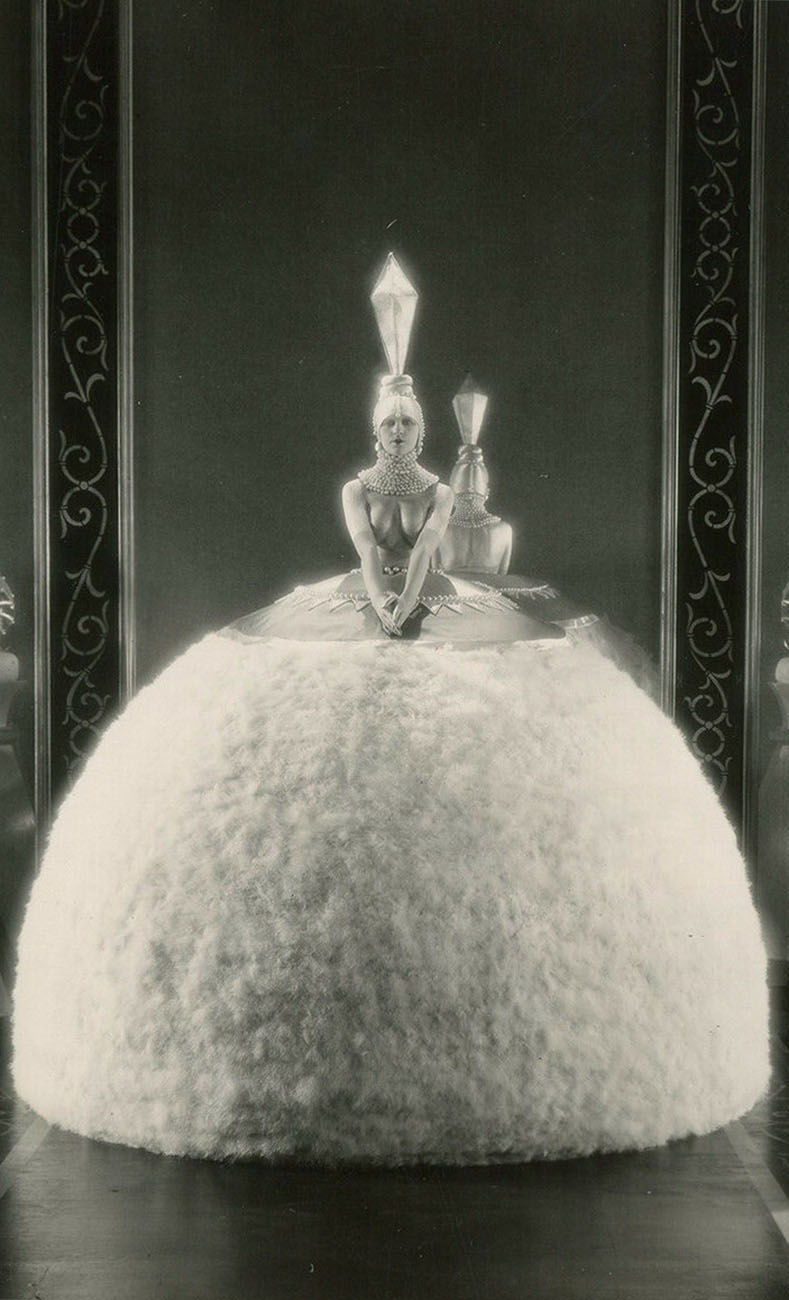
The Pageant of Past, Present and Future Fashions was held on 29th February 1928 (Leap Year Night) at Claridge’s (London) in aid of the Winter Distress League. The costumes for the dresses of the (far) future were designed by Cecil Beaton. The image above shows Ms. Freeman-Thomas in an outfit titled ‘The Ascot Dress of the Future’.
Detail from Mrs Freeman-Thomas by Cecil Beaton (formerly Miss Blossom Forbes-Robertson), 1928
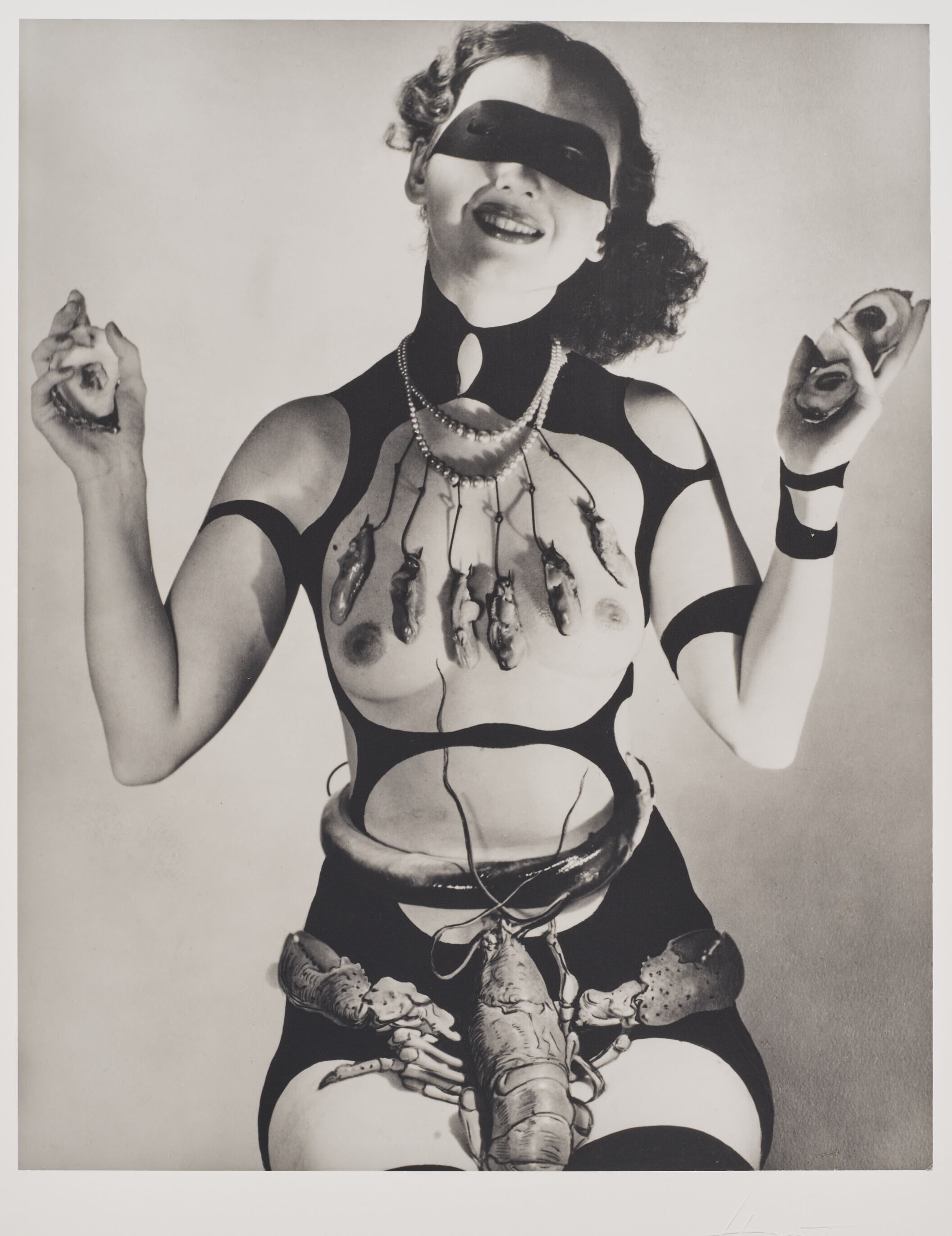
Horst P. Horst (1906–1999) ~ Costume design by Salvador Dali for ‘Dream of Venus’, 1939 | src Christie’sHorst P. Horst (1906–1999) ~ Costume design by Salvador Dalí for ‘Dream of Venus’ (Lobster # 1), 1939 | src Christie’s
In June 1939 Salvador Dalí designed a pavilion for the New York World’s Fair built by the architect Ian Woodner. The building was named Dream of Venus.
The pavilion featured a spectacular facade full of protuberances, vaguely reminiscent of the Pedrera building by Antoni Gaudí. The main door was flanked by two pillars representing two female legs wearing stockings and high-heeled shoes. Through the openings of the irregular façade, visitors could see reproductions of the Saint John the Baptist by Leonardo da Vinci and The Birth of Venus by Botticelli. The outer part of the building also had crutches, cacti, hedgehogs, etc. Inside, the pavilion offered visitors an aquatic dance show in two large swimming pools, with sirens and other items also designed by Dalí, some of them taking their inspiration from the work of Bracelli. Between the painter’s initial ideas and the final result of the project there arose major modifications, which led Dalí to complain about the Fair’s requirements in a pamphlet entitled Declaration of the Independence of the Imagination and the Rights of Man to His Own Madness. […] [quoted from dali.org]
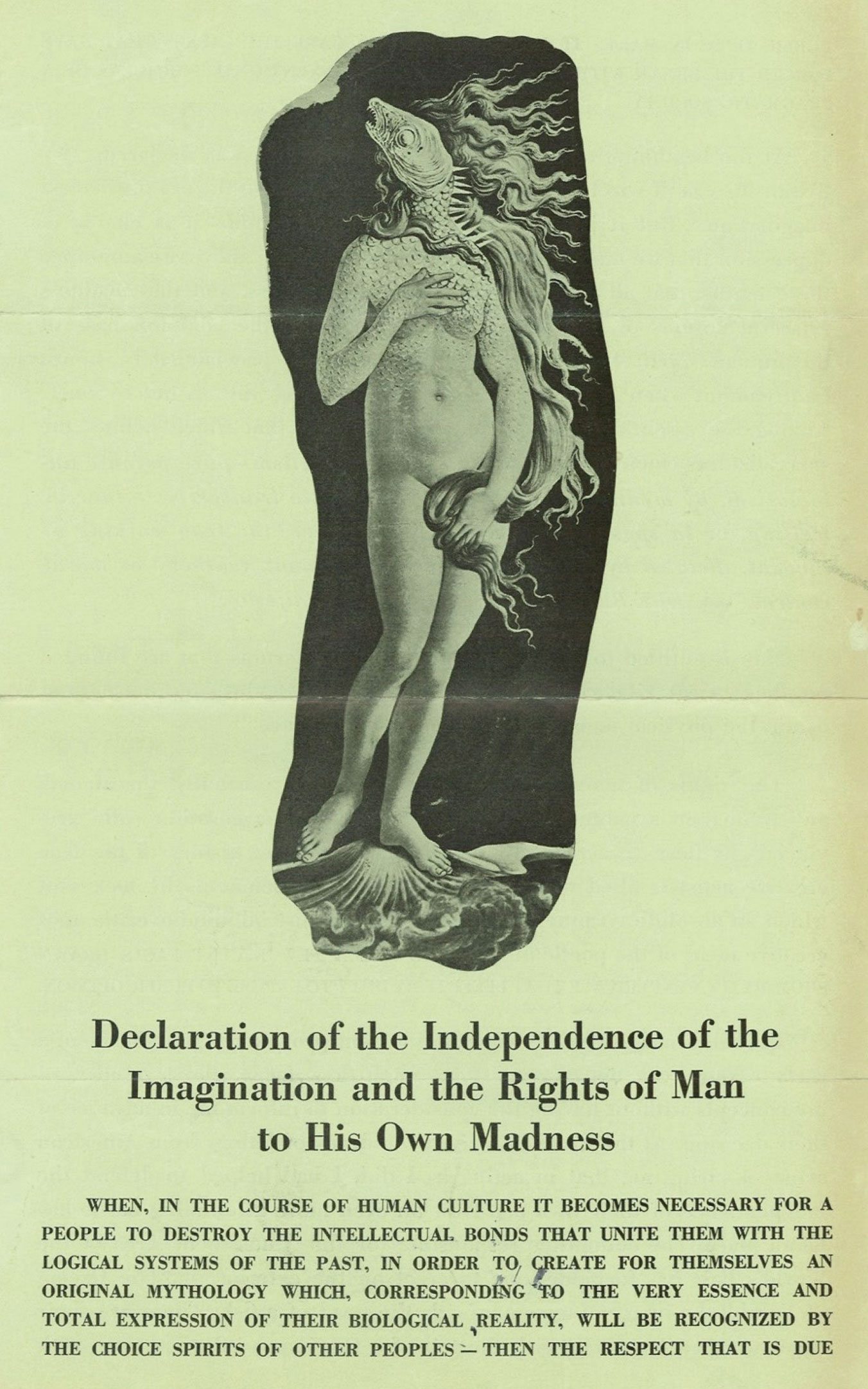
Salvador Dalí (1904 – 1989) ~ Declaration of the Independence of the Imagination and the Rights of Man to His Own Madness, 1939, ink on paper | src National Art Library; also AIC
Salvador Dalí wrote this declaration after his experience creating a pavilion for the 1939 New York World’s fair. The ‘Dream of Venus’ pavilion was a Surrealist undersea grotto where semi naked women performed in tanks playing piano and milking cows amongst other suitably surreal activities. The image on this pamphlet of Botticelli’s Venus with the head of a fish was Dalí’s original idea for the Pavilion’s entrance. However, the design was rejected by the Fair’s organizers who stated “‘A woman with the head of a fish is impossible” and replaced it with a simple reproduction of Venus. Believing that his artistic vision had been unacceptably compromised, Dalí responded by producing this pamphlet berating the Fair’s organizers and rallying against mediocrity in art by consensus. [quoted from V&A museum]
Julien Levy ~ Facade of the pavilion “Dream of Venus” conceived by Salvador Dalí for the New York World Fair (1939) | src AIC
[…] Despite the conflicts that derived from Dalí’s collaboration with the organizers of the Fair, his participation has to be rated as a highly important moment within the painter’s increasing approximation to mass culture, and his need to project his ideas beyond the strict circles of artistic culture. In this sense it may not be exaggerated to state that The Dream of Venus was a first version (though with features and a context of its own) of that other enormous “inhabitable” and “visitable” artistic object that was to be the Dalí Theatre-Museum of Figueres many years later. [quoted from dali.org]
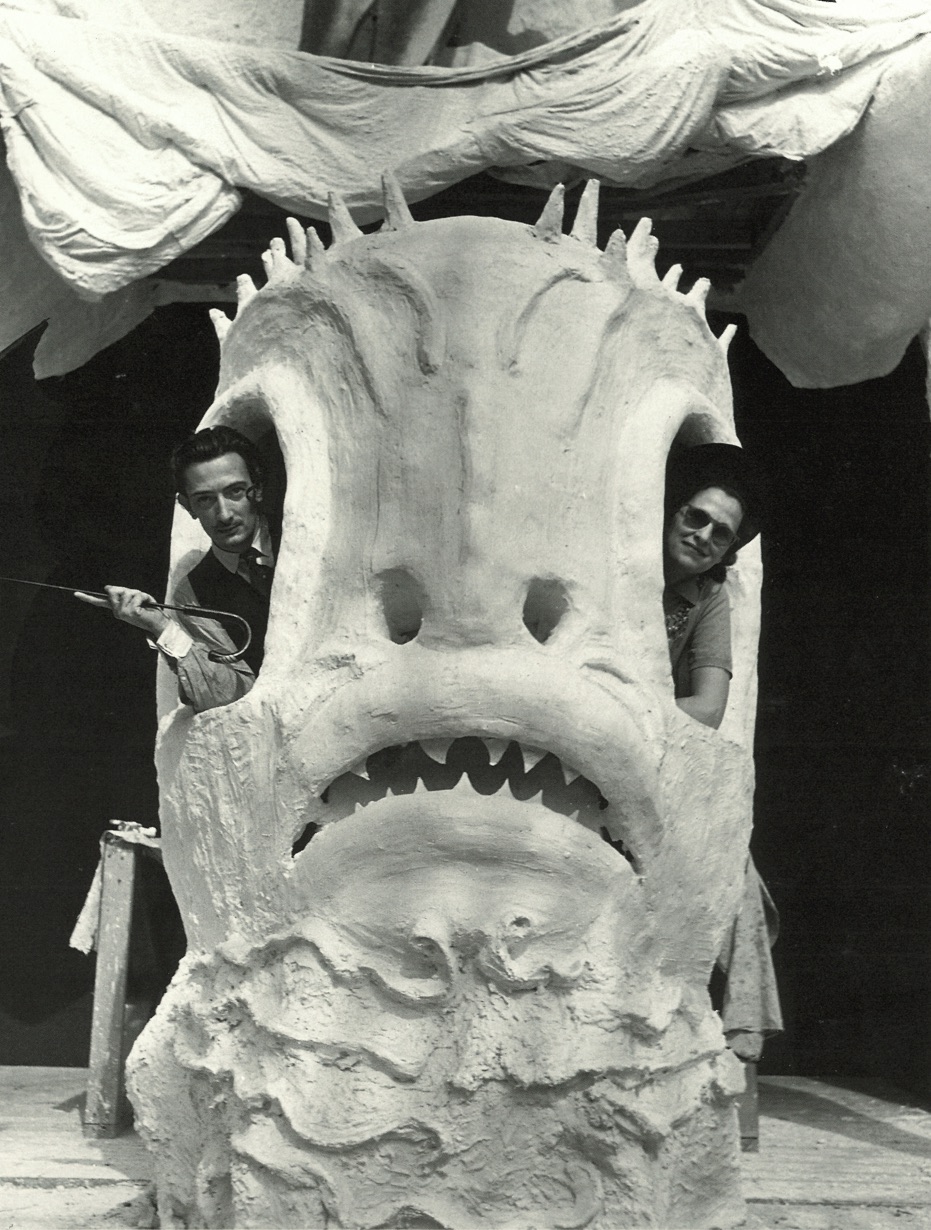
Gala and Dalí in the ticket booth of the pavilion “Dream of Venus” by Salvador Dalí for the New York World Fair (1939)Entrance of the pavilion “Dream of Venus” conceived by Salvador Dalí for the New York World Fair (1939)
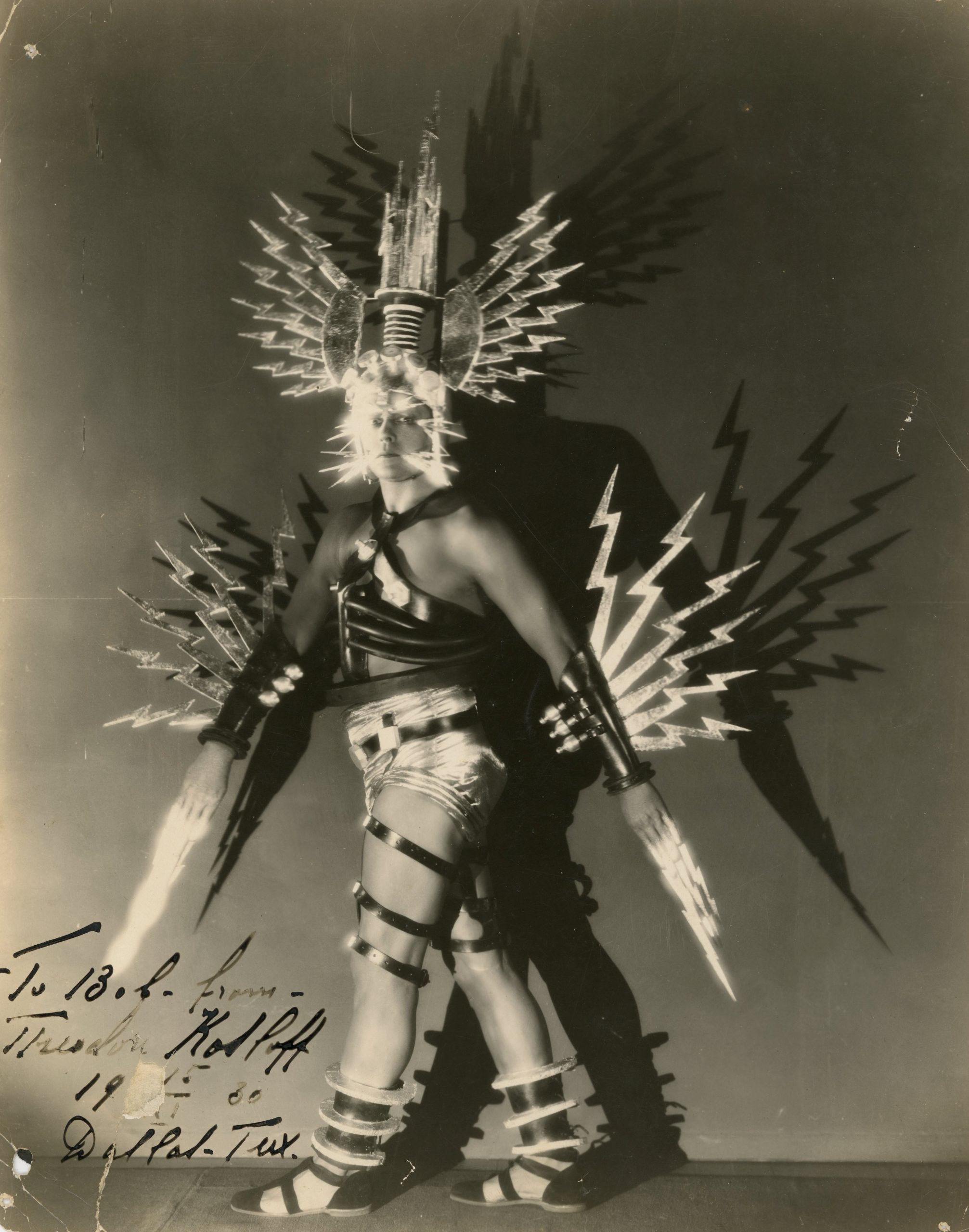
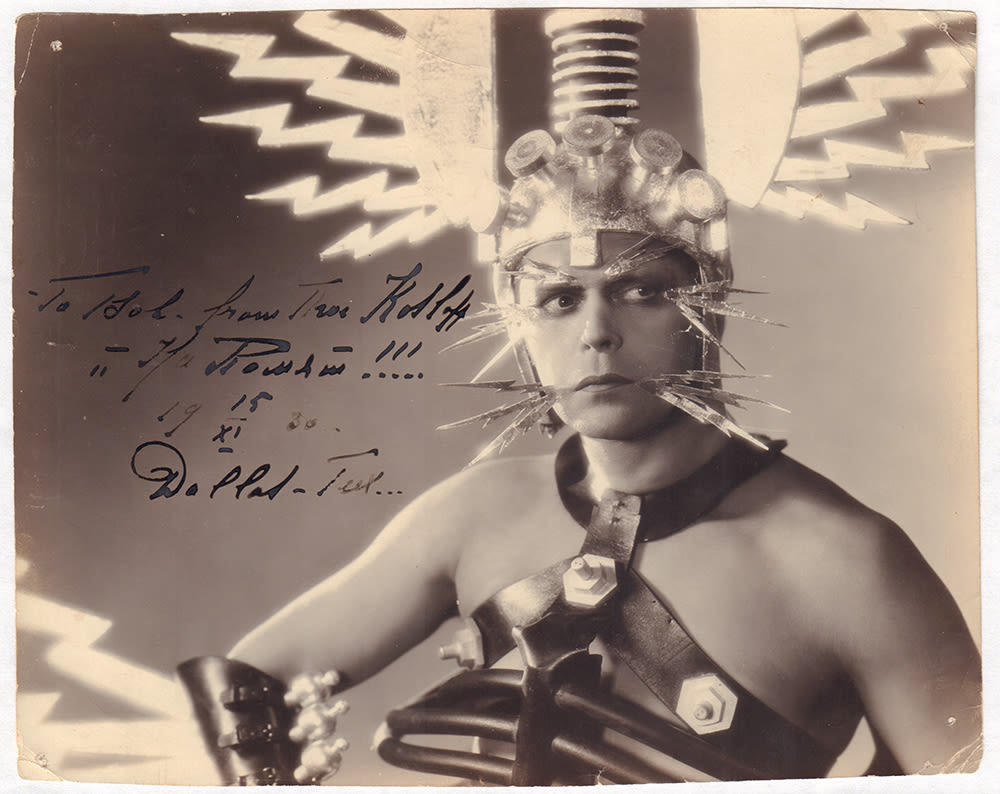
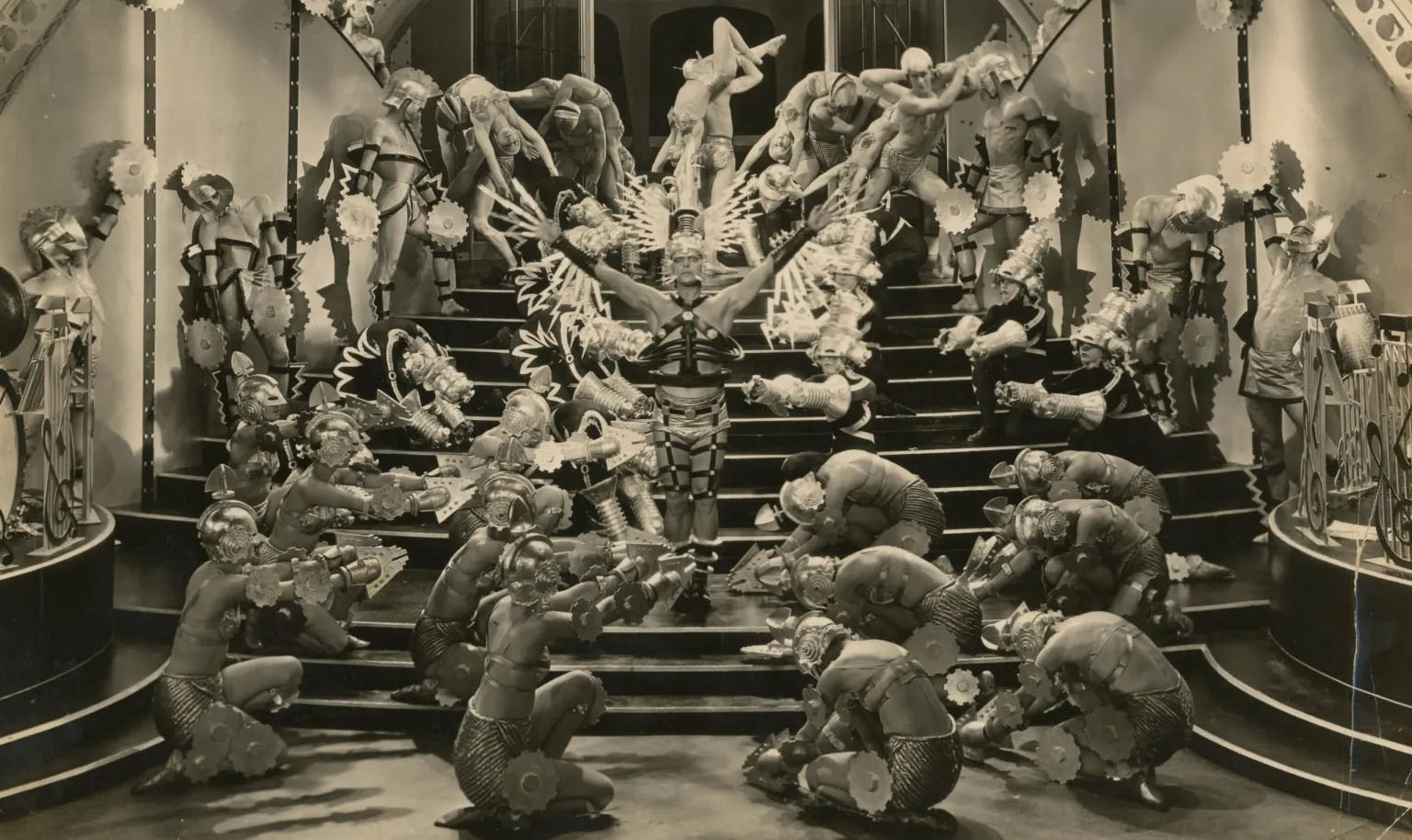
Theodore Kosloff dans un costume Electricity d’Adrian, pour la séquence de ballet intitulé Ballet Mécanique, dans Madam Satan, le film de Cecil B. DeMille, 1930“Madam Satan” film photograph featuring Theodore Kosloff as “Electricity”, 1930. | src Special Collections Research Center, George Mason University Libraries C0468“Madam Satan” film photograph featuring Theodore Kosloff as “Electricity” and a group of dancers dressed as turbines or generators for the ballet sequence entitled Ballet Mechanique. | src George Mason University Libraries
Publicity still for the American romantic comedy film Bright Lights (Robert Z. Leonard, 1925) Lilyan Tashman in the perfume bottle costume designed by Erté in Bright Lights (Robert Z. Leonard, 1925)
Image retrieved from Wikimedia commons. Original source, according to Wikimedia: Vieira, Mark A. (2019). Forbidden Hollywood: The Pre-Code Era (1930-1934): When Sin Ruled the Movies (eBook). New York: Running Press. Hachette Book Group
Lilyan Tashman in the perfume bottle costume designed by Erté in the now lost silent film Bright Lights (Robert Z. Leonard, 1925) | src Grapefruitmoon Gallery on eBayLilyan Tashman in the perfume bottle costume designed by Erté in Bright Lights (Robert Z. Leonard, 1925)
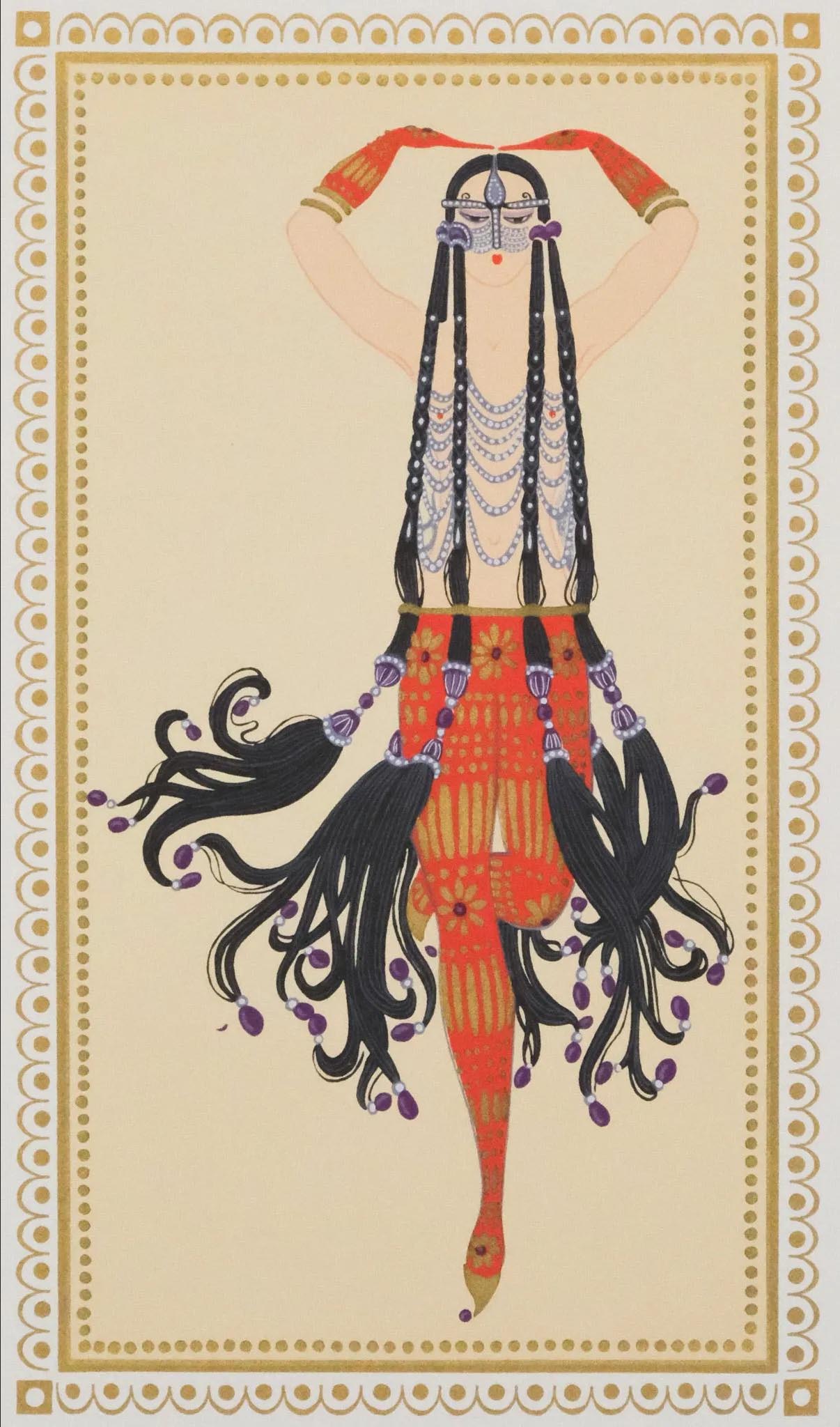
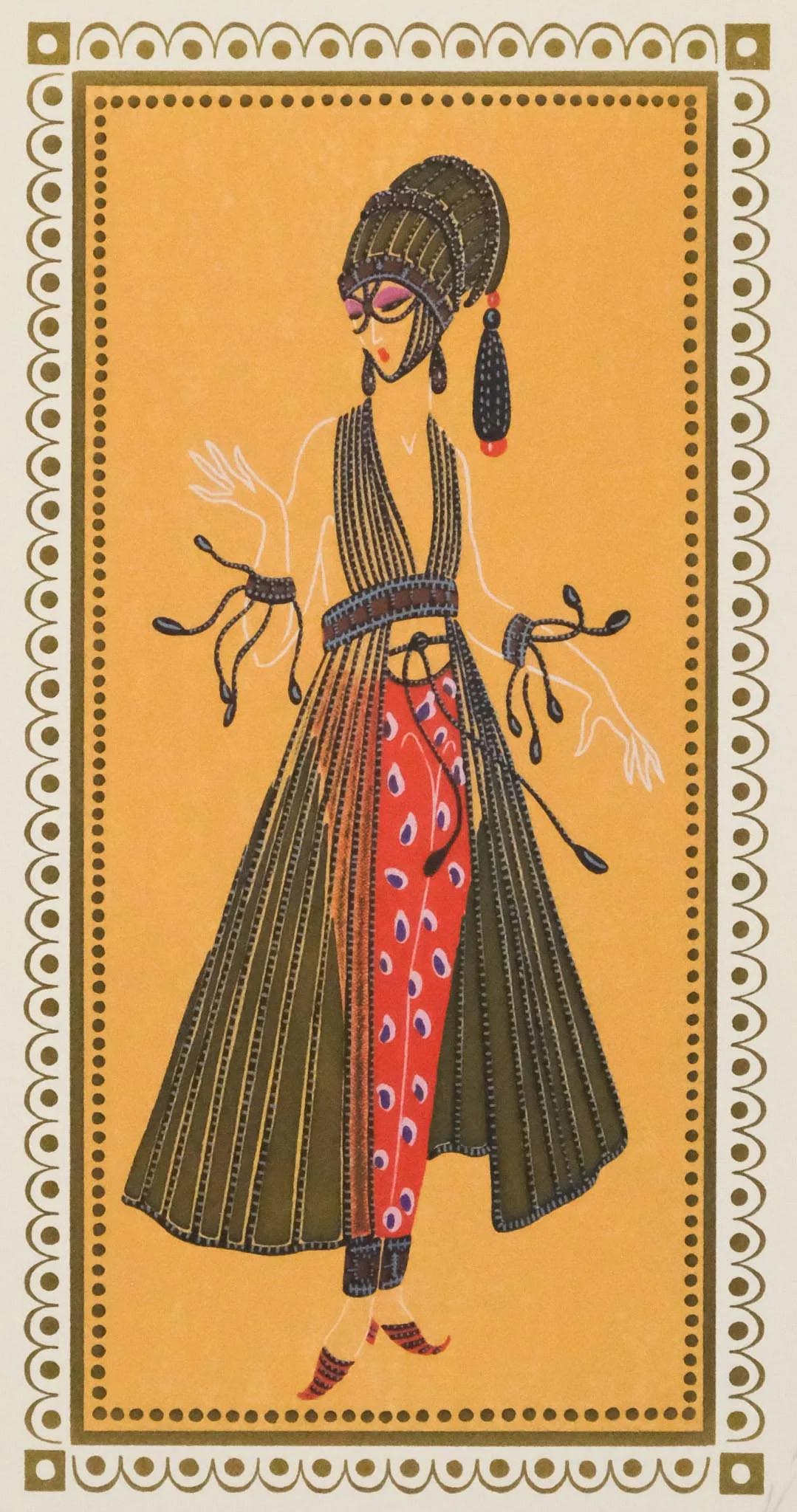
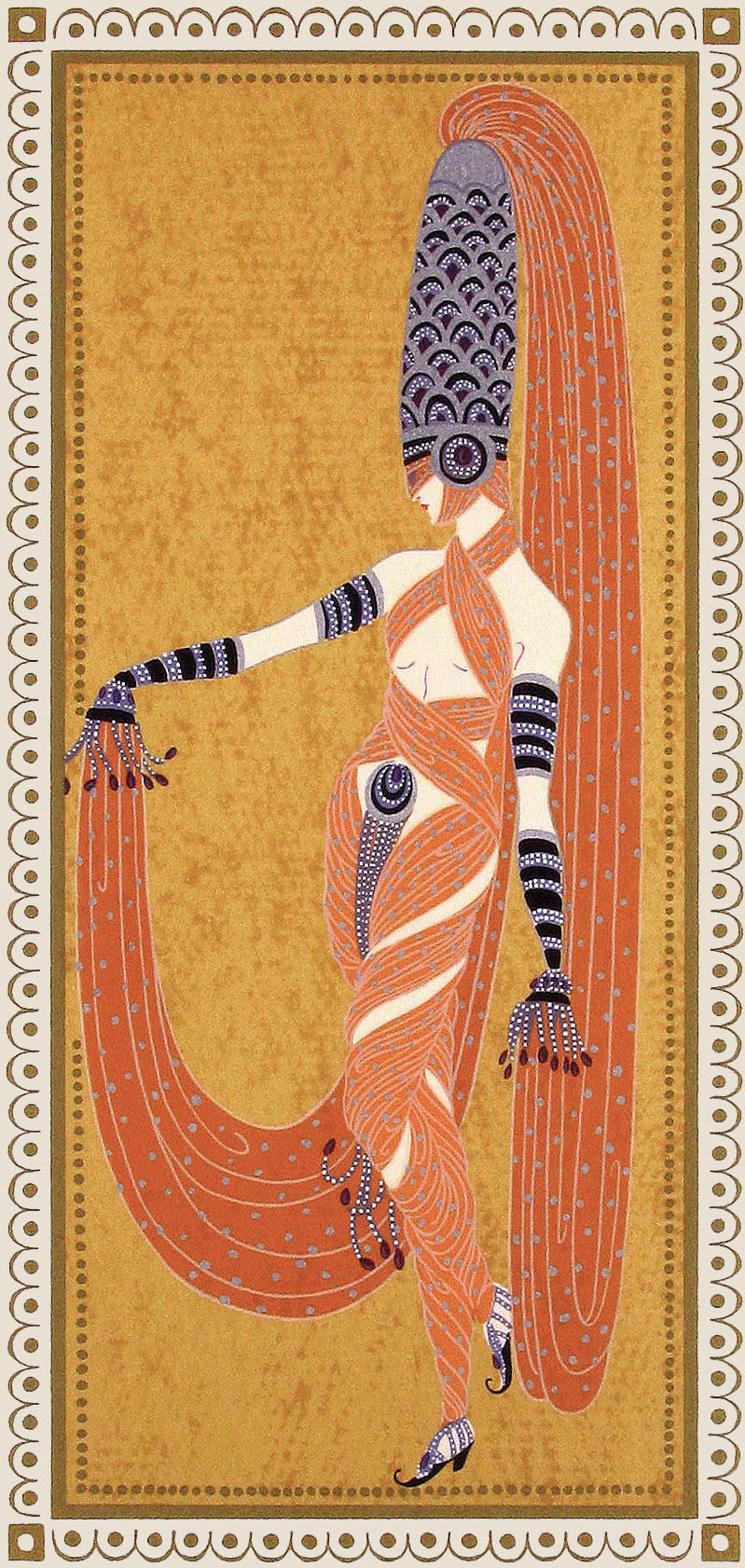
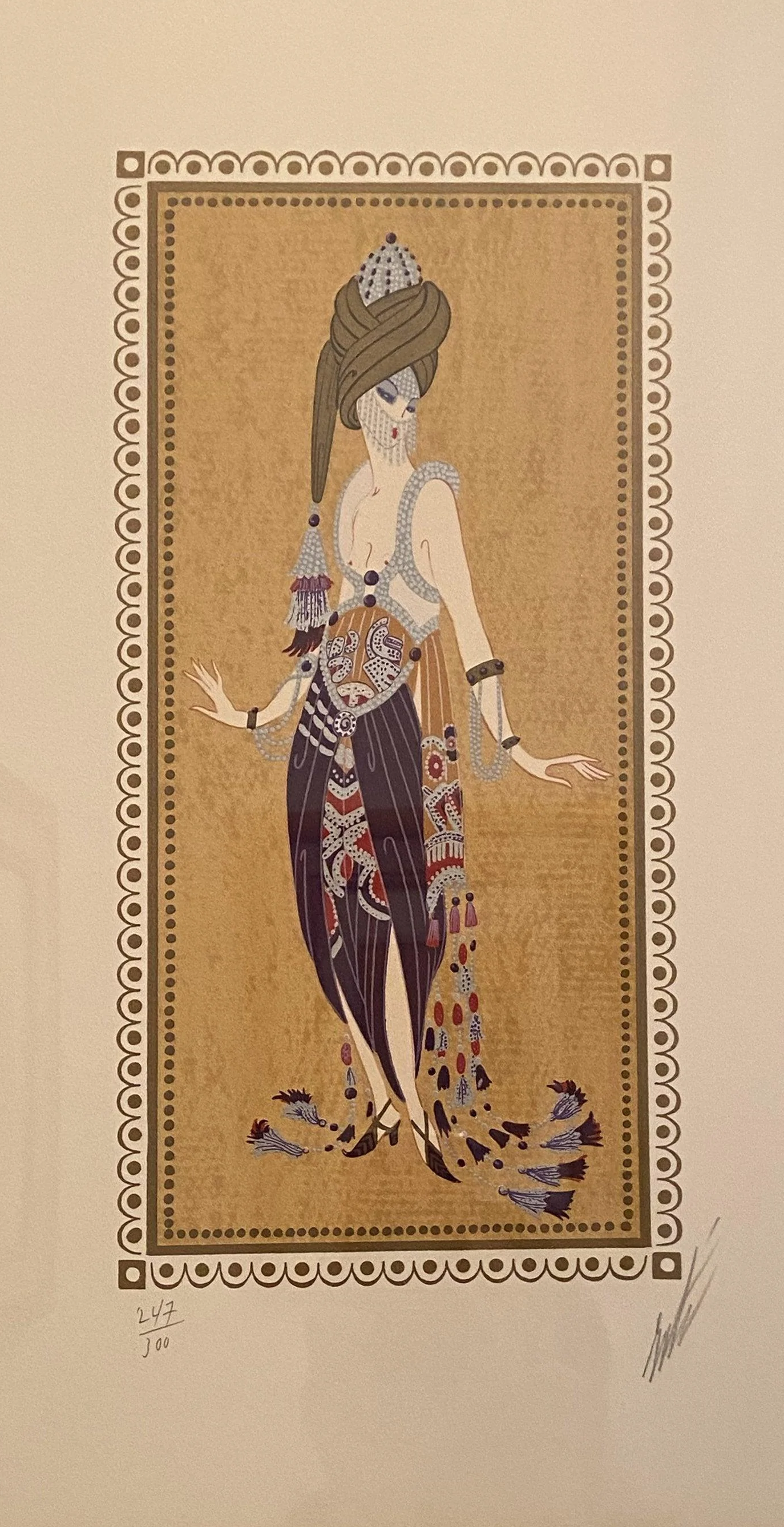
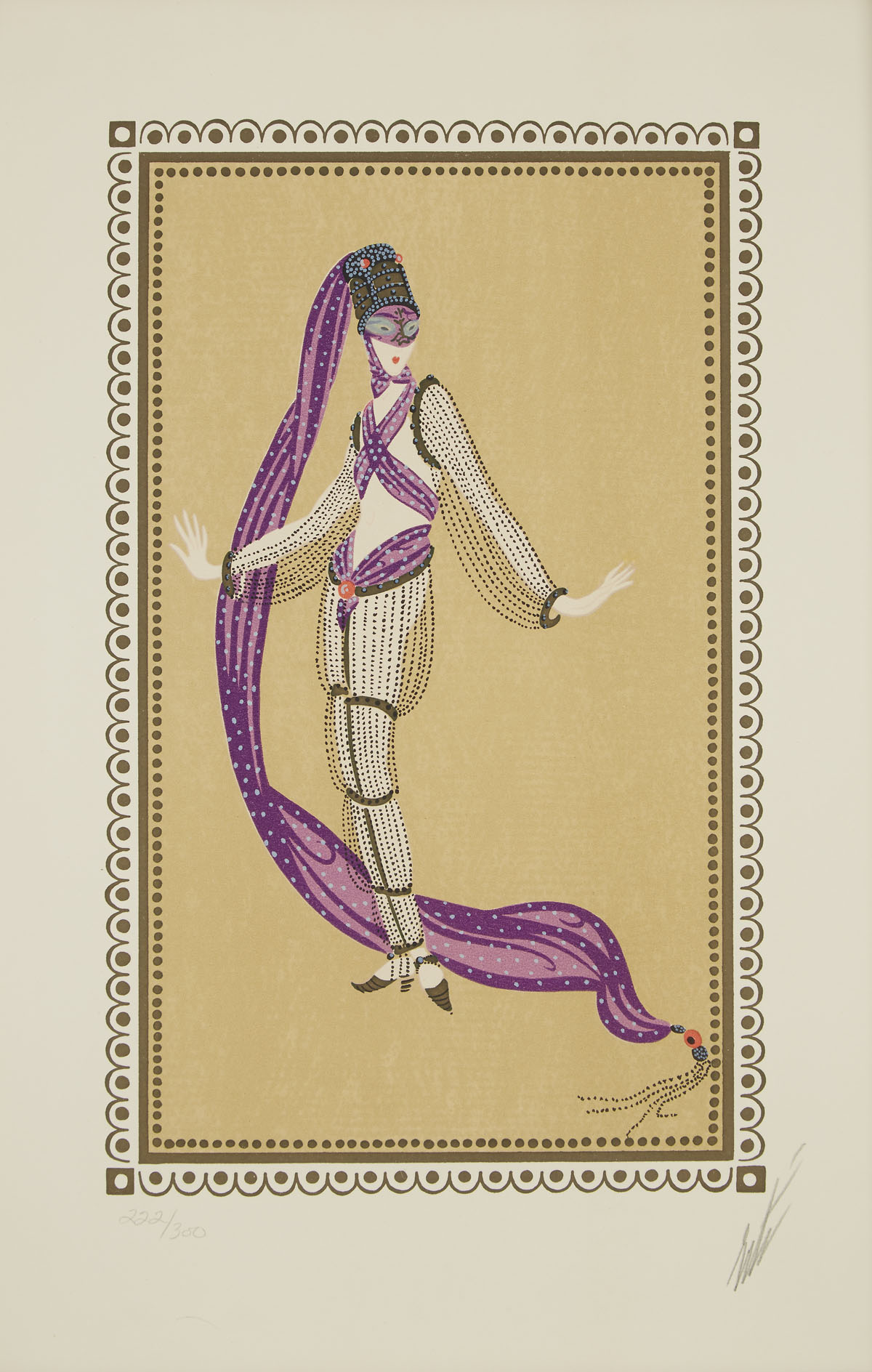
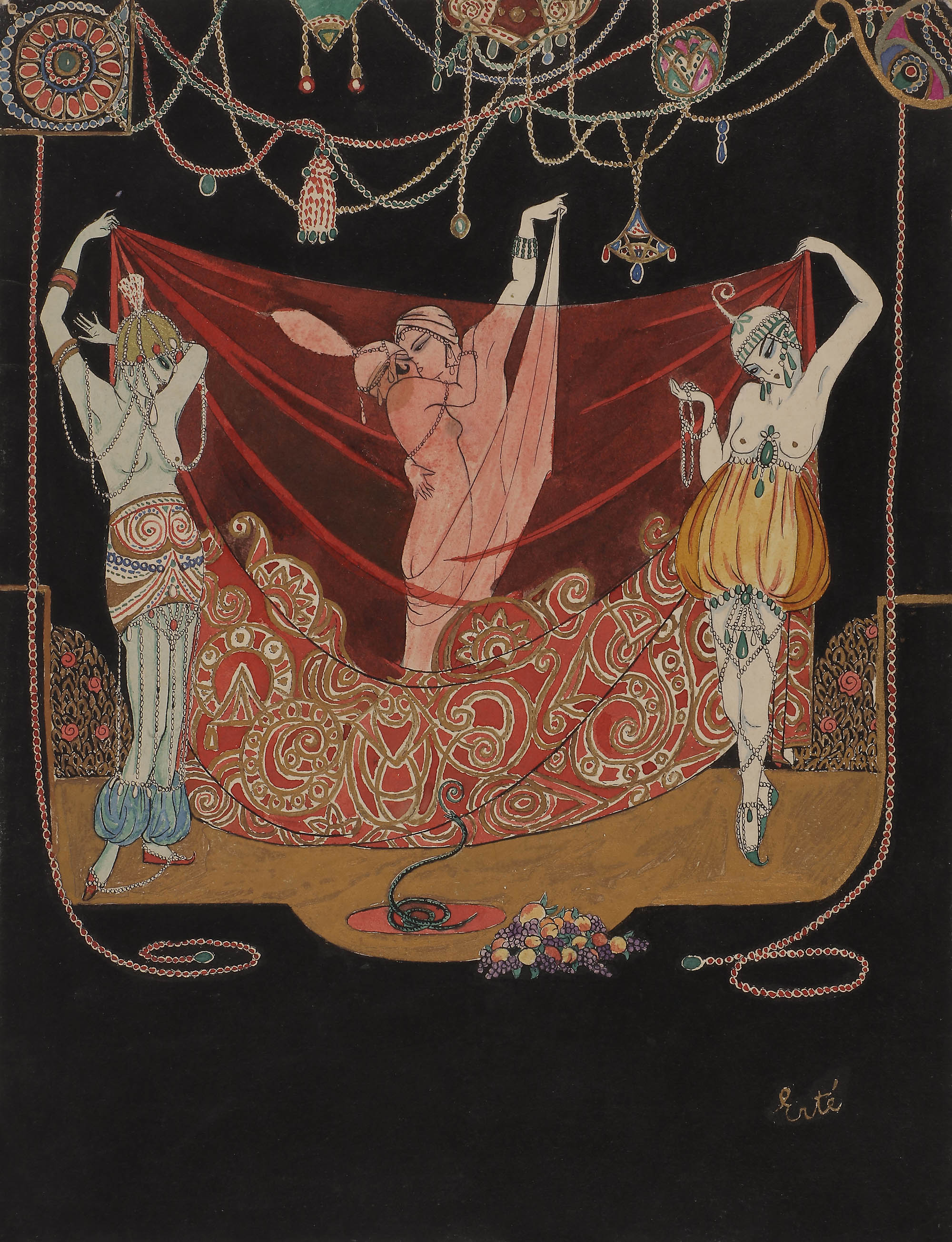
Romain de Tirtoff (Erté, 1892-1990) :: Scheherazade – La Nuit. Lithograph depicting a beauty in Middle Eastern garb. | src liveauctioneersRomain de Tirtoff (Erté, 1892-1990) :: Scheherazade; La Favorite du Calife (Calyph’s Favourite), lithograph depicting a beauty in Middle Eastern garb. | src liveauctioneersRomain de Tirtoff (Erté, 1892-1990) :: “Scheherazade – 8 “La Nuit Winter Garden NY”, 1924 (Gouache). | src liveauctioneersRomain de Tirtoff (Erté, 1892-1990) :: “A Beauty of Bagdad”, from Scheherazade series (nº7). | src Kodner AuctionsRomain de Tirtoff (Erté, 1892-1990) :: “Scheherazade. Thousand and One Nights”, from the Scheherazade Suite. | src Ro GalleryRomain de Tirtoff (Erté, 1892-1990) :: Harem Dancer (Calyph’s Concubine), from the Scheherazade Suite, ca. 1980. Lithograph. | src DoyleRomain de Tirtoff (Erté, 1892-1990) :: Almee (Harem dancer), from the Scheherazade Suite, ca. 1980. | src Martin Lawrence GalleriesRomain de Tirtoff (Erté, 1892-1990) :: [Scheherazade suite: A Thousand and One Nights], [ca. 1979] | src Freeman’sRomain de Tirtoff (Erté, 1892-1990) :: [Scheherazade suite:A Thousand and Second Night], [ca. 1979] | src Freeman’s
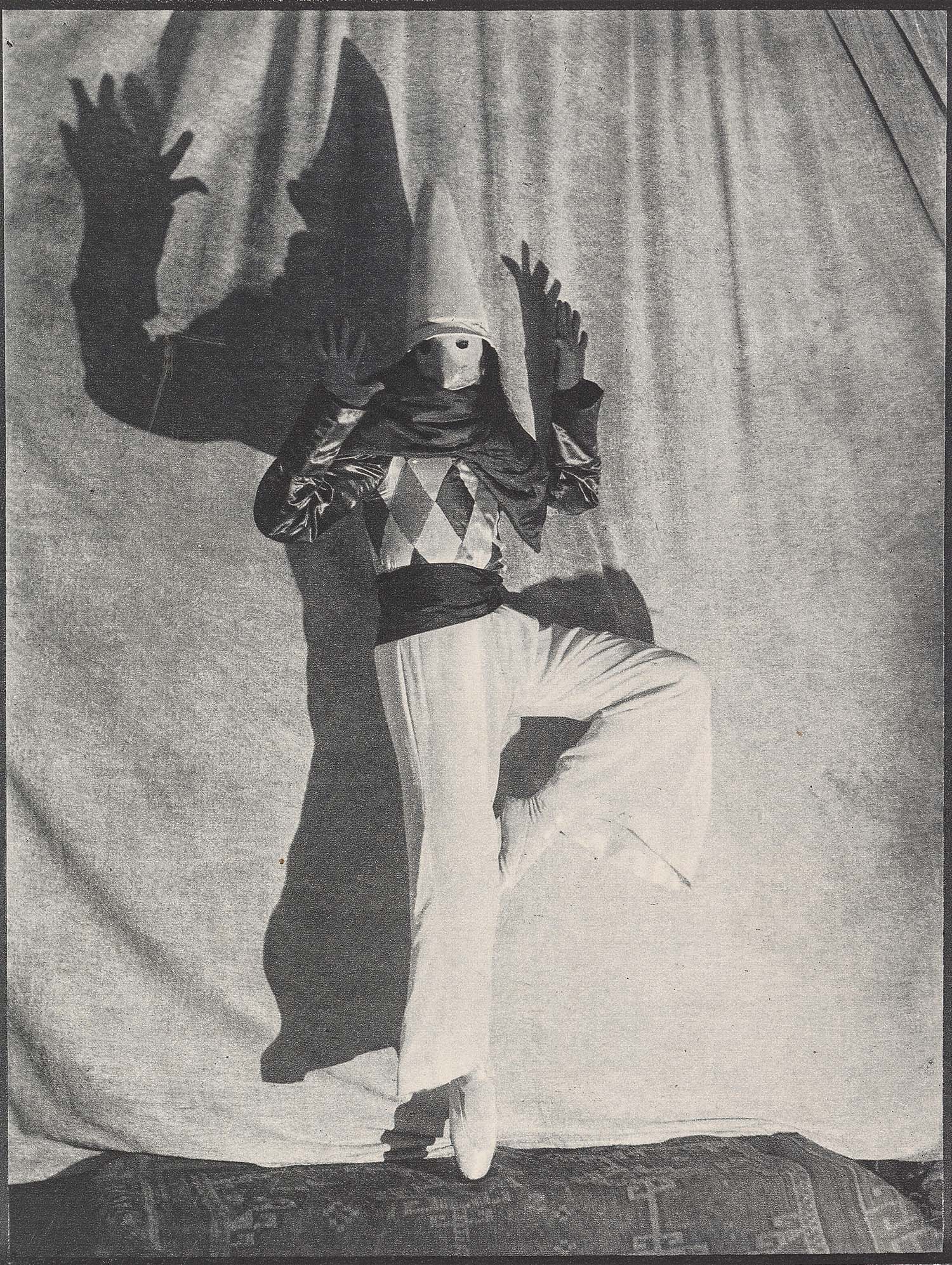
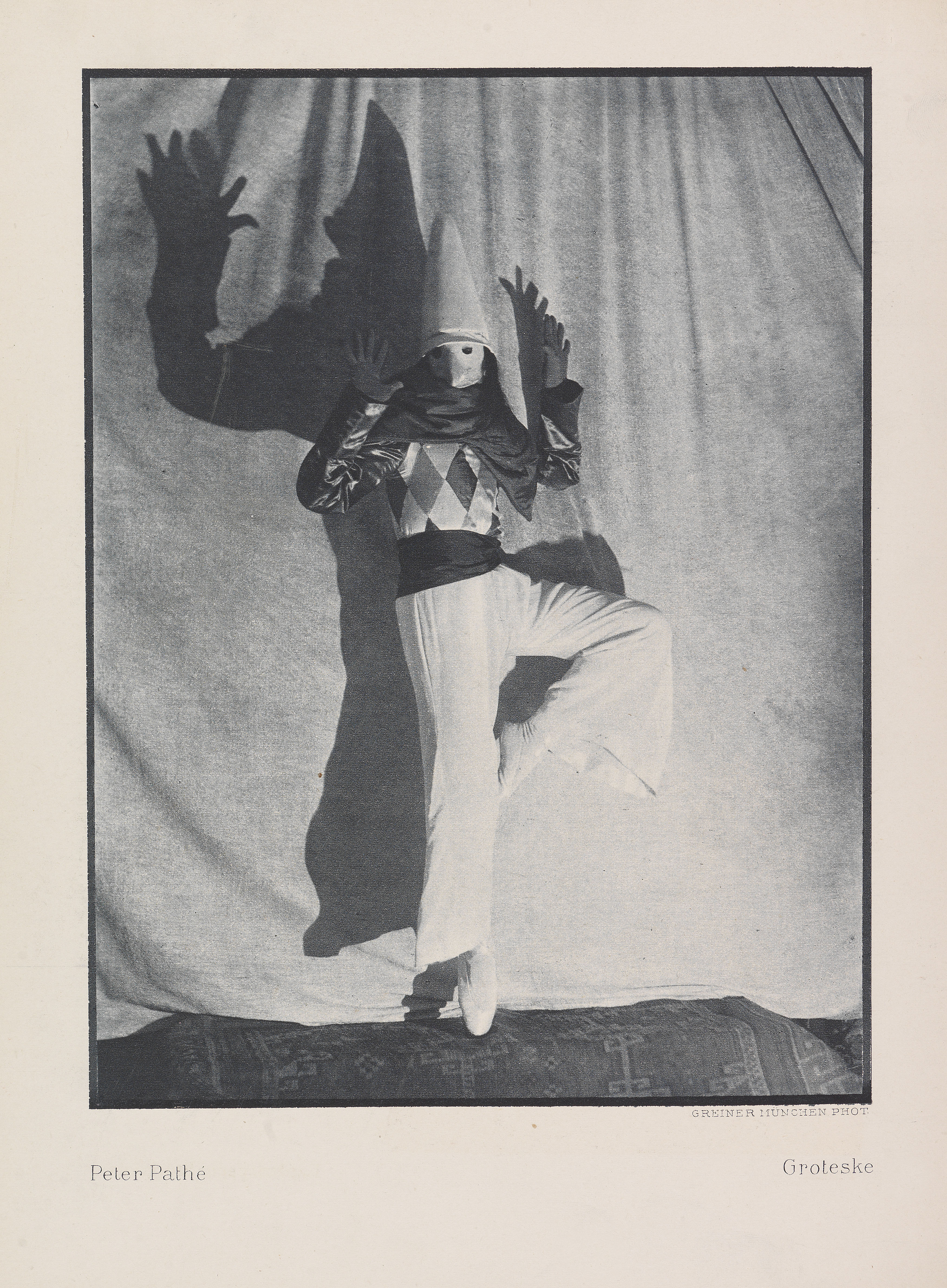
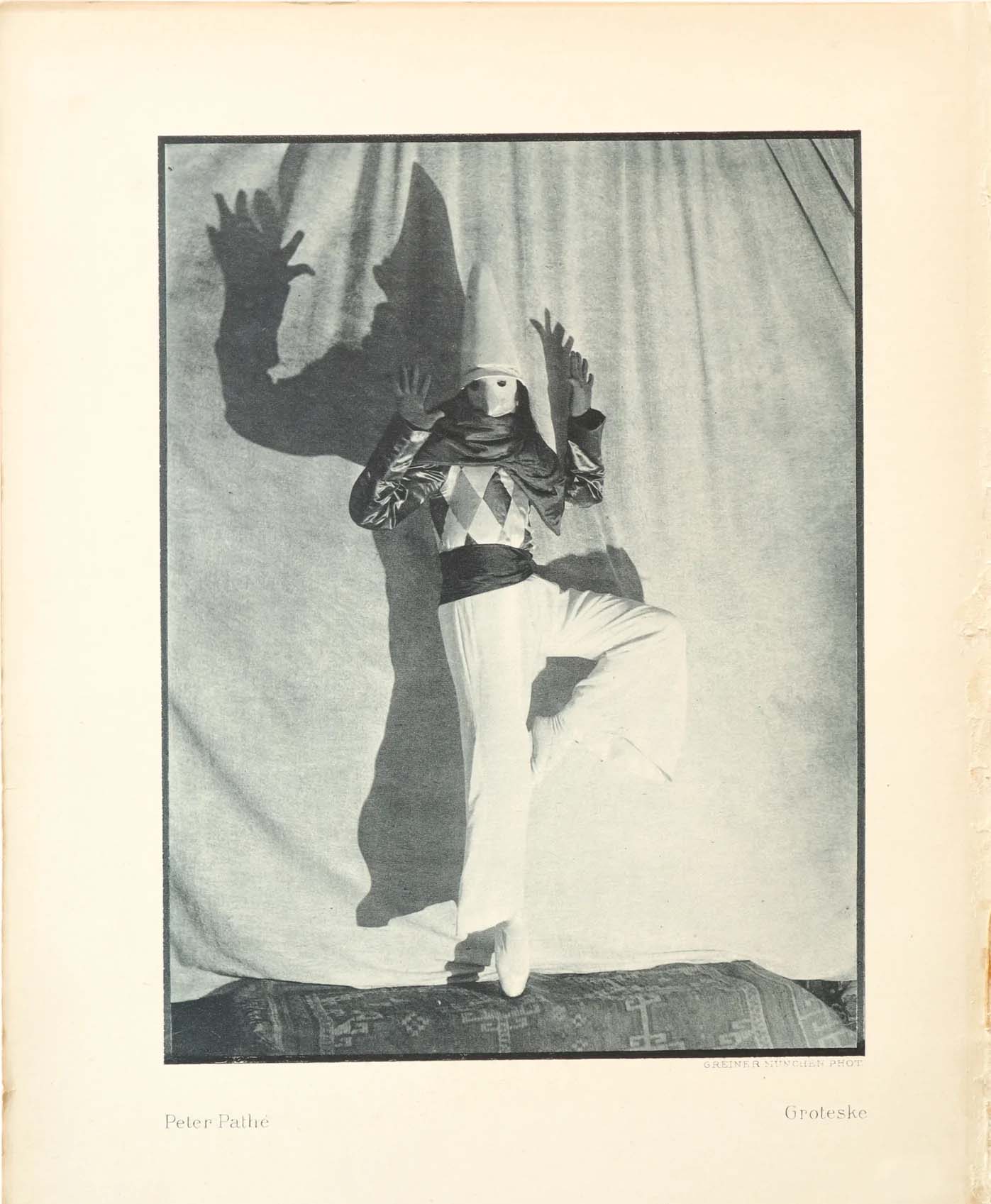
From : Walter Schnackenberg : Kostüme, Plakate und Dekorationen. Zweite Auflage. München, Musarion 1922. | src Ketterer KunstGreiner :: Peter Pathé in Groteske. From a book of Schnackenberg’s works, published in Munich in 1922 by Musarion. | src Ketterer KunstPeter Pathé in Groteske. Photo by Greiner. Costume design: Walter Schnackenberg. | src L’Affichiste
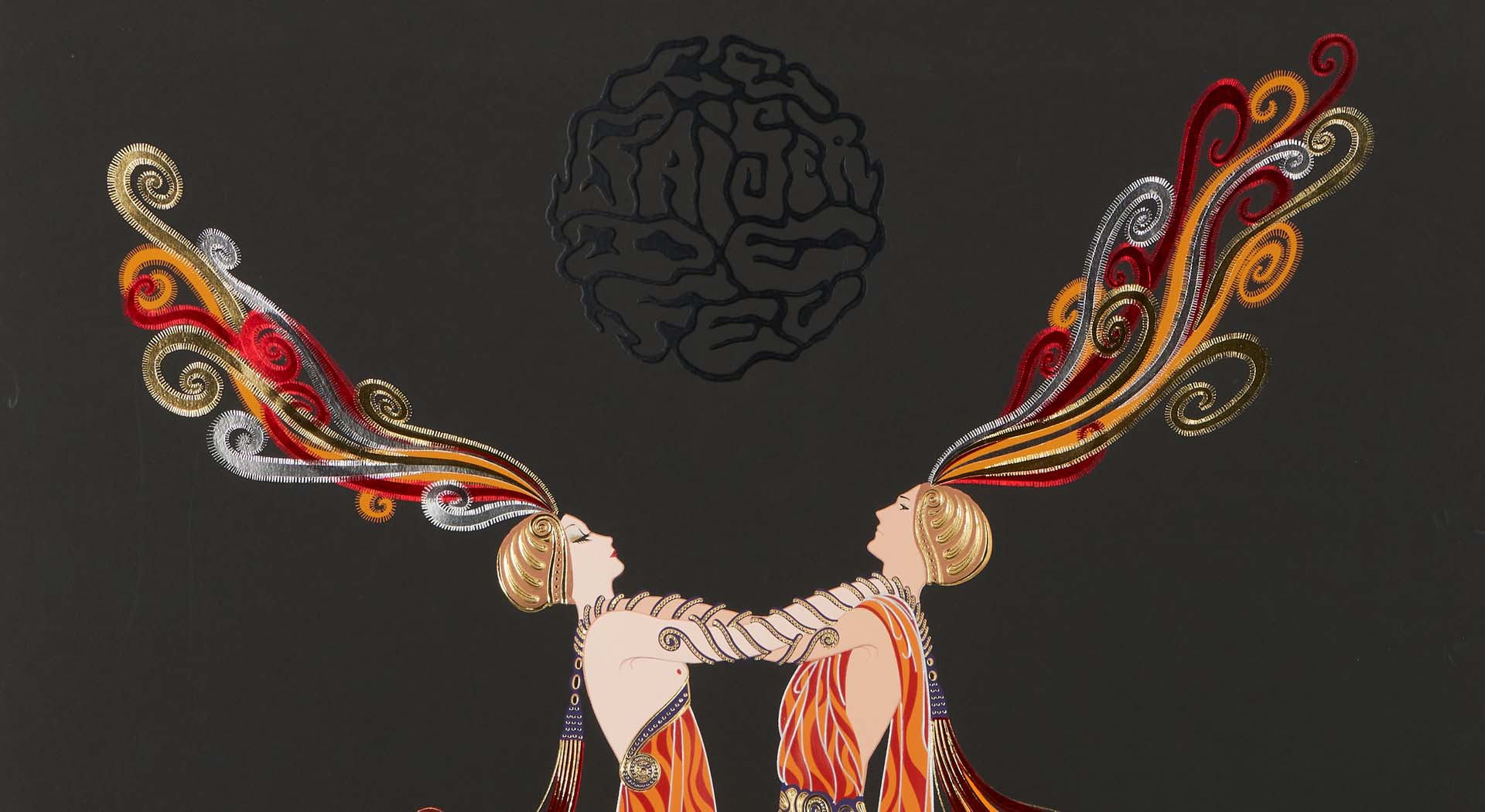
Erté (Romain De Tirtoff) :: Kiss of Fire, ca. 1983. [Detail]
Erté (Romain De Tirtoff, Russian/French, 1892-1990) color serigraph on paper with silver, gold, and red foil embossing titled “Kiss of Fire” from the artist’s Love and Passion Suite, numbered 61/300, published circa 1983. Depicts a partially nude male and a female couple in profile standing on a gold surface and dressed in red, orange, and purple flowing garments and headdresses reminiscent of flames, their arms resting on each other’s shoulders, against a black background with a black circular pattern embossed above. Numbered in white pencil, lower left below image, signed “Erte” in white pencil, lower right below image. | quoted from Case Fine Arts & Antiques
Erté (Romain De Tirtoff) :: Kiss of Fire, ca. 1983. From the artist’s Love and Passion Suite.Erté (Romain De Tirtoff) :: Kiss of Fire, ca. 1983. From the artist’s Love and Passion Suite. (Close up) | Case Fine Arts & Antiques















 un regard oblique