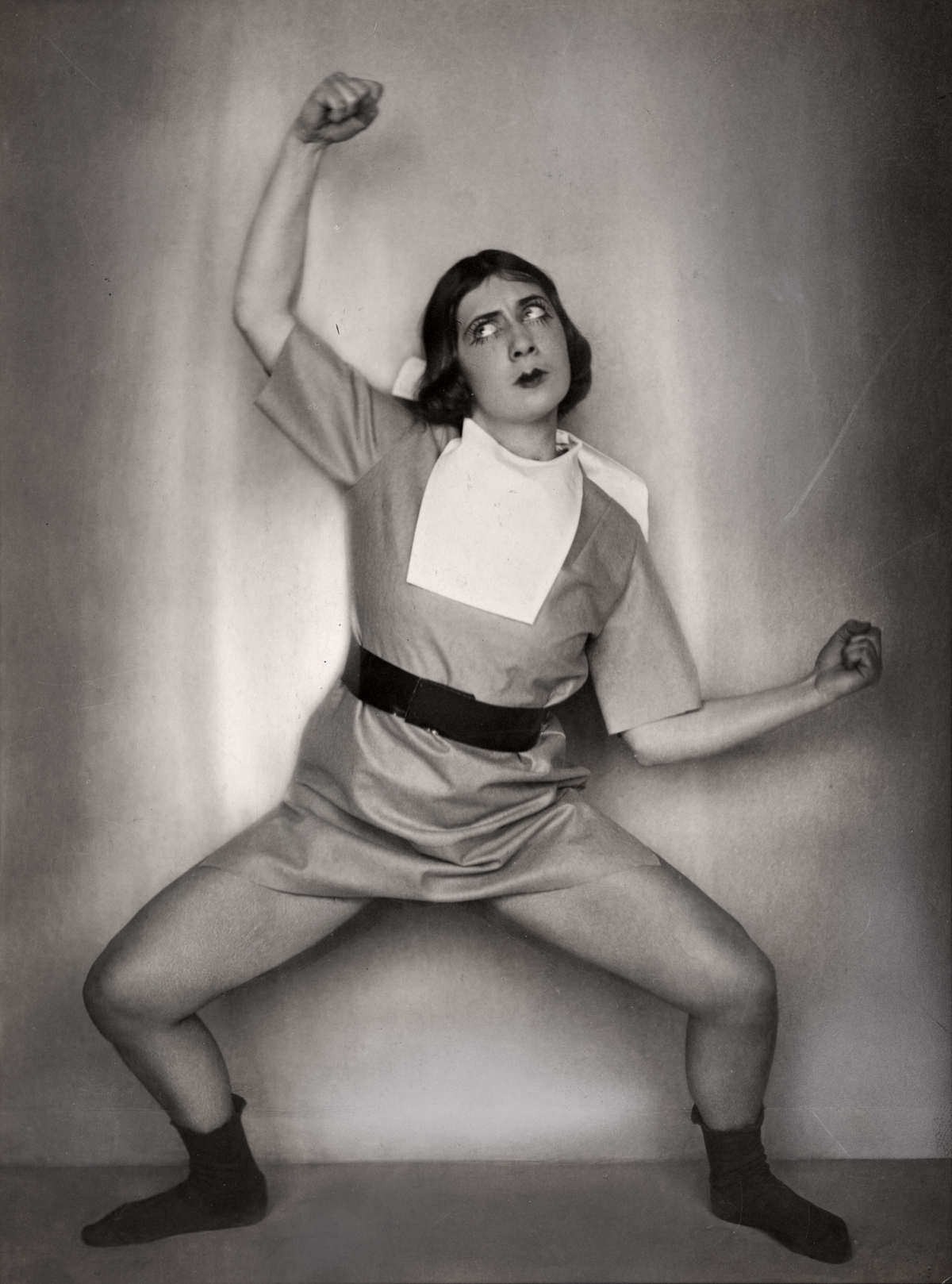
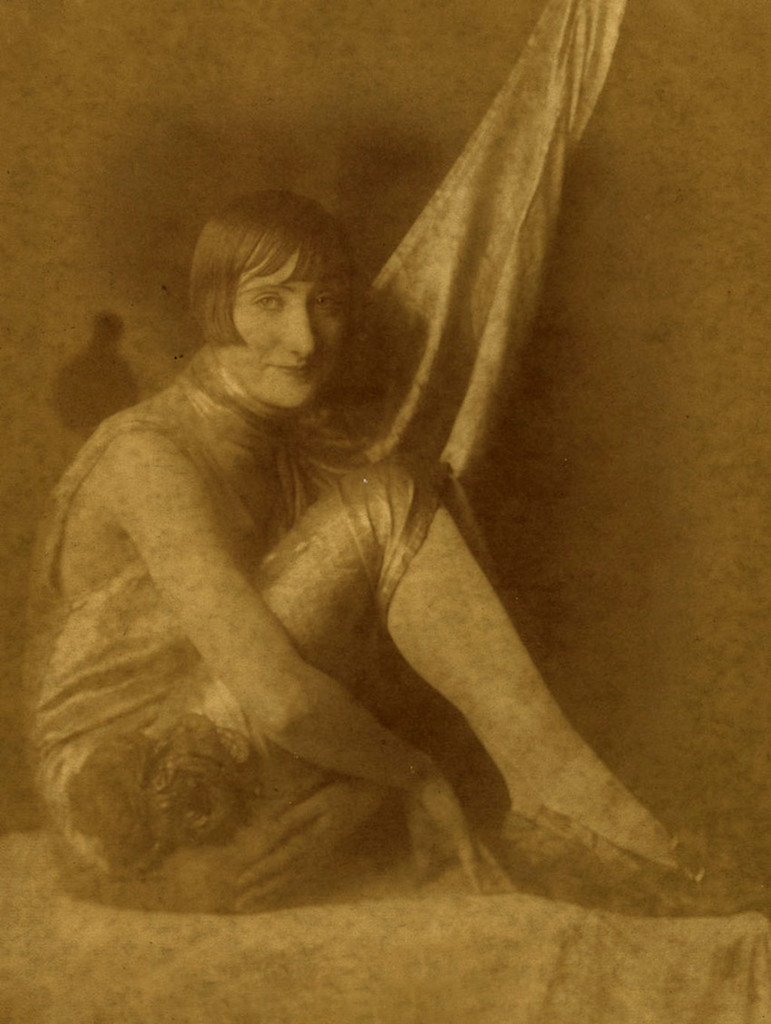
Kitty Hoffmann (1900–1968) ~ De danseres Cilly Wang. Wenen | The dancer Cilli Wang, Wien, 1932 | src Fotocollectie Het Leven
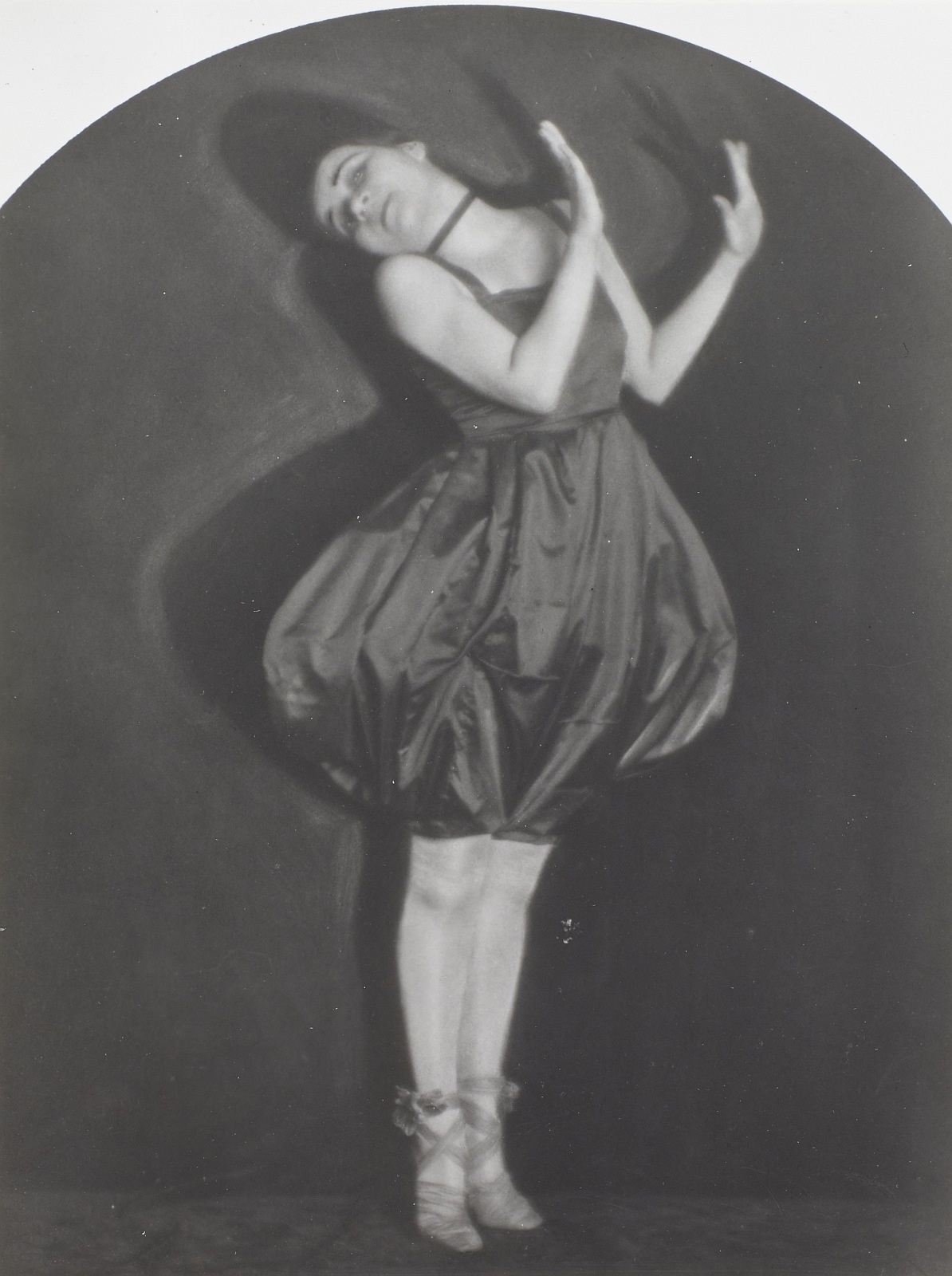
Cilli Wang (1909-2005) was a Viennese dancer and cabaret artist. She attended dance classes at the Vienna Academy of Music and Performing Arts (Max Reinhardt Seminar) with Gertrud Bodenwieser. In 1928 she gave her first performance by dancing to the recitation of the actor Ernst Ceiss.
In the 1930s she evolved into a transformational artist, appearing on cabaret and small art stages, such as Erika Mann’s “Pfeffermühle” in Zurich, the “Catakombe” in Berlin and, not least, in “Lieben Augustin” and “Simpl” in Vienna.
Her trademark were pantomimic dances and performances with parodic, grotesque and illusionistic elements – which she herself called Verwandeleien / transformations (she also designs her own costumes as well as the puppets and props she used).
For her parodic performances, which were a rarity in her time, she was called the Pavlova of Parody. Initially performing in ensembles, her interest was in the connection between spoken word and movement. She created dance movement numbers to Goethe, Wilhelm Busch and Christian Morgenstern, which she recited herself. She parodied Hitler and made fun of folk dances. Her talent for comic numbers led to comparisons with Charlie Chaplin.
text adapted from Theatermuseum Wien & German wikipedia entry
Zander & Labisch :: Foto von Margo Lion mit Marlene Dietrich und Oskar Karlweis in “Wenn die beste Freundin…” [If your best friend…] aus der Revue “Es liegt in der Luft” [It is in the Air] , Berlin, 1928. From Marcellus Schiffer und Margo Lion Archiv at Akademie der Künst, Berlin
Privatfoto von Margo Lion, from a Fotoalbum (1920-1932). From Marcellus Schiffer und Margo Lion Archiv at Akademie der KünstePrivatfoto von Margo Lion, from a Fotoalbum (1920-1932). From Marcellus Schiffer und Margo Lion Archiv at Akademie der KünsteRolf Mahrenholz ~ Margo Lion in den “Hetärengesprächen”(Dialogue of the Courtesans). Der Querschnitt B.7, H.8, August 1927 | src arthistoricumPrivatfoto von Margo Lion, from a Fotoalbum (1920-1932). From Marcellus Schiffer und Margo Lion Archiv at Akademie der KünsteAtelier Willinger :: Porträtfoto von Margo Lion, signiert (Seitenprofil). | src Akademie der Künste, BerlinPrivatfoto von Margo Lion, from a Fotoalbum (1920-1932). From Marcellus Schiffer und Margo Lion Archiv at Akademie der KünstePorträt und Atelierfoto von Margo Lion. Postkarte, signiert. | src Marcellus Schiffer und Margo Lion Archiv at Akademie der Künste
Privatfoto von Margo Lion, from a Fotoalbum (1920-1932). From Marcellus Schiffer und Margo Lion Archiv at Akademie der Künste, BerlinPrivatfoto von Margo Lion, from a Fotoalbum (1920-1932). From Marcellus Schiffer und Margo Lion Archiv at Akademie der Künste, BerlinPrivatfoto von Margo Lion, from a Fotoalbum (1920-1932). From Marcellus Schiffer und Margo Lion Archiv at Akademie der Künste, BerlinPrivatfoto von Margo Lion, from a Fotoalbum (1920-1932). From Marcellus Schiffer und Margo Lion Archiv at Akademie der Künste, BerlinPrivatfoto von Margo Lion, from a Fotoalbum (1920-1932). From Marcellus Schiffer und Margo Lion Archiv at Akademie der Künst, BerlinPrivatfoto von Margo Lion, from a Fotoalbum (1920-1932). From Marcellus Schiffer und Margo Lion Archiv at Akademie der Künste, BerlinPrivatfoto von Margo Lion, from a Fotoalbum (1920-1932). From Marcellus Schiffer und Margo Lion Archiv at Akademie der Künste, BerlinPrivatfoto von Margo Lion, from a Fotoalbum (1920-1932). From Marcellus Schiffer und Margo Lion Archiv at Akademie der Künste, Berlin
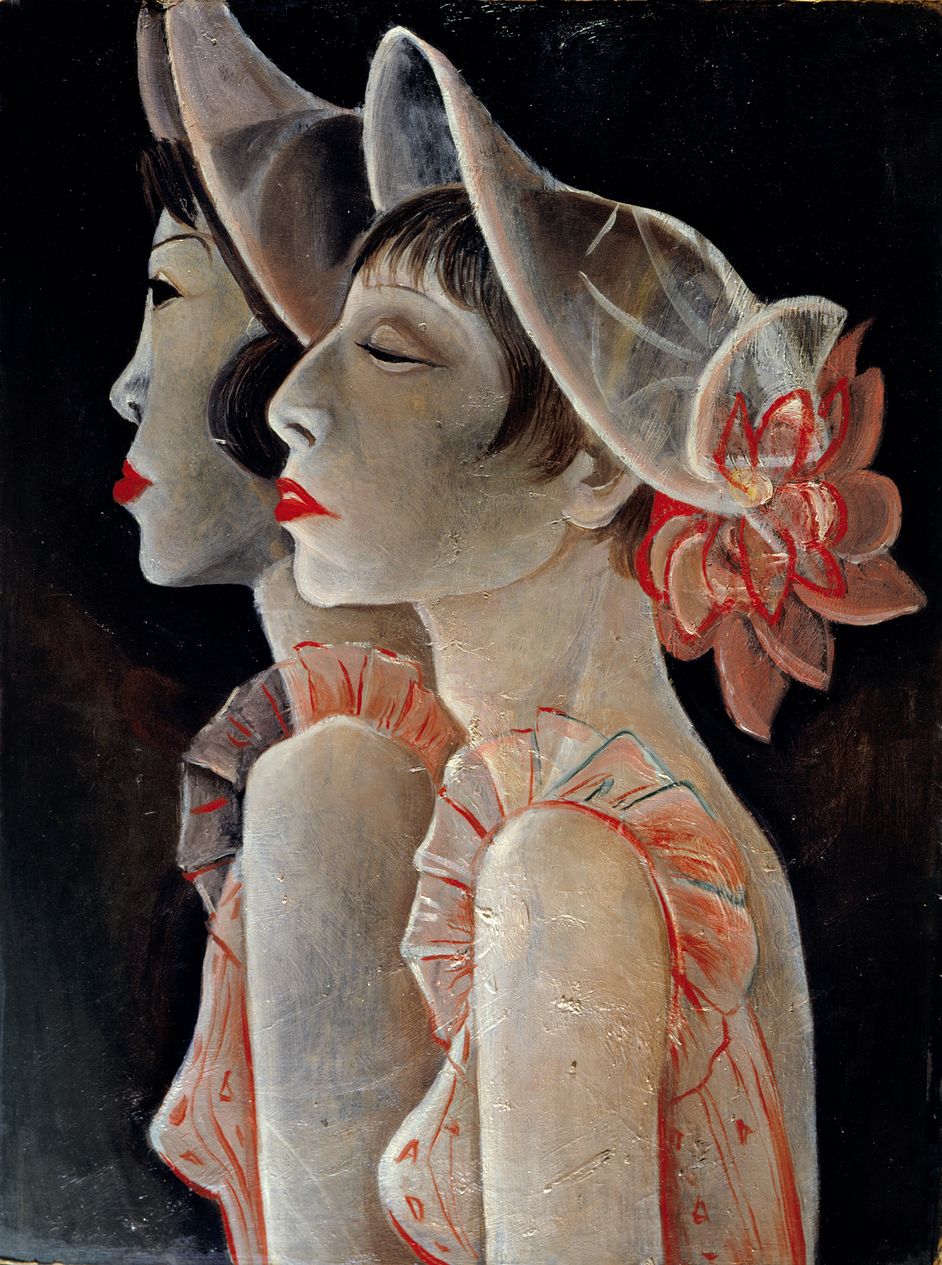
In the pleasure-hungry Berlin of the 1920s, theatres vied for attention with spectacular variety shows. Chorus girls in scanty costumes provided an erotic touch. As links in the chain of swinging legs, they were usually depicted as a type, not as individuals. But the two women in “Chorus Girls” by Jeanne Mammen (1890–1976) could hardly be more different. The artist centres on their weary faces, sallow skin and garish lipstick. The real attraction – the dancers’ long-limbed bodies – are only visible down to the breast. They pause for breath, no trace of glamour here.
Mammen, a free-lance artist and a prototype of the emancipated “New Woman”, often highlighted female clichés of the day. The chorus girl in front has the facial features of the artist. The figure behind resembles her sister Mimi. [quoted from Berlinische Galerie]
Jeanne Mammen :: Josephine Baker, ca. 1926. [Revue Neger]. Barbican Centre | src Flickr
Weimar Clubs and cabarets – German cities, 1920s
After the collapse of its Empire and the defeat of the First World War, Germany became a democracy, the Weimar republic. In the early 1920s, people yearned for excitement, there was a sense of liberation and the economy started to recover. Night clubs appeared which fused cabaret, literature, art, music, theatre and satire in multi-sensory experiences. American jazz and dance crazes including the foxtrot, tango, one-step and Charleston became popular and exotic dances by Anita Berber, Valeska Gert and famously Josephine Baker were performed.
Fantasy spaces were created such as the dance-casino called Scala where the ceiling was sculpted into jagged structures that hung down like crystalline stalactites. The pulsating energy of such clubs and bars was captured by artists including Otto Dix, Jeanne Mammen and Elfriede Lohse-Wächtler.
[Barbican Centre] From Into the Night: Cabarets & Clubs in Modern Art (October 2019 to January 2020)
Visions of a dark world in the art of Weimar Germany [Apollo magazine]
Review on the exhibition Magic Realism: Art in Weimar Germany 1919-33 (Tate Modern, 2018-19)
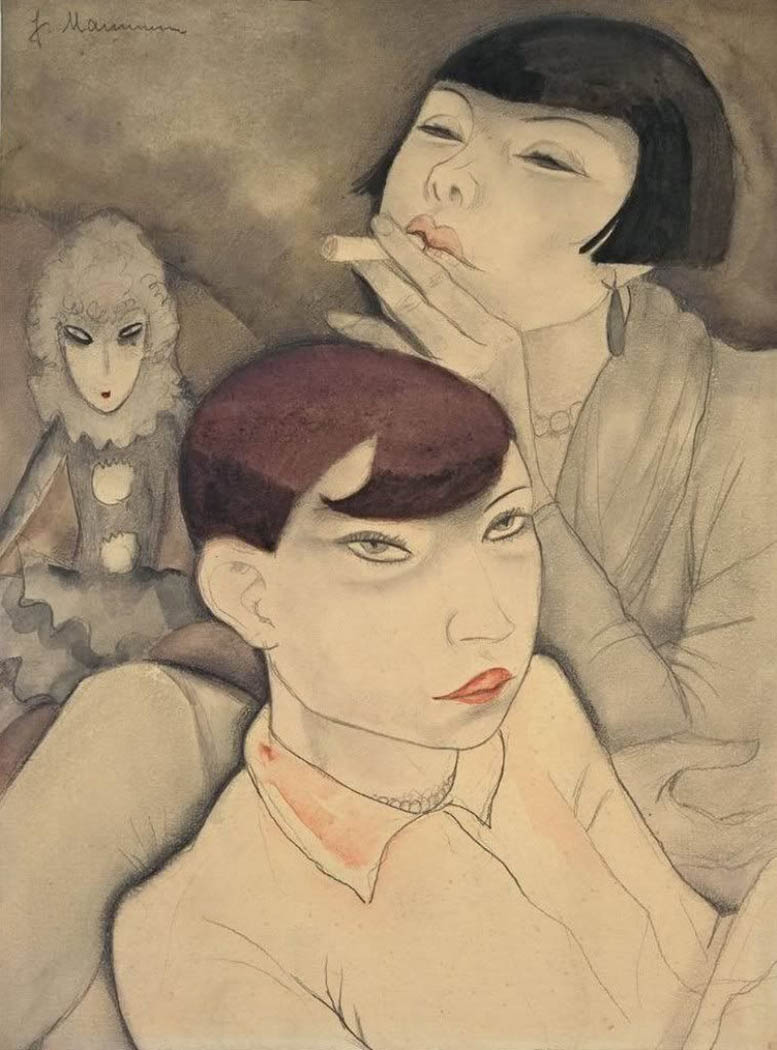
[…] towards the end of the exhibition, a small cluster of drawings introduces the work of Jeanne Mammen. Mammen’s drawings – gauzy depictions of women in watercolour, pen and ink – illustrated fashion magazines and poetry publications throughout the 1920s, until the Nazis shut down the journals she worked for and she went into inner exile, refusing to show her work. Here, they fill an important gap in describing women’s experiences of city life. Mammen observed women on the streets of Berlin and in nightclubs, and often depicted them in conversation, smoking, or playing cards. In Brüderstrasse (Free Room) (1930), the women are intimate and aloof; in Boring Dolls (1929), they’re defiant, out for their own pleasure.
[…] The exhibition doesn’t quite tease out the paradoxes between trauma and humour, leaving both to loiter in the murkiness of Dix’s circus tent. What we’re given is a vision of a world that hinges on reality yet twists from view. It’s a distortion of the truth, full of landscapes littered with war debris and nightclub corners filled with smoke. It’s the same world, but darker than before.
quoted from the review by Harriet Backer for Apollo magazine




![Zander & Labisch :: Foto von Margo Lion mit Marlene Dietrich und Oskar Karlweis in "Wenn die beste Freundin…" [If your best friend...] aus der Revue "Es liegt in der Luft" [It is in the Air] , Berlin, 1928. From Marcellus Schiffer und Margo Lion Archiv at Akademie der Künst, Berlin](https://live.staticflickr.com/65535/52115789620_9d39c8c29a_o.jpg)








 un regard oblique