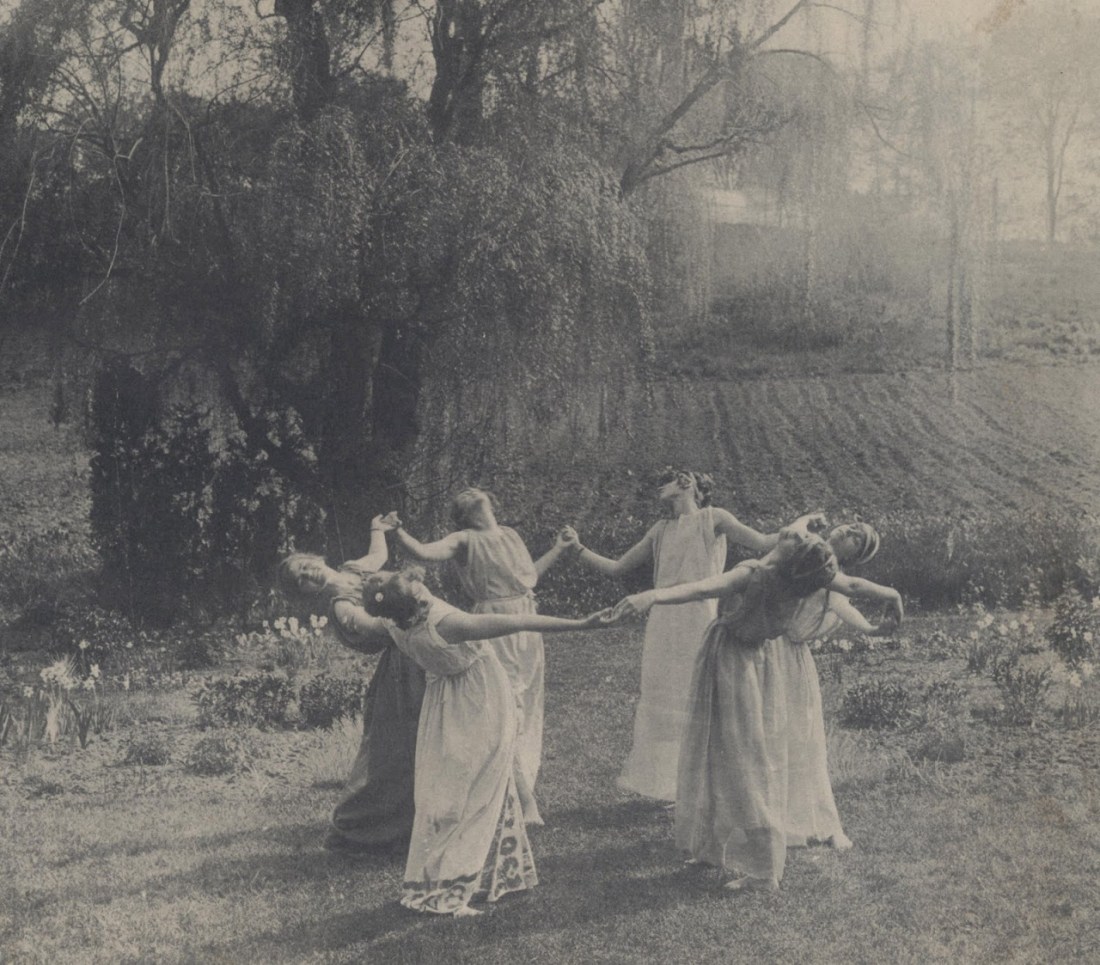
Vassar college girls practising their Greek dances, circa 1923 / source and hi-res: WHI
images that haunt us
Vassar college girls practising their Greek dances, circa 1923 / source and hi-res: WHI

Frédéric Daniel Boissonnas Baud-Bovy ::
Dalcroze exercises, undated, reproduced in André Levinson, La Danse d’aujourd’hui (Paris: Editions Duchartre et Van Buggenhoudt, 1929). Photo: Boissonnas.
Dalcroze ‘Eurhythmics’ system enables a deeper engagement
with music through physical movement and had an enormous impact on early
modern dance pioneers
/ source: Royal Ballet School
more [+] this photographer

Claude Harris :: Eugene Lapitsky & Bronislava Nijinska as The Bandits in On the Road, 1925. Nijinska’s Théâtre Chorégraphique.

Dancer Alicia Markova as the Nightingale in Balanchine’s Le Chant du Rossignol [Song of the Nightingale], 1925, with music by Stravinsky and designs by Matisse. From a
programme for the Diaghilev Ballets Russes, 1925. Originally
choreographed by Massine in 1920, the ballet was revised as a vehicle
for the very young Alicia Markova. Photographer unknown. / src: Royal Ballet
 https://embedr.flickr.com/assets/client-code.js
A Geisha biting a Tenugui, 1920′s
“[She] rises to one knee and puts one end of her [tenugui] hand towel in her teeth, pulling on it with her right hand. This is a typical Kabuki gesture for a female character in the throes of a deep emotion.” According to “The Art of Kabuki” edited by Samuel L. Leiter, first published in 1979, page 114. / src: Blue Ruin
 https://embedr.flickr.com/assets/client-code.js
Geiko Tomigiku reading a Newspaper, 1921. The supremely stylish Tomigiku, dated 28/12/1921 on the reverse./ source: Blue Ruin
 https://embedr.flickr.com/assets/client-code.js
Maiko Momotaro – Sakkou Hairstyle, 1920′s
“Originally believed to be worn by married women of the merchant class during the late Edo period (1603-1868), starting in the Meiji era (1868-1912) the sakkou was the hairstyle worn by apprentice geisha in the weeks leading up to their debut as full-fledged geisha.“
(Voyages en Photographie) / src: Blue Ruin
 https://embedr.flickr.com/assets/client-code.js
Koyakko showing her Obi, 1920′s
The very iki (stylish or chic) geisha Koyakko. During her subsequent career as the master dancer Hanayagi Sumi, an orchestral ballet entitled “Heavenly maiden and fisherman” was written for her, which she first performed in 1932. / src: Blue Ruin

Swallows in Flight Obi. This postcard dates to around the 1920′s or 1930′s. In Japan, the swallow is a traditional symbolic image for meekness, gentleness, sweetness and grace. It is also an emblem of spring. / via
firsttimeuser / src: Flickr


