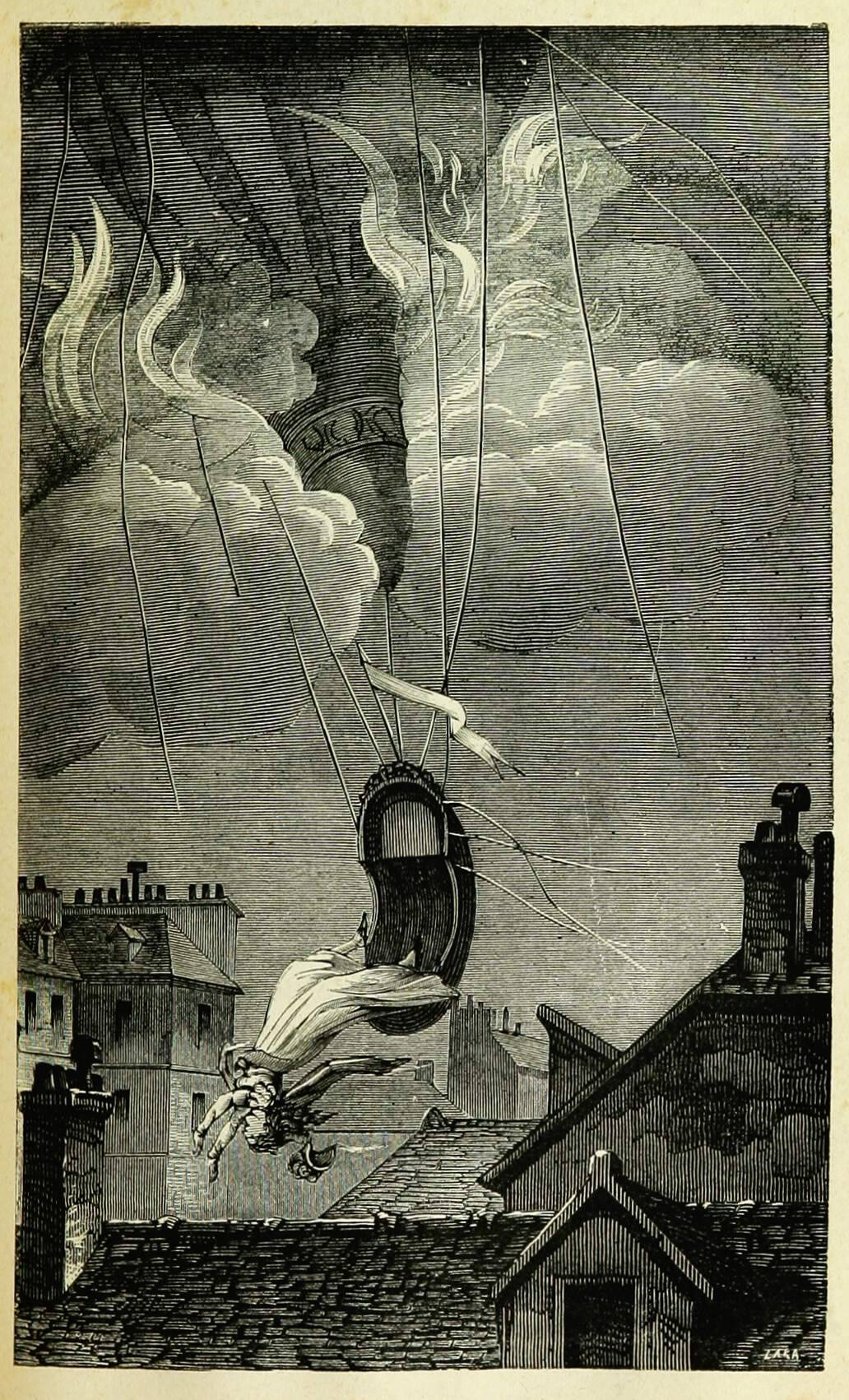
Death of Sophie Blanchard 1819

Death of French aeronaut Madame Sophie Blanchard after fireworks ignited her balloon, Paris, 1819. Woodblock engraving. From Louis Figuier’s “Les Merveilles de la Science: Aerostats” (Marvels of Science: Air Balloons), Paris : Librairie Furne, Jouvet et Cie., 1867. | src old book illustrations and internet archive

A woman is falling from the gondola of a hot-hair balloon flying over the roofs. She is Sophie Blanchard was the widow of aeronaut Pierre Blanchard, and an aeronaut herself.

On July 6, 1819, Madame Blanchard was taking part in an exhibition in the Tivoli garden in the rue Saint-Lazare. She carried with her a parachute full of fireworks in order to give the public the spectacle of fireworks descending from the middle of the air. She held a fire lance in her hand to light the fireworks she was supposed to launch from the balloon gondola. A false movement brought the orifice of the balloon into contact with the fire lance: the hydrogen gas ignited. Immediately an immense pillar of fire rose above the machine. Madame Blanchard was then distinctly seen trying to extinguish the fire by compressing the lower orifice of the balloon: then, recognizing the uselessness of her efforts, she sat down in the basket and waited. The gas burned for several minutes, without communicating with the balloon gondola. The rapidity of the descent was very moderate, and there is no doubt that, had she been directed towards the country, Madame Blanchard would have reached land without accident. Unfortunately it was not so: the balloon fell on Paris; it fell on the roof of a house in the rue de Provence. The gondola slid down the slope of the roof, on the side of the street. “A moi!” cried Madame Blanchard. These were her last words. As it slid down the roof, the gondola encountered an iron spike; it stopped abruptly, and, as a result of this shock, the unfortunate aeronaut was thrown out, and fell, head first, on the pavement. (quoted from scanned book at internet archive)

The caption reads in the original French: “Mort de madame Blanchard”. IA

The visit by Lady Hawarden

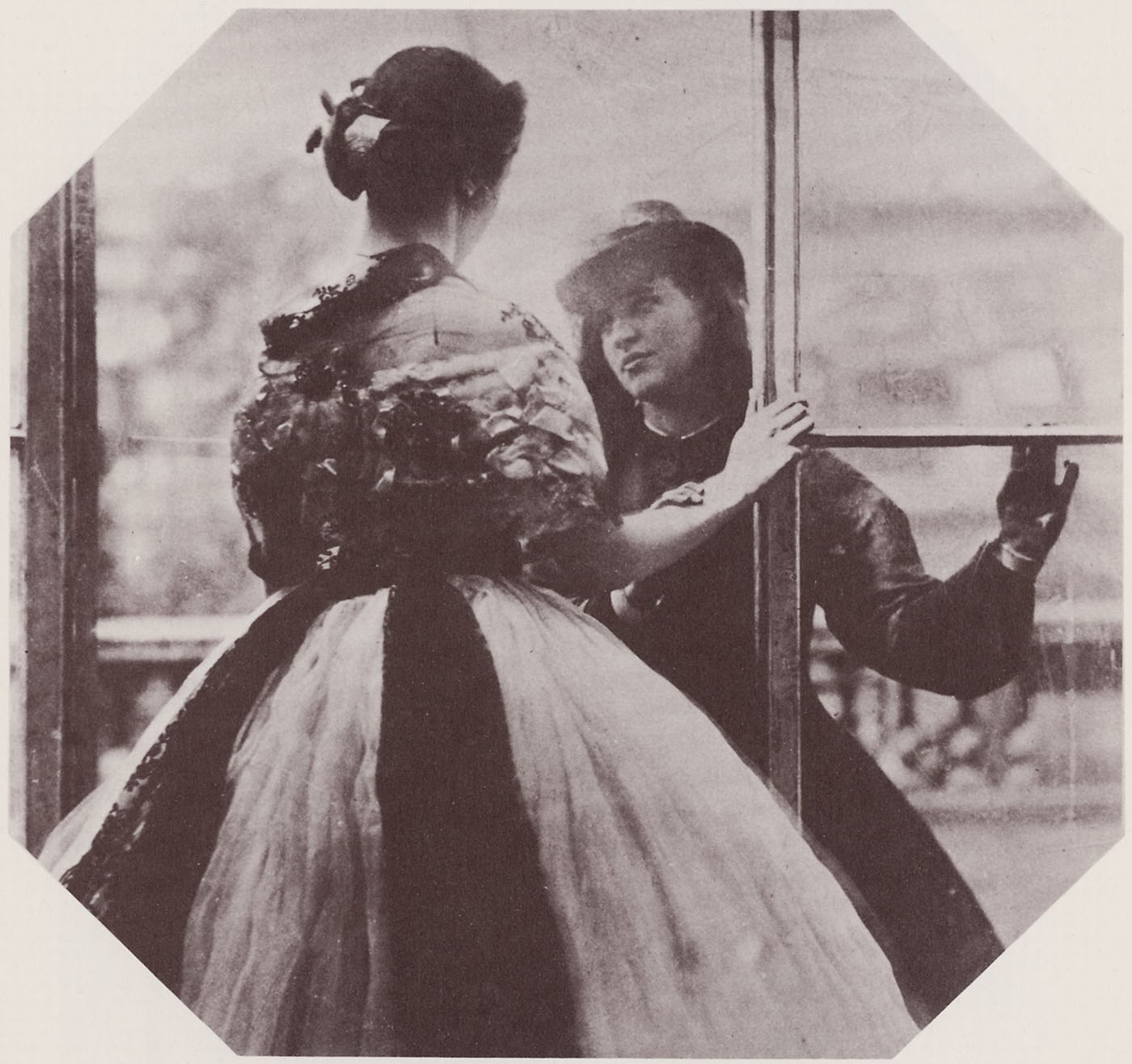
Lady Hawarden (1822-1865) ~ Study from Life / Photographic Study ca. 1864. Albumen print from glass negative (detail)
Lady Clementina Hawarden (1822-1865) ~ Study from Life or Photographic Study ca. 1864. Albumen print from glass negative | src V&A Museum
Lady Clementina Hawarden (1822-1865) ~ Study from Life or Photographic Study ca. 1864. Albumen print from wet collodion on glass negative | src V&A Museum

‘In this photograph as in Ph 380-1947 (image below) her two eldest daughters of Lady Hawarden reaffirm their bond with each other and with their mother. Isabella Grace, in an evening dress, her hair elaborately arranged, with her back to the camera perhaps in order to show the intricacies of her dress and hair to full advantage, stands at the French window to the terrace. Clementina, poised like a mirror before her sister, her expression perhaps reflecting that on Isabella Grace’s face, incongruously wears a riding habit and appears dishevelled. Their rapport is visually strengthened by the lines of the window, which direct our eyes to their arms, gracefully linked.’

Clementina Hawarden (1822-1865) :: Untitled (Isabella Grace and Clementina), 1864. Albumen print. | src V&A Museum
Clementina Hawarden ~ Der Besuch (The visit) | src Zeno.org

Pierre- Louis Pierson ::

Scherzo di Follia (Game of Madness),

1861-67, printed ca. 1930.

[Countess of Castiglione /

Countess Virginia Oldoini Verasis di Castiglione

] / source: Metropolitan Museum

“Virginia Oldoini, Countess Verasis de Castiglione (1837-1899), created a sensation when she appeared on the social scene in Paris in 1855, having been sent by the Italian statesman Cavour to secretly win Napoleon III over to the cause of Italian unity by “any means she chose.” Within months, the statuesque beauty was the mistress of Napoleon III and a much-talked-about ornament of the lavish balls so prevalent during the period. After the fall of the Second Empire in 1870, she led an increasingly secluded existence, which gave rise to fantastic speculation about her affairs. As the years went by, her mental stability declined and she ventured out only at night, shrouded in veils.
The countess’s raging narcissism found in photography the perfect ally; Pierre-Louis Pierson produced over seven hundred different images of her. In a reversal of roles, the sitter would direct every aspect of the picture, from the angle of the shot to the lighting, using the photographer as a mere tool in her pursuit of self-promotion and self-expression.” quoted from source

related post by Len Prince (reenactment), here

more [+] by this photographer